| Author |
 Replies: 20 / Views: 16,769 Replies: 20 / Views: 16,769 |
|
Pillar of the Community
United States
790 Posts |
I was browsing Wizard Coin Supply and came across this product. It claims to reveal dates on more worn coins. I'm guessing this is some sort of acid, yes? Can't imagine it does the coins any good. Given the boxes of "no date" Buffalo nickels I've seen at every coin shop, I'm assuming that any benefit that might come of revealing the occasional rare date is offset by the damage done to the coins in the process. Has anybody tried it? |
|
|
|
Bedrock of the Community
Canada
10743 Posts |
I have.  It will restore the dates on the Buffalo nickels if they are not too worn, it has worked for me and, I think a member here does it all the time and does the whole coin. I just did the date area. |
|
Rest in Peace
United States
18456 Posts |
Nic-o-Date is an acid that brings up the date on a worn dateless Nickel . This doesn't make the coin look pretty ,but if you find a rare date and mint it will have some decent value . I presently soak my worn out Nickels in a solution of Peroxide and vinegar . this acidity solution also will bring up the dates with decent results .  |
|
Pillar of the Community
 United States
4624 Posts |
When the coin was struck, the date is slightly hardened by the process and a tiny bit of the copper and nickel atoms migrate. The Ferric Chloride acid in Nic-A-Date (or the acetic acid in the vinegar) dissolve the two atoms at slightly different rates. This can expose the date from what was formerly worn flat.
It leaves the coin damaged with obvious visual clues. So the restored date coins sell for a lot less than dated coins, but on some of the rarer ones, it's a way to get a hole filled. And, after all, it was an almost worn out dateless Buff to start with.
This only works on Nickels with their higher % of Nickel in the alloy than copper-nickel coins.
-----Burton 50+ year / Life / Emeritus ANA member (joined 12/1/1973) Life member: Numismatics International, CONECA Member: TNA, FtWCC, NETCC, EveryCountry (online) coin club Owned by three cats and a wife of 40+ years (joined 1983) Author: 3rd Edition of the Sample Slabs book, https://www.sampleslabs.info/ |
|
Pillar of the Community
United States
1314 Posts |
The process of minting a coin causes a deformation of the metal crystals in the metal, in much the same way compressing a bunch of packing peanuts into a complex shape might break and deform some of the peanuts. Because the metal crystals of the coin are changed in areas of sharp contour, like the date, the mild acid will act on deformed crystals differently than it will on undeformed crystals. Wipe wood stain on a polished board and you will see how the stain varies with grain density and direction. In the best of circumstances, the traction rates will be visible. My experience is that an equivalent home made brew had only modest results. But it was enough to fill a slot in the Buffalo nickel collection. |
|
Pillar of the Community
United States
1314 Posts |
I could be wrong. Simultaneous typing.
|
|
Pillar of the Community
United States
4624 Posts |
I don't think you are, I think it's the combination - work hardening changes crystal structure (that's why annealing and softening work using the same tool: heat). I think there is also a preference when forming crystals to avoid 'foreign' atoms. But both Nickel and Copper are transition metals and so the bonding structure isn't as simple as non-metals. But that's all from memory of chemistry class long, long ago. I couldn't find anything that actually talks to how it works, just a couple of videos showing the process.
-----Burton 50+ year / Life / Emeritus ANA member (joined 12/1/1973) Life member: Numismatics International, CONECA Member: TNA, FtWCC, NETCC, EveryCountry (online) coin club Owned by three cats and a wife of 40+ years (joined 1983) Author: 3rd Edition of the Sample Slabs book, https://www.sampleslabs.info/ |
|
Pillar of the Community
 United States
790 Posts |
Thanks, guys! There are a lot of things on that site that seem to run counter-intuitive to the things I'm learning here. Coin baths and coin cleaning solutions, cloths to WIPE coins with, etc. I'm guessing they all have their place when someone knows what they're doing.
The main reason I was looking was to see if there was something specifically to remove PVC from copper coins. I'm getting mixed info as to whether acetone is a good option.
|
|
Pillar of the Community
United States
6130 Posts |
A dateless Buffalo nickel is worth about 15-25 cents. A nic-a-dated common buffalo is worth 5-10 cents. A nic-a-dated key date is worth maybe 25-50% of what a partial date would bring (it leaves an ugly stain) but remember that it was a 15 cent coin previously. You're basically gambling 5 cents on whether it is a better date. I would only do it on coins with a mintmark, and NEVER do it on a Type 1 raised mound. |
|
Rest in Peace
United States
18456 Posts |
< twslisa > , For PVC I would use acetone , for Verdigris I would use a chemical called Verd-a-care created by one of our members . |
|
Moderator
 United States
198363 Posts |
Quote:
This only works on Nickels with their higher % of Nickel in the alloy than copper-nickel coins. Nickels and Cu-Ni clad coins (outer layers) are both 25% nickel to 75% copper. |
|
Pillar of the Community
United States
4624 Posts |
However, the surface 25/75 layer is fairly thin because the overall % is 8.33 so the work hardening cannot go very deep on clad coinage before hitting the softer solid copper core.
-----Burton 50+ year / Life / Emeritus ANA member (joined 12/1/1973) Life member: Numismatics International, CONECA Member: TNA, FtWCC, NETCC, EveryCountry (online) coin club Owned by three cats and a wife of 40+ years (joined 1983) Author: 3rd Edition of the Sample Slabs book, https://www.sampleslabs.info/ |
|
Bedrock of the Community
United States
94367 Posts |
Acetone is ideal for removing PVC, been using it for 30 years without incident.
|
|
Moderator
United States
198363 Posts |
Quote:
However, the surface 25/75 layer is fairly thin because the overall % is 8.33 so the work hardening cannot go very deep on clad coinage before hitting the softer solid copper core. That is a much better explanation.  |
|
Pillar of the Community
United States
1314 Posts |
Here is one I tried. The chemical was common vinegar. The coin, a Liberty head nickel. before: 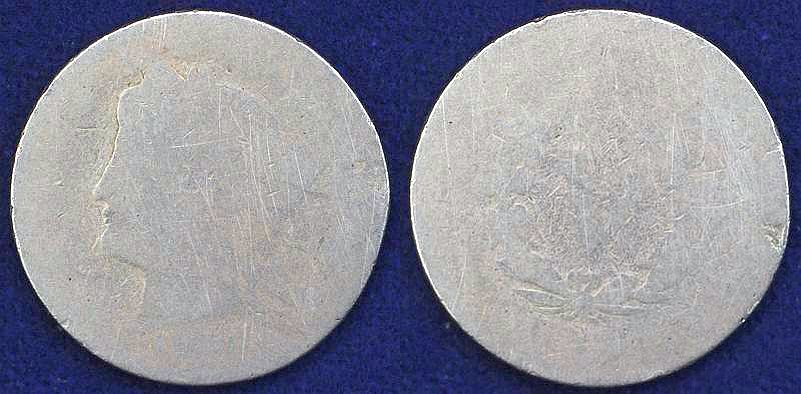 after: 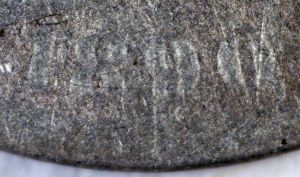 Theoretically, I didn't destroy much value. It's still worth 5 cents. |
|
Moderator
Australia
17035 Posts |
I made a pic once, illustrating how acids actually reveal the date.  As I understand it, it is the alignment of the crystal structure within the metal (caused by the metal "flowing" as it is compressed when the coin is made) that is the root cause. The acid does not make the date itself "stand out", but it does turn the outline of each of the numerals in the date into a shallow trough, which can then be seen, as it is the transition zone between date and field that is most vulnerable to acid attack. Don't say "infinitely" when you mean "very"; otherwise, you'll have no word left when you want to talk about something really infinite. - C. S. Lewis
|
| |
Replies: 20 / Views: 16,769 |







 Posted 11/03/2016 07:35 am


