



Coin Community Family of Web Sites Join Thousands of Coin, Bullion, & Money Collectors
Join Thousands of Coin, Bullion, & Money Collectors Royal Canadian Mint products, Canadian, Polish, American, and world coins and banknotes. Coin, Banknote and Medal Collectors's Online Mall Specializing in Modern Numismatics 300,000 items to help build your collection! Shop for APMEX Bullion on eBay!Vancouvers #1 Coin and Paper Money Dealer


Username:
Password:
Save Password
Forgot your Password?


This page may contain links that result in small commissions to keep this free site up and running.

Welcome Guest! Registering and/or logging in will remove the anchor (bottom) ads. It's Free!

How To Grade World Coins?

To participate in the forum you must log in or register.
Author Previous TopicReplies: 6 / Views: 4,215Next Topic  
Pillar of the Community
0xDA71D's Avatar
United States
1215 Posts
 Posted 11/05/2016  9:25 pm Show Profile   Bookmark this topic Add 0xDA71D to your friends list Get a Link to this Message Number of Subscribers
Hey, I was wondering whether there is a definitive guide to grading world coins, in the context of the ANA grading system. Of course, world coins are, as a whole, much more varied in terms of relief depth, and in many numismatic markets overseas, grading does not even matter nearly as much as it does in America and the standards of problem coins are far different.

Having a pretty extensive and diverse world silver collection, most of which I have probably graded widely off point, I was wondering if there is a system of grading world coins that is fairly consistent in the American coin market.

Usually, I take certain features of these coins that look alike features of American coins and use PCGS photograde or some more well-known photo grading resources to compare the details. For instance, on French coins, I look at the liberty's upper details and compare them to those of the Walker series. Also, on Brazilian coins that feature fasces, for instance, I compare the details with Mercury dimes. Also, for coins that depict some British monarch, I use CCF's canadian coin photograding resource to compare details on the monarch. Since many motifs in coinage are semi-universal, I find this an easy way to roughly guess a grade.

However, this lends itself to huge problems in that even with the same motifs, there are factors such as strike or relief depth. Also, coins that are generally flat in relief seem very difficult to properly grade as they wear evenly (eg. obverse of 1960s German 5 marks). Islamic coins would also fall into the category generally.

I think I myself have gotten slightly more consistent in world coin grading over the years, but it's still a big challenge and it's more guesswork than anything else. Maybe it's not so important anyways?

Do you all have any suggestions?
Pillar of the Community
Chute72's Avatar
United States
1314 Posts
 Posted 11/05/2016  9:53 pm  Show Profile   Bookmark this reply Add Chute72 to your friends list Get a Link to this Reply
Good topic.
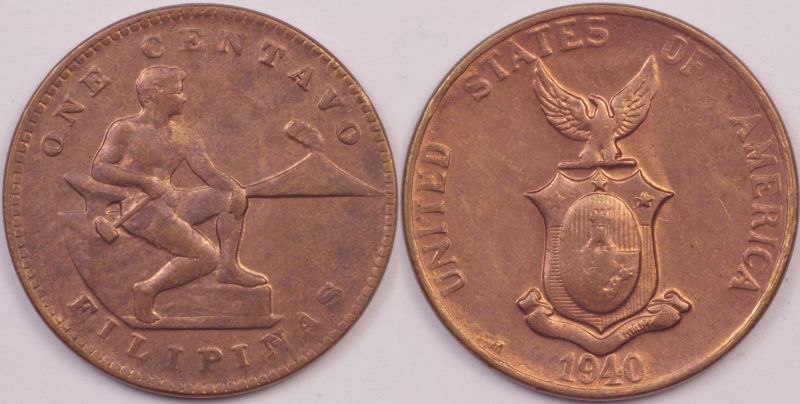
I have a hard time with this series.
Note the reverse shield and ribbon underneath.
It's uncirculated. I believe just a worn die and weak strike.


How-To-Grade-World-Coins?
Pillar of the Community
0xDA71D's Avatar
United States
1215 Posts
 Posted 11/05/2016  10:17 pm  Show Profile   Bookmark this reply Add 0xDA71D to your friends list Get a Link to this Reply
Chute, I think your coin is at most an AU, despite the weak strike. If you look at the legs, the high points look a little discolored. Also on the upper chest running up the forearm. However, there is still luster evident.

You bring up a good point with your example, though. Coins on the extreme ends of the spectrum (Po-G) and (AU-MS) are quite easy to grade, as there is some universal characteristic that defines these grades. For instance, wear, bagmarks and eye appeal are quite universal traits of coins (although the latter a bit subjective). Additionally, the cruddiness of a coin and the requirement for most good coins to have a full rim will do fine as markers for the lower grades of world coins. However, it's the majority of coins, those that fall between VG and XF that are worrying to grade, in my opnion.
Pillar of the Community
Chute72's Avatar
United States
1314 Posts
 Posted 11/05/2016  10:40 pm  Show Profile   Bookmark this reply Add Chute72 to your friends list Get a Link to this Reply

Quote:
the high points look a little discolored. Also on the upper chest running up the forearm. However, there is still luster evident

This points out my lack of understanding.
I was under the impression that grading was based on wear, not bag marks or toning. I see many MS65s that are brown.
But I'm still learning. Both copper and foreign are new to me.
New Member
Carygrant's Avatar
1 Posts
 Posted 11/06/2016  03:08 am  Show Profile   Bookmark this reply Add Carygrant to your friends list Get a Link to this Reply
For what it's worth, I have to agree, EF45-AU53/55. Been collecting Philippines for a few years and I have a 1904 MS63(ish) centavo that is just barely starting to turn from RD/BRN to BRN. The radial lines are still brilliant in all places but the obverse on top of left hand where it rests on the knee (that point might not be relevant because the reverses are different designs). I'm guessing when I bought the coin, it was in one of the better or sam preservation containers of its life - a 2x2 paper/mylar flip. One man was from/in Japqa+×

Sorry, to answer the original question Europe and almost all other countries don't use our common Sheldon scale. They only have 5-6 main grades: P/G, VG, F, VF, XF, AND UNC. Might be completely mistaken nowadays; last time I did business with overseas collectors was 3 years ago. Both gentlemen couldn't grasp the concept of thedifferences between an MS60 and an MS65, even after they read the ANA/Sheldon literature along with pictures. One gentleman was from/in Japan and the other man was from Latvia and living in central Europe.
Edited by Carygrant
11/06/2016 03:34 am
Pillar of the Community
trout1105's Avatar
Australia
7096 Posts
 Posted 11/06/2016  05:38 am  Show Profile   Bookmark this reply Add trout1105 to your friends list Get a Link to this Reply
With a small amount of research ANY coin regardless of it's country of origin can be graded using the Sheldon scale.
All the same rules apply even if the coin doesn't come from Australia
Pillar of the Community
UltraRant's Avatar
Norway
1358 Posts
 Posted 11/06/2016  2:35 pm  Show Profile   Bookmark this reply Add UltraRant to your friends list Get a Link to this Reply
A grading system isn't 'connected' in any way to a certain country or era. So if you want to use your system for grading as it's the most common to where you live, then please go ahead. I usually have to use three different grades to make myself understood and I have no big issues in making myself understood, I believe.

If you want to know how to give a detailed grade on a specific coin, you should just do research. The internet is packed with tons of pics of coins which you can use as reference, there are thousands of sites with mintage numbers, coin specifics, etc. And if you have any specific question then you can of course always make some pics and put them there in the world coin forum or so. There are enough people from the dark side who are willing to help.
  Previous TopicReplies: 6 / Views: 4,215Next Topic  

To participate in the forum you must log in or register.


Disclaimer: While a tremendous amount of effort goes into ensuring the accuracy of the information contained in this site, Coin Community assumes no liability for errors. Copyright 2005 - 2026 Coin Community Family- all rights reserved worldwide. Use of any images or content on this website without prior written permission of Coin Community or the original lender is strictly prohibited.
Contact Us  |  Advertise Here  |  Privacy Policy / Terms of Use

Coin Community Forum © 2005 - 2026 Coin Community Forums
It took 0.23 seconds to rattle this change. Forums