(This is a bit long, but I wanted to share)
We started planning our trip to India over a year in advance. Our friends were planning a lavish 3 day wedding about 45 minutes north of Delhi the weekend of Thanksgiving. We saved for the trip with proceeds from our
ebay sales. It took a year to save up. We booked our flights, and extended our trip to include 3 nights in Goa on the southern coast of the country before the wedding. We got our shots, updated our passports, and called our banks to alert them of our travel.
And then one week before we were to take off the Prime Minister declared all 500 and 1000 rupee notes were now invalid and had to be turned in. It was a power play against what he called black money plaguing his country. It was designed to affect criminals with large stashes of cash who were limited to one limited transfer of money each day. To trade in old money you had to wait in line, get fingerprinted and be limited to how much you could exchange. This made the new highest note in the nation the 100 rupee note. Worth about $1.45 US. To curb this the government also issued a new 2000 Rupee note at the same time. These notes though were a different size and old ATM's were not calibrated to fit them. On top of that, when you got your hands on these notes they were hard to spend. Small shops wouldn't accept them because they didn't want to give out all of their precious 100 notes in change. India is also a country where haggling is way of doing business. Every item is marked up so that you can negotiate and all of your power is taken away when you negotiate a price of 600 rupees, and then ask for change from a 2000 rupee note.
Before we left we had planned on going to AAA and exchanging money but AAA refused to exchange rupees until the financial change could be better understood. This was also true with every other currency exchange in the Boston area. We started thinking outside of the box. I messaged friends on facebook who were often traveling to see if they had any rupees. I posted on this forum, called coin shops, and even craigslist all to no avail. I packed a few silver rounds to take with me to barter. We packed our own bottled water, and boxes of snacks and granola pars in case we couldn't find food. We even tried to find incoming flights from India during our layover in Europe to trade currency directly with those leaving the country.
When we arrived, we were mentally prepped for the lack of money, but sill uneasy. We had a driver waiting for us at the airport while we lined up at both currency exchange lines. We waited about an hour to exchange as much money as we could. I had read online that Thomas Cook was the worst deal but at the airport they had the better posted rate of the two exchanges. I was in that line with a friend while my fiance was in line for a lesser exchange rate with our other friend. At the front of the line we could only exchange $70 US and the great rate we saw, was cut by large unadvertised fees. (Turns out Thomas Cook was the worst deal after all). The teller scanned my passport and handed me 4100 rupees. 2 2000 notes and 1 100. I asked for smaller change. I can't spend the 2000 notes I told her as I needed to take a taxi. She replied that taxis took credit cards. My hands were tied. It was 2am and we needed the money. In the other line my fiance got a much better rate and a variety of bills but after over an hour in line (which was not as bad as some of the lines I read about) we now had to track down our driver who thought we had left the airport.
We were grateful that we were not there when the money was first changed. Any tourists stuck with 500 and 1000 notes were stuck with them. Only able to exchange about 2000 a day after waiting hours in line, and hoping that tellers wouldn't run out of smaller notes.
We flew south the next morning to Goa where funds became much harder to find. We were luckily staying at hotel that accepted credit cards and we had one card that didn't have a foreign transaction fee. This meant that we would eat 3 meals a day at our hotel and save our cash for buying gifts and trinkets at the markets and on the streets.
We asked at the front desk if they would exchange US money and they said they couldn't. They said they didn't have enough but after seeing the manger with two fists full of low denomination notes we assumed that it must be that they wanted us to eat and spend money at the hotel instead.
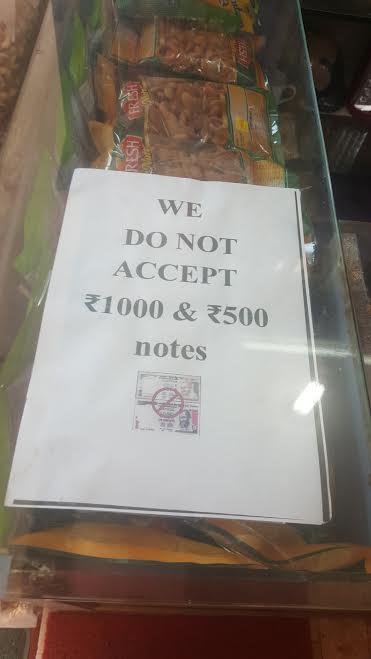
We found two money exchange places on google maps and walked a few miles to find that they didn't exist. A few shop owners we came across let us negotiate to pay a higher price on items in exchange for giving us change for 2000 rupee notes. Every shop had signs up saying they wouldn't take 500 or 1000 and some of these shops tried to give them to us in change anyways.
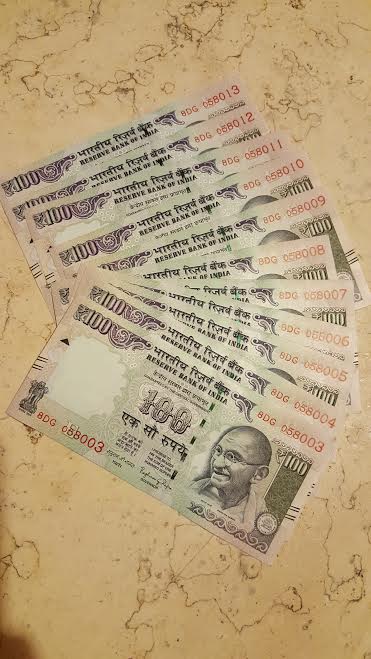
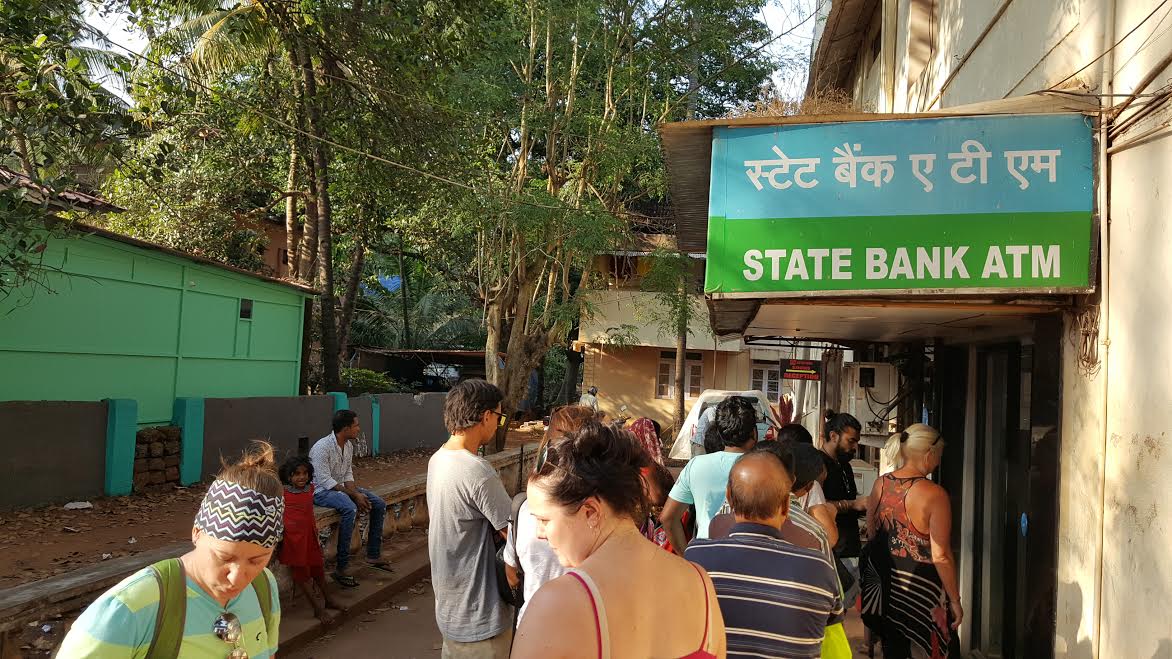
Then we got lucky. After seeing dozens of ATM's that were closed and out of money, we found one with a line. We waited while it was restocked by two men and an armed guard. The people in the lines were patient, and there seemed to me no hostility. There was a mix of locals and tourists, and nobody got angry or hostile. When we reached the front we were told by others that the limit was 2000 rupees but that there were 100s in the machine. There were four of us together. We decided that after we got our money we would leave together and picked our direction in case there was anyone waiting around watching the lost tourists with pockets full of money. My fiance took out the limit 2000 rupees and it gave her a 2000 rupee note. Crap. Our other two friends tried the same on the other machine and had the same result. I asked the guard if there were 100s in the machine and he said to try to take out 1900 instead of 2000. I did and the machine whirred and spit out a stack of 19 CU freshly minted sequentially numbered 100 rupee notes. (Not what you want to hand a collector when money is so scarce as I didn't want to even spend them).
But now we knew the trick, and the next day we would wake up early before our flight back to Delhi and line up again, and all get 1900 more from the local ATM.
We paid our Hotel bill by credit card with all of our meals on it and were even able to add our ride to the airport onto it. But still had to tip the driver a small stack of 100s for the one our drive.
Once we flew back to Delhi the wedding was a whole different story. The family had already taken care of all our wedding expenses. Hotel, driver to pick us up at the airport, tip for the driver, meals, and transportation. This part of the trip was a relief and some of our friends who flew in just for the wedding part never even touched rupees. They landed, got in their car, went to the resort, and at the end took the car back and flew home. This part of the trip would have been a lot more stressful if not for the wedding, and the family who was putting us up.
The last leg of our trip was a 24 hour side trip to the Taj Mahal in Agra. It was about 3 hours from the wedding venue and we had booked a driver for 2500 rupees each, admission to the Taj which was 1000 rupees per person and a hotel in Agra for the night which didn't take credit cards but luckily accepted US money. For this we had to find somewhere in Agra to exchange our money. We still had hundreds of US dollars but no way to spend it. Which makes is unlike any other vacation I have ever been on.
The morning in Agra we were heading to the Taj, our driver brought us to a roadside money exchange. It was the worst rate we saw the entire time we were in the country. It was a small room in a makeshift strip mall. The driver said something to the man in Hindi before we went in. We think it has to do with a kickback. I handed him my American money and he counted it and left. I was certain that I was just ripped off or that he was taking the money to another currency exchange with a better rate and coming back with my money and his cut. When he came back he brought another man who had keys to the cash box. They opened it up, counted out my money and gave me enough rupees to pay the balance for our driver, his tip, and our admission to the Taj Mahal. It was the biggest rip off of the trip. However, we didn't have to wait in line for hours to get it. Which, in exchange gave us more time sightseeing, and we agreed it was worth it.
In all the money situation was about as bad as we expected. We had money to spend but nowhere to convert it. The country is mostly cash based, and having credit cards only helped at some places. We had to do some creative thinking, and eat at the same restaurants night after night, but we made the best of it and never went hungry. The locals also never got hostile about the long lines for money, and the shop owners understood how tough it was for us to get money and negotiated accordingly. I never needed the silver rounds I brought to negotiate, but am glad that I had them just in case we ran out of rupees. And when all was said and done and we landed back in Boston last week I still had 3 sequentially numbered 100 rupee notes. (one of which I used to tip my father for picking us up at the airport)







 Posted 12/06/2016 1:23 pm





