Instead of counting sheep last night I ran through some scenarios of how this could happen and I agree with SPP that this could not happen at the mint.
The metal flow and enlargement of CANADA suggest whatever happened was almost instantaneous, it hasn't been tooled or stretched with a crimping machine.
I'm really stretching my imagination but here is the type of scenario I think might result in this type of damage. If you've ever seen a powerhammer in a blacksmith shop these things are AWESOME! In the video below he tests the machine with a piece of wood between the dies(yes, they are called dies just like the coining process) and in order to stop them from 'kissing' or 'clashing' he uses a piece of wood. Now what would happen if you put a coin on a piece of hardwood and gave it a whack? Would the coin partially seat itself into the wood to protect the obverse and rim, and still have the force to completely flatten the reverse?
6k-B3AL06zQ
*** Edited by Staff to add YouTube tags. [youtube][/youtube] Please use them in the future. We prefer embedded video. ***
Laugh or call me crazy but the scenario is the only one that fits. It would also support the reason for concave, or rounding in the rim, a partial collar strike or "railroad rim" is typically sharp and shelf-like.
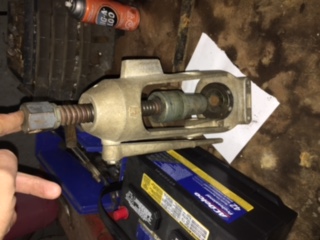
I "Swagger" which is a form of crimping device would easily produce a cent such as the one originally posted here. All it would take would be a large steel washer acting as a collar and a flat swaging die to squeeze the cent into the makeshift collar creating the coin in question. Simple.
Quote: All it would take would be a large steel washer acting as a collar and a flat swaging die to squeeze the cent into the makeshift collar creating the coin in question. Simple.
I did a quick search on swaging tools, it revealed everything I need to see. That is a lot more simple explanation of the theory.
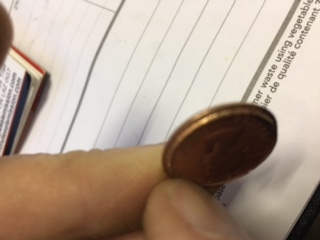
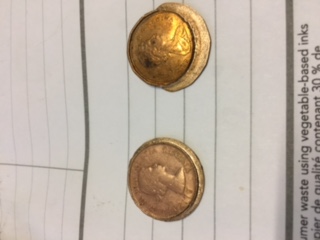
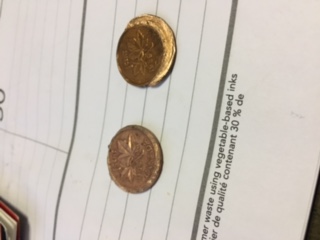
Each coin took 15 seconds to make. Keep in mind that if I used a smaller washer as the collar then I could have stretched the lettering in Canada from Toronto to Montreal.
I think it's kind of interesting how old coins surface from time to time which cause collectors to wonder if it could be an undiscovered error that's really cool.
One thing, unlike paper money and prior to the ARP of more recent times, coin remained in circulation regardless of its condition. It was not culled other than if it was in really rough shape, banks and stores wouldn't accept it and so it either got tossed aside or thrown away. This included having been squeezed, bent, burned, hammered, viced, sawed, rusted, or carved. What could be done to a coin in an era when every garage was filled with tools I think was a national challenge unlimited by imagination. Old, worn pennies always seemed to be the #1 favourite. I was a bank teller in the 70s and sorting through damaged pennies was one of the reason they remain my least favourite denomination.
Hey Daryl , I appreciate the attemp to reproduce this, I also have been thinking about how to replicate, I do believe that the posibilty to attain the same railroad effect is quite possible in most garages, and it's quite plausible that this is the case here, although in your example of how this could be done, there would most definitely be a loss in diameter whereas my specimen is measuring same diameter in comparison to several other same year 1 cent coins. It looks as though mainly the rim is what has been "squished" out . Also I'm not sure that the example method would explain the discolouring around the outter rim and parts of the design, with such a smooth texture transition from the colour to the copper. But still maintaining majority of the design depth.
Lovin all the suggestions, just wish I knew where this coin has been " bang head" lol
Wish I had a better coin photography device.....#128300;
Quote: I'm not sure that the example method would explain the discolouring around the outter rim and parts of the design...
This is the effect of the copper plating thinning and splitting as the coin expanded to a size greater than it was designed for. It looks very similar to the effect seen on broadstruck zincoln cents. Just sayin... partial collar broadstrike...
Hardly any loss in the diameter of the 1960 penny. I didn't have a pocket full of pennies when I decided to try this, just a couple I found in my desk drawer at the office. I will look for a plated cent like yours and try again later.
darryldarryl - I would love a few of your examples to use as error teaching tools (fabrications are important to learn from as much as some errors)... It would be interesting to see the effects on the three different types of pennies (bronze, Cu-plated steel, Cu-plated zinc), if all other parameters were relatively equal.
"Discovery follows discovery, each both raising and answering questions, each ending a long search, and each providing the new instruments for a new search." -- J. Robert Oppenheimer
Disclaimer: While a tremendous amount of effort goes into ensuring the accuracy of the information contained in this site, Coin Community assumes no liability for errors. Copyright 2005 - 2026 Coin Community Family- all rights reserved worldwide. Use of any images or content on this website without prior written permission of Coin Community or the original lender is strictly prohibited. Contact Us | Advertise Here | Privacy Policy / Terms of Use








 First Page


 Posted 01/11/2017 5:05 pm