| Author |
 Replies: 16 / Views: 5,217 Replies: 16 / Views: 5,217 |
|
Pillar of the Community
United States
6196 Posts |
|
|
|
|
Bedrock of the Community
United States
62064 Posts |
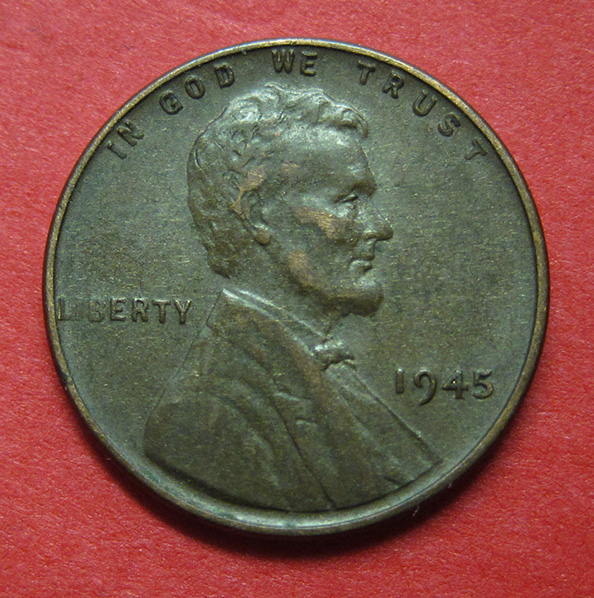
Colors change as the coin ages. I'm not sure if the mint was striking other Countries coin that year or not. You might want to research that to see. Or maybe someone else has that handy?
|
|
Pillar of the Community
 United States
6196 Posts |
Very true. Colors change over time, but after looking at 150,000 wheat cents in the last year I am pretty good at knowing when something looks off. And in this case, it becomes more interesting because what are the odds of pulling a coin that looks the wrong color and then finding a second problem, that of it being >10% overweight. I don't know if there is anything at all actually going on with this coin, but two red flags make me look for answers. Here is a 1943 on a Cuban planchet. Color is the same, but most of these types of coins show some sort of off center/loss of devices. http://minterrornews.com/features-2...1c_cuba.html |
|
Bedrock of the Community
United States
12437 Posts |
Quote:
Here is a 1943 on a Cuban planchet. Color is the same, but most of these types of coins show some sort of off center/loss of devices.
They show loss of the devices because they are smaller and lighter than a Lincoln Cent planchet. Your coin cannot be struck on a Cuban 1 cent planchet because your coin is ~50% heavier than the 2.3 gram spec for the Cuban planchet. |
|
Bedrock of the Community
United States
62064 Posts |
So it just maybe a heavy planchet coin.
|
|
Pillar of the Community
United States
6196 Posts |
I was under the impression that a Cuban 2 centavo planchet was 3.5g, which is what led me to look at Cuba as a possibility.
Looked it up. Apparently that is the right weight, but way wrong year. Cuban 2 centavo was 3.5g in 1915-16. Would have had to have that roll of metal stored in the back corner a looooong time for it to show up in 1945.
Edited by tropicalbats
01/19/2017 12:35 pm
|
|
Pillar of the Community
United States
2775 Posts |
Seems the Philly mint was busy this year (1945) with foreign coinage.
The only one I found in the proper (pre strike) weight and diameter category was produced for the Netherlands, 25 Cent Stukken 3.575grams and 19mm diameter, but is off in the composition category. 64% silver and 36% copper.
So unless calculation for punched on the wrong stock can be attributed, I'll have say rolled thick seems more applicable at the moment. Thanks, Doug.
Edited by Halo1st
01/19/2017 3:49 pm
|
|
Pillar of the Community
United States
3463 Posts |
You should do a specific gravity test to get a close idea of what this coin may be made of. I have put together this page to show how it's done: http://www.lincolncentsonline.com/C...%20Zinc.htmlThis would also tell you if it is a thick planchet error or not as it accurately measures the mass of the coin. Edited by cwb
01/20/2017 01:37 am
|
|
Pillar of the Community
United States
6196 Posts |
Easy enough. And nice webpage by the way.
Specific gravity: 9.0g/ml
Diameter: 19.05mm
Thickness of rim: 1.65mm
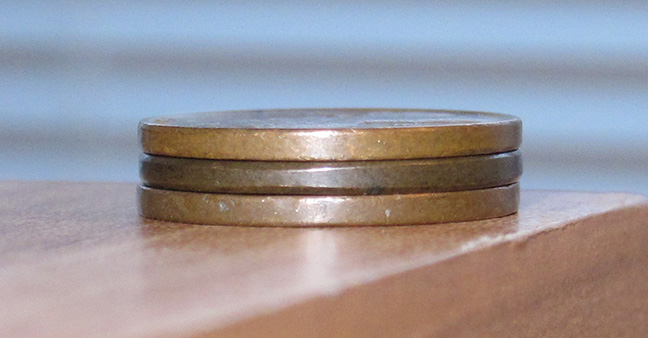
So looking at it from the math end, it is 6% thicker but 13% heavier. While not intuitive, this makes perfect sense as the coin is not a perfect cylinder but a recess-ended cylinder. Thus increasing total rim width would have a higher percent increase in total weight as the field would become thicker while the field to rim distance remains the same.
Not sure how much specific gravity helps here, though, as the copper and nickel (8.9) have about the same specific gravity so pretty hard to tell what alloy the coin is based in just on that.
But looking at all the comments and numbers, it would seem to be a standard 1945 copper cent thick rolled by a little bit.
Edited by tropicalbats
01/20/2017 01:03 am
|
|
Pillar of the Community
United States
3463 Posts |
What number did you get when you measured the mass of the coin in the water?
|
|
Moderator
 United States
14463 Posts |
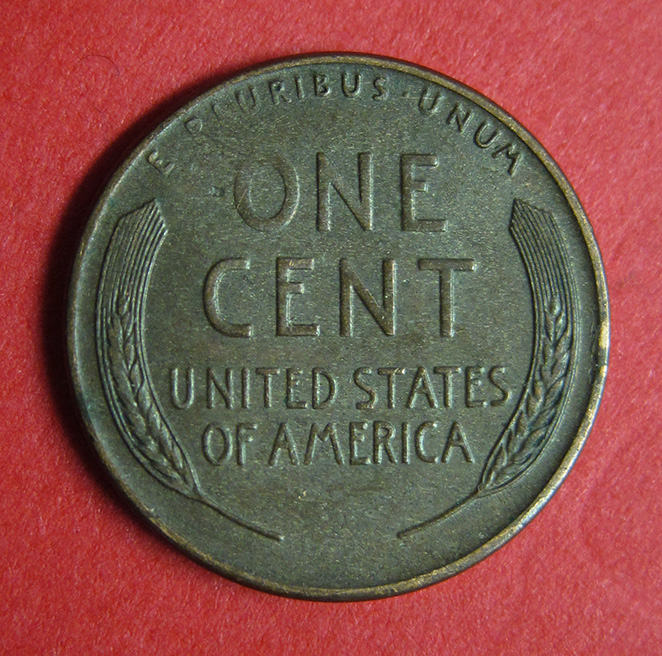
at 3 o'clock on the reverse, that almost looks like paint chipping  |
|
Pillar of the Community
United States
6196 Posts |
Mass of the coin in water was 0.4
Close inspection of the 3 o'clock position shows it to be a normal rim scuff exposing something close to coin's non-toned surface color.
Edited by tropicalbats
01/20/2017 10:50 am
|
|
Bedrock of the Community
United States
12437 Posts |
Quote:
Thickness of rim: 1.65mm There is no standard thickness for the rim of a struck coin, only for the thickness of an unstruck planchet. The thickness of the rim of a coin is a function of striking pressure, a coin with a stronger strike will have a thicker rim. |
|
New Member
United States
31 Posts |
Just a begginer, but  with Coop...Heavy planchet error..... Nice find,! Edited by dtl
01/20/2017 9:45 pm
|
|
Pillar of the Community
United States
1543 Posts |
|
|
Pillar of the Community
United States
2752 Posts |
The most prosaic and most likely explanation is that this cent was struck on a planchet derived from rolled-thick cent stock. Such cents can be as heavy as 4.2 grams.
Error coin writer and researcher.
|
| |
Replies: 16 / Views: 5,217 |












 Posted 01/19/2017 11:43 am


