|
This page may contain links that result in small commissions to keep this free site up and running.

Welcome Guest! Registering and/or logging in will remove the anchor (bottom) ads and the security checks. It's Free!
To participate in the forum you must log in or register. | Author |
 Replies: 9 / Views: 1,920 Replies: 9 / Views: 1,920 |
|
|
Rest in Peace
United States
233 Posts |
I wonder if this coin was nailed to a door post for good luck / protection, in much the same spirit as: http://goccf.com/t/277828 ... Indian cents ... Protection from curses, the IRS, police and more! Q/ Can you identify this coin? Q/ How might I best remove the unknown foreign matter layered onto the center of the design? (If it were a stamp, I'd call it a hinge remain.) Q/ Any thoughts on why this particular coin might have been chosen as a door charm? Q/ Any family-friendly thoughts about whatever else it might have been nailed to? Cheers, /s/ ikeyPikey 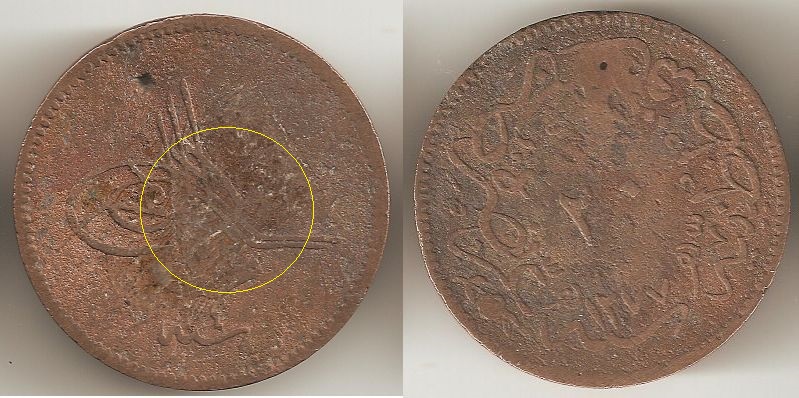 |
|
|
|
Pillar of the Community
United States
7067 Posts |
Edited by Kamnaskires
01/28/2017 3:15 pm
|
|
Rest in Peace
 United States
233 Posts |
Six minutes to a solution ... well done, BobL!
|
|
Rest in Peace
United States
233 Posts |
Re "1277/4 Sultan Abdulmecid 20 Para Konstantinye Ottoman Turkey" (from Cenkmen) 1277: Abdülmecid I reigned 1839-1861, and 1277 Hirji is ~1860 Gregorian, so I guess I grok that well enough. Q/ But, please, what means the "/4"? ... which I also do not see on the coin  Cheers, /s/ ikeyPikey |
|
Bedrock of the Community
Canada
11922 Posts |
1277 would be 1861 in the Gregorian calendar, and that date represents the year the leader at the time came into power (meaning this coin is from Abdülaziz's reign, rather than Abdülmecid's). Quote:
Q/ But, please, what means the "/4"? ... which I also do not see on the coin The 4, located underneath the centre design of the first picture, is the regnal year. The first year of Abdülaziz's reign was 1277, or 1861, while the fourth would be 1280, or 1864—your coin's date. |
|
Rest in Peace
United States
233 Posts |
|
|
Bedrock of the Community
Canada
11922 Posts |
I think that the first link just got the ruler wrong, since this should have been made under Abdülaziz's reign. Abdülmecid died before this coin was made, and his coins should have the date 1255 on them, like this similar 20 para coin. |
|
Rest in Peace
United States
233 Posts |
|
|
Moderator
 Australia
17006 Posts |
since we've now got the ID down nicely, let's look at your other questions. Quote:
Q/ How might I best remove the unknown foreign matter layered onto the center of the design? (If it were a stamp, I'd call it a hinge remain.) When you don't know what it is, it's impossible to be certain what would be best to use. In such cases, the general advice is to try various solvents. Badthad's "solvent ladder of polarity" is good: start with water, then try methanol/ethanol, then acetone, then xylene. If none of those seem to shift it, then we're probably talking about corrosion of some kind, rather than a foreign matter deposit. Quote:
Q/ Any thoughts on why this particular coin might have been chosen as a door charm? I'm not certain the "nailing coins to doors" thing was commonplace in the Middle East. 19th century Middle Eastern houses tended to be less permanent, more "organic" than Western houses: the forces of nature knock down a wall, so you quickly put it back up again; kids get married, add on a couple more rooms for them to live in. Quote:
Q/ Any family-friendly thoughts about whatever else it might have been nailed to? Many holed middle-eastern coins are holed as a display of wealth, and for ceremonial outfits - particularly wedding outfits worn by women. However, this is usually gold and silver coins, or brass imitations of same, not the large copper coins. So this theory can probably be discounted. Don't say "infinitely" when you mean "very"; otherwise, you'll have no word left when you want to talk about something really infinite. - C. S. Lewis
|
|
Rest in Peace
United States
233 Posts |
Quote:
... let's look at your other questions ... Thank you, Sap! Yes, I'll escalate, with my newly-purchased can of acetone. (Much to my surprise, Home Depot also sells MEK (Methyl Ethyl Ketone), for which they ought to require proof of a hazmat license & a working vent hood.) This coin was clearly nailed, not carefully drilled - note the flattening around the 'exit' wound - so I did not consider the communal wedding dress, or other jewelry applications. Certain Middle Eastern refugees keep the keys to their former homes on a nail on a wall (though not nailed into the wall). And there was a minority group in the Ottoman Empire that nailed protective devices to their doorposts, so the practice might not have been unknown to the majority population. Cheers, /s/ ikeyPikey edited to add a few googlings about nailings: Quote:"When the men of the village joined up in 1914-18, the village blacksmith, John Hugill, nailed a coin for each man to the doorpost below a lucky horseshoe just inside his forge," says Thorpe. "Thirty men joined, so there were 30 coins, and they all returned. One of the men did lose an arm, though, so John Hugill took one of the coins off, cut a piece out of it, and nailed it back again." http://www.telegraph.co.uk/history/...eturned.html Quote:IN ORDER FOR ONE TO KEEP SPIRITS OUT OF THEIR HOUSE HE OR SHE SHOULD NAIL PENNIES ON THE FLOOR OF THE DOORWAY https://research.udmercy.edu/find/s...?fl_id=11075 Quote:... Nailing a coin to a doorpost originated in South-Western Europe ... ... Merchants nailed coins they would not accept to a post of their stand ... http://www.worldofcoins.eu/forum/in...17372.5;wap2 Edited by ikeyPikey
01/31/2017 2:49 pm
|
| |
Replies: 9 / Views: 1,920 |
|
To participate in the forum you must log in or register.
 
- My Last Purchase: A Bronze Greek Coin Representing The Poetess Sappho
- How Many Countries Do You Have Coins From?
- Post Your Coins With Coats Of Arms, Shields, Crests, Crowns, Etc.
- How Far Back Can We Go? Ninth Edition!
- 1966 Nickel Die Adjustment Strike?
- Post Your Stories & Pix Of Found Money
- 1885-Zs Mexico - 25 Centavos W/Arcing Die Crack, Tilted & Re-Punched Reverse Die
- 1934 Peace Dollar NGC MS-67+ At Auction
- Will Our Coins Ever Be Valuable?
- G L B 49's MS-70 Perfect Silver Coins
- ID Help - Roman Provincial Coin
- 1894 Fifty Cents - Grade This Coin. It May Or May Not Be TPG.
- 1847 Undecimo Edge Great Britain Gothic Crown, Gothic Type, NGC PF61
- Error Opinions, 1971-D DDO, 1955-D/S, 1996-P Quarter
- Post Your Coins Representing The Animal Kingdom.
- Post Your Bird Coins
- Post Your Coin Or Medal With Flora
- Continuing List To Show Everyones Latest Acquisitions
- Post Your Coins Of Steel (And Iron)!
- Post Your Lion Coins!
Disclaimer: While a tremendous amount of effort goes into ensuring the accuracy of the information contained in this site, Coin Community assumes no liability for errors. Copyright 2005 - 2026 Coin Community Family- all rights reserved worldwide. Use of any images or content on this website without prior written permission of Coin Community or the original lender is strictly prohibited.
Contact Us | Advertise Here | Privacy Policy / Terms of Use
|
| Coin Community Forum |
© 2005 - 2026 Coin Community Forums |
| It took 0.33 seconds to rattle this change. |
 |
|
| |
| |







 Posted 01/28/2017 3:42 pm


