This is intended as a guide for anyone taking a trip to the UK and wanting to try coin bag hunting, or for any British collectors who have never done it and want to give it a try.
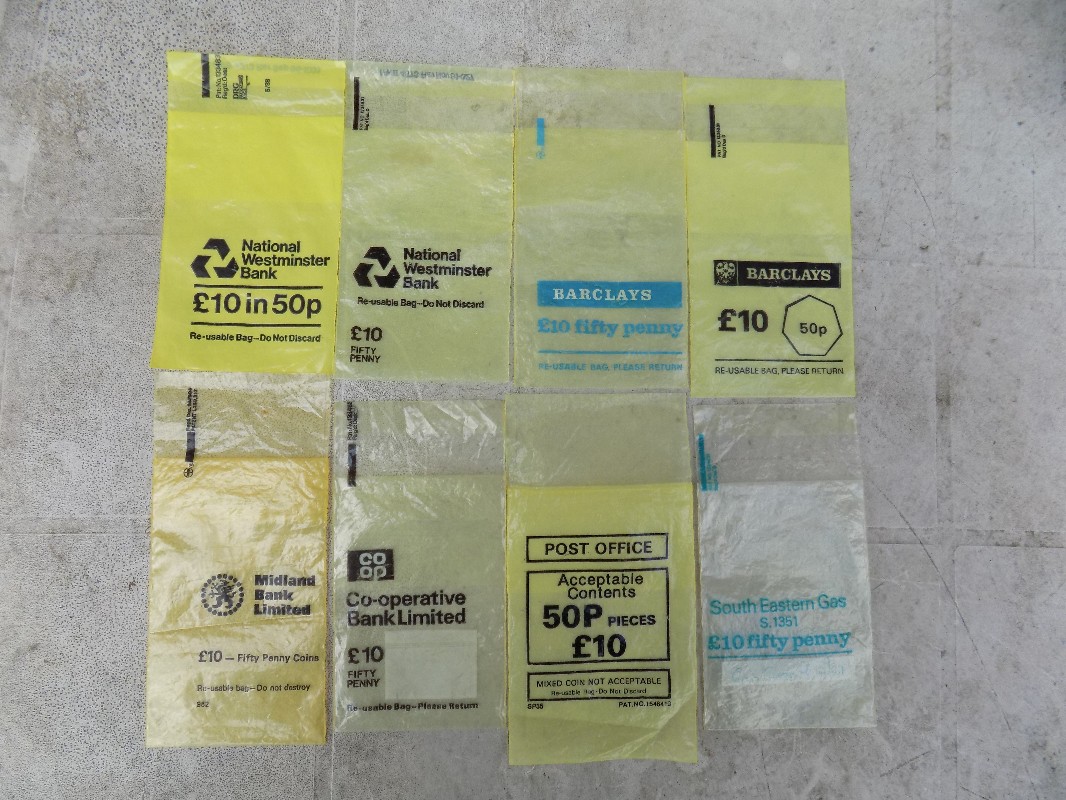
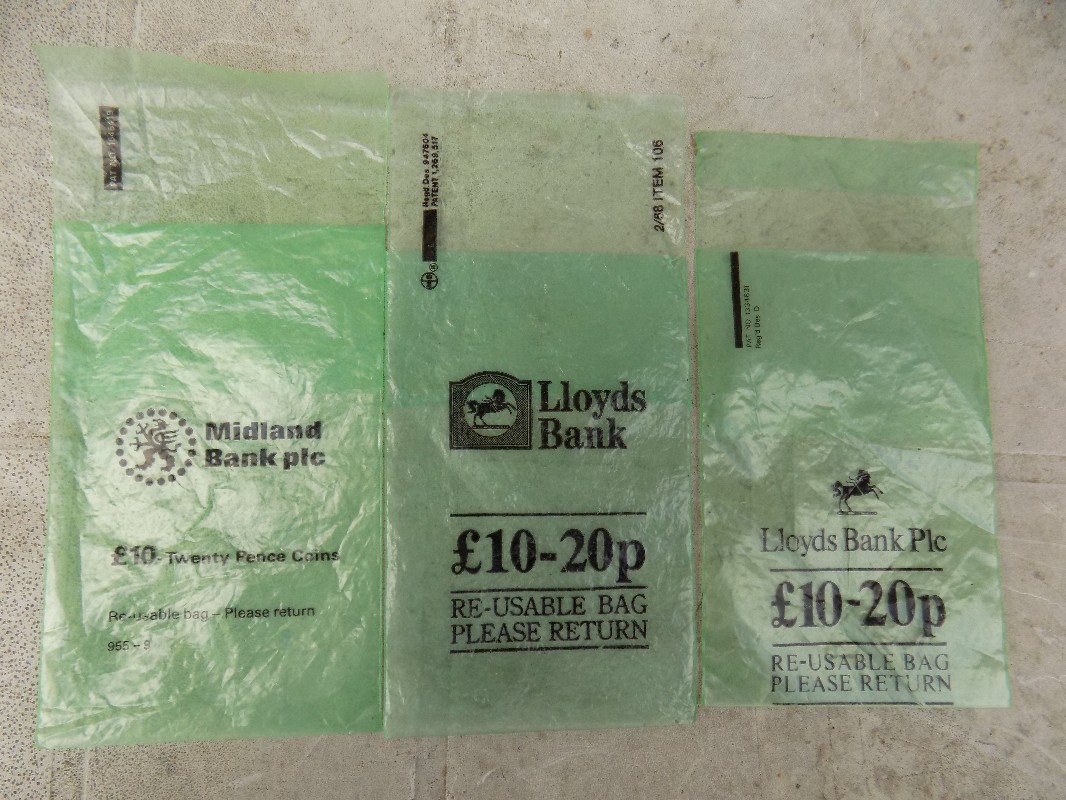
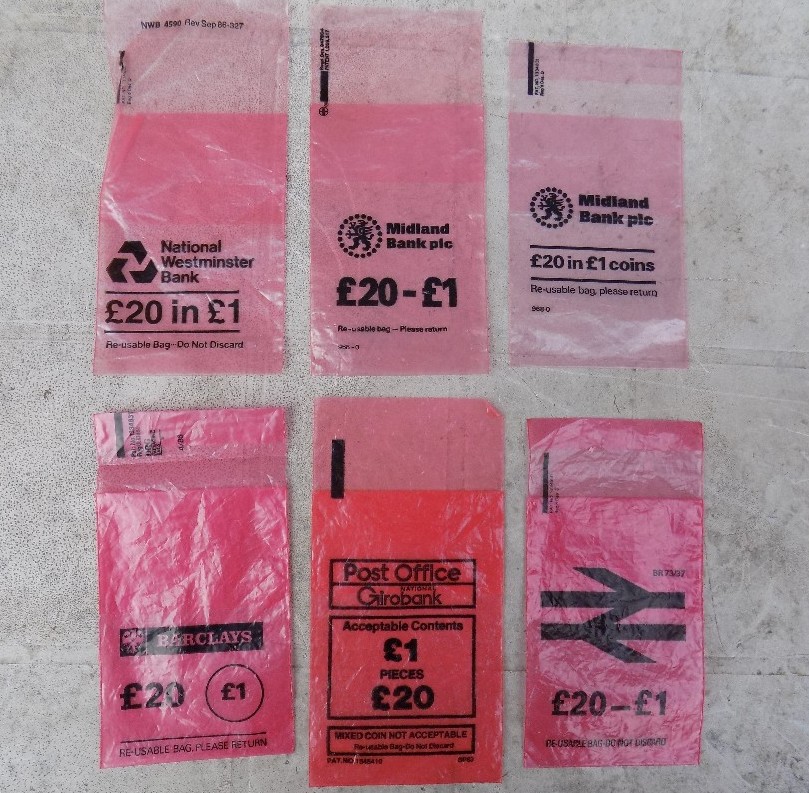
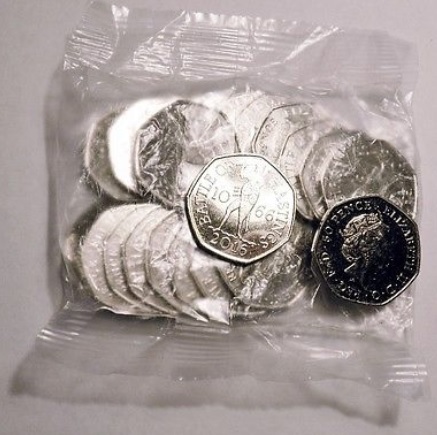
As most CCF members will know, British banks don't supply coins in rolls, but in small plastic bags.

The only rolls of British coins that I've ever seen are plastic-wrapped rolls of 1971-dated decimal ½p, 1p and 2p pieces: I believe that these may have been supplied to customers prior to February 15, 1971 in a similar way to the 'starter packs' distributed in the Eurozone countries in late 2001.
In my experience, you can obtain small quantities of coins (such as a single £10 bag of 50p's) from almost any bank, but to get larger quantities, you will need to have an account there. If you are using the bank for another purpose - such as exchanging foreign currency - then the bank is unlikely to refuse a request for coins.
If you get a large number of bags of coins, they used to be supplied in a nice linen sack, tied up with string, with the bank's name printed on the side.

But nowadays they usually come in big plastic bags like this:

Apart from banks, larger post offices may be able to supply bags of coins, although unfortunately these days even some major cities in the UK have lost their Crown post office and only have a sub-post office inside a chain store.
Seaside towns often have amusement arcades with machines that take coins of various denominations: these can be a source of change, especially 2p and 10p coins.
In my experience, it is very hard to find a bank that is willing to change bags of coins back into notes, unless you have an account there. For problem-free bag hunting, you really need two accounts in different banks.
So - what is there to find?
Unlike in the USA, there are eight denominations in regular use. Apart from British coins, you may occasionally get coins from Jersey, Guernsey, the Isle of Man, Gibraltar, St Helena or the Falkland Islands, which are the same size and composition as British ones. It's also possible to find an Irish Republic 1p or 2p: these coins are no longer legal tender in their homeland as they were replaced by the Euro in 2002. (Other pre-Euro Irish denominations are not found as they differed in size and composition from those currently circulating in the UK).
Let's look at the different types of coins issued since decimalisation:
First series - issued 1968 (5p, 10p); 1969 (50p) and 1971 (½p, 1p. 2p) to 1981.
These coins have the Machin portrait of the Queen on the obverse and the denomination on the reverse is in 'New Pence'. Only the 1p and 2p from this series are still in circulation: the ½p was demonetised on January 1, 1985 and the 5p, 10p and 50p were all replaced by smaller coins in the 1990s.
Second series - issued 1982 to 1984 (20p first issued in 1982 and £1 coin first issued in 1983; ½p issued for last time in 1984).
These coins have the Machin portrait of the Queen on the obverse; the denomination is shown in words on the reverse - i.e. 'ONE PENNY' instead of 'NEW PENNY'. No 2p coins of this series were issued for circulation, but some have escaped from BU sets and are still legal tender. The 1p, 20p and £1 coins of this series are also still in circulation.
Third series - issued 1985 to 1997 (bimetallic £2 introduced in 1997; 5p 10p and 50p coins reduced in size from 1990, 1992 and 1997 respectively).
These coins have the same reverse designs as the second series, but have the Raphael Maklouf portrait of the Queen on the obverse. All denominations are still in circulation: 1p, 2p, 20p and £1 from 1985, 5p from 1990, 10p from 1992 and 50p and £2 from 1997. The 1p and 2p switched to bronze-clad steel from 1992.
Fourth series - issued 1998 to 2008
These coins have the same reverse designs, but the portrait on the obverse is by Ian Rank-Broadley. All are still in circulation.
Fifth series - issued 2008 to 2015
These coins retain the Rank-Broadley portrait but have new reverses based on sections of the Royal Arms. All are still in circulation. The 5p and 10p switched to nickel-clad steel from 2011.
Sixth series - first issued in 2015
These coins have the new portrait of the Queen by Jody Clark.
1p
Earliest date in circulation: 1971
Obtained in bags of 100 - cost £1
Advantage: very cheap, easy potential to put together a long date run.
Disadvantages: Little chance of making a valuable find; if you don't have a dump bank, you'll have to put them in a Coinstar machine or take ages spending them.
All 1p coins since 1971 are quite common, apart from the sole NIFC date, 1972, which was only issued in proof sets. The 1992 and 1999 bronze (non-magnetic) pennies were only issued in Proof and BU sets: circulating coins of these dates are made from bronze-clad steel. Some of the pre-2008 pennies have a variety with either raised or incuse rivets on the portcullis. Pre-1992 bronze pennies are gradually getting scarcer but are still readily obtainable. You may get occasional US cents or 2- or 5-euro cent coins masquerading as pennies.
2p
Earliest date in circulation: 1971
Obtained in bags of 50 - cost £1
Advantage: cheap; possibility of getting the rare 1983 "New Pence" mule.
Disadvantages: If you don't have a dump bank, you'll have to put them in a Coinstar machine or take ages spending them.
There are several NIFC coins: 1972, 1973, 1974 (all proof only); 1982, 1983, 1984, 1992 bronze and 1999 bronze (proof and BU). The scarcest coin issued for circulation is the 2008 with the Prince of Wales feathers on the reverse (10,600,000). I also find the 2013 quite scarce and the 2016 is proving elusive so far. The 1998 exists on bronze and bronze-clad steel planchets: both types are common. The great 2p rarity is the 1983 mule with "New Pence" on the reverse instead of "Two Pence". Although no 1983 2p's were issued for circulation, over 600,000 were issued in BU sets, and a large number of these sets were distributed as free gifts by food and drink manufacturers in exchange for proofs of purchase. This was all part of a publicity drive to familiarise the public with the new £1 coin (rather like the Cheerios dollars!) Some of these sets were simply treated as money by the recipients and broken open and spent. Only a handful of these mules have been found.
5p
Earliest date in circulation: 1990
Obtained in bags of 100 - cost £5
Advantage: fairly cheap.
Disadvantages: Very small and fiddly; no rare dates issued for circulation. If you don't have a dump bank, you'll have to put them in a Coinstar machine or take ages spending them.
Searching through 5p coins isn't very exciting. The oldest coins only date from 1990, and the majority of those found in circulation are the nickel-plated steel variety issued since 2011. The only NIFC date is 1993.
10p
Earliest date in circulation: 1992
Obtained in bags of 50 - cost £5
Advantage: if you like varieties, there are several different ones for 1992!
Disadvantages: Heavily dominated by coins issued in the past five years!
The majority of 10p coins found in circulation are the nickel-plated steel variety issued since 2011. There are several varieties of 1992 10p, and the first type of 2008 10p (with the crowned lion on the reverse) is quite scarce, with a mintage of 9,720,000. There are four NIFC dates: 1993, 1994, 1998 and 1999. There is also the extremely rare 2009 mule with the crowned lion reverse - only two reported so far!
20p
Earliest date in circulation: 1982
Obtained in bags of 50 - cost £10
Advantage: A chance to get the famous 'undated' error coin.
Disadvantages: Apart from the above, not very interesting.
The cupro-nickel 20p has been issued for circulation every year since 1982, apart from 1986 which was only minted in Proof and BU sets. The 1992 coin exists with 'large' and 'small' head varieties, neither of which is rare. The great prize is the mule 20p issued in 2008, when an undated obverse die was paired with a new shield reverse die. It's believed that between 50,000 and 100,000 of these coins were struck.
50p
Earliest date in circulation: 1997
Obtained in bags of 20 - cost £10
Advantage: Lots of different types to collect, several of which are scarce.
Disadvantages: Quite expensive to obtain in quantity, and rather bulky.
In just 20 years since the current version was introduced, an astonishing variety of 50p's has been issued. Any bag is almost guaranteed to contain two or three commemoratives. The 50p is by far the most interesting coin to 'bag hunt'! The real prize is the 2009 Kew Gardens commemorative, with only 210,000 issued for circulation. Other scarcities are the 29 different 50p's issued in 2011 for the Olympic Games (mintages between 1 and 3.5 million), and the 2003 Suffragettes, 2011 World Wildlife Fund and 2008 Britannia reverse (all around 3 million). These are worth putting aside in AU or better. At present the five 2016 Beatrix Potter commemoratives are highly sought-after, although mintage figures have not yet been released. Note that lots of people are currently trying to sell all kinds of circulated commemorative 50p coins on
ebay, even common ones like the Girl Guides or Public Libraries, for ridiculous prices.
The following 50p coins are NIFC: 2009 shield type, 2009 Olympics Athletics (same design as the 2011 Olympics Athletics coin, but dated 2009), 2010 shield type, 2011 shield type, 2015 Battle of Britain (Rank-Broadley obverse). The 2009 Olympic Althletics coin was sold at a premium in individual packs and is identical to the 2011 issue apart from the date. The other NIFC coins were issued in Proof and BU sets.
£1
Earliest date in circulation: 1983 (being replaced by bimetallic coin from March 2017)
Obtained in bags of 20 - cost £20
Advantage: With the reverse design changing frequently, there are a lot of different round pounds to collect. You may get the scarce Edinburgh pound; great possibilities for lovers of contemporary forgeries! Easy to spend if you are stuck with them.
Disadvantages: Expensive to obtain in quantity; risk of getting lots of forgeries; possibility of getting foreign coins with a face value of less than £1.
The circular nickel-brass £1 coin has been issued for circulation every year since 1983, with the exception of 1998, 1999 and 2016 which are NIFC. There is also a special 2016 'last round pound' commemorative, which is also NIFC. The scarcest £1, and the only one with a mintage below 1 million, is the 2011 variety with the Edinburgh coat-of-arms on the reverse. The similar 2011 Cardiff pound is also quite scarce (1.6 million) and fetches between £5 and £10 on
ebay in average circulated condition. The 2008 pound with the first type of Royal Arms reverse has a mintage of about 3.9 million: no other circulating pound coins have a mintage below 5 million.
An estimated 3% of the round pounds in circulation are forgeries. Some are crude and easily spotted; others are almost indistinguishable from the real thing. Look out for mis-matched obverses and reverses, and incorrect edge lettering, such as a Scottish 'thistle' coin with the Latin 'DECUS ET TUTAMEN' around the edge instead of 'NEMO ME IMPUNE LACESSIT'. Incidentally, the edge lettering can be either way up and can start in any position with regard to the design of the coin: please don't pay attention to sellers on
ebay claiming that they have rare 'error' £1 or £2 coins with upside-down edge lettering!
For some reason, you are much more likely to get a foreign coin masquerading as a pound than as any other denomination. I've found New Zealand dollars, Euro 20-cent coins, Sri Lanka 5 rupees and Uganda 500 shillings - all worth much less than one pound!
During the period that both designs are in circulation, banks will supply round and 12-sided £1 coins in separate bags, and depositors must not mix the two different types in the same bag.
£2 (bimetallic)
Earliest date in circulation: 1997
Obtained in bags of 10 - cost £20
Advantage: Several scarce coins to collect. Easy to spend if you are stuck with them.
Disadvantages: Very expensive to obtain in quantity. To stand a decent chance of getting some of the rarer dates, you'd need to change several thousand pounds into £2 coins.
The rarest bimetallic £2 are the four commemoratives issued for the Commonwealth Games in 2002, of which the Northern Ireland one is the scarcest. Others with a mintage figure of below 1 million are: 2008 Olympic Centenary, 2008 Olympic Handover, 2011 King James Bible, 2012 Olympic Handover, 2015 Navy and 2015 Britannia. The only NIFC £2 coins are the 2015 Magna Carta and Navy coins with the Rank-Broadley portrait.
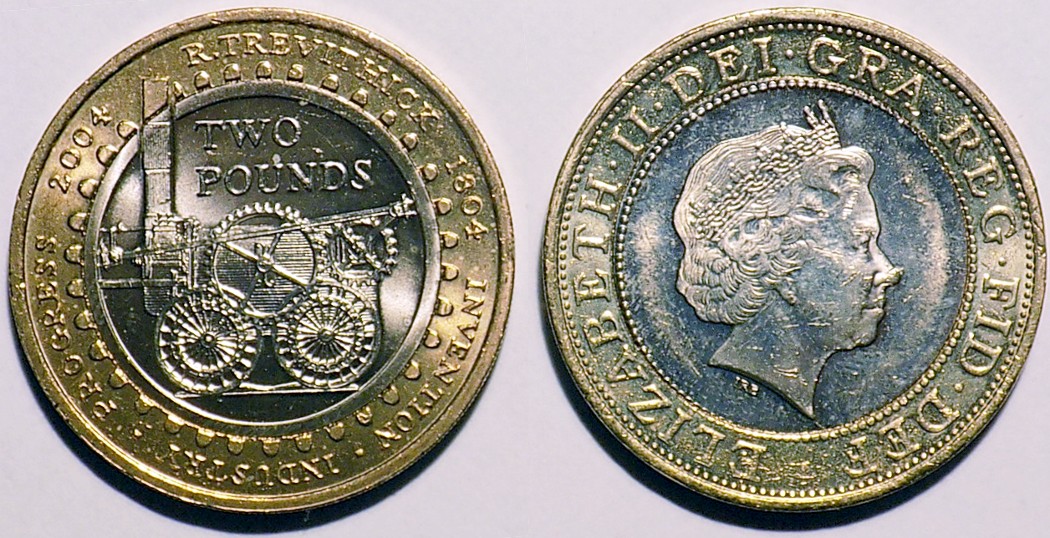
Other coins
Bank tellers occasionally have an odd NIFC coin lying in their tray, if they have been paid in by another depositor. It's always worth asking. You could get a 1972, 1977, 1980 or 1981 crown (face value 25p) or one of the more recent crown-size £5 coins. The earlier solid brass commemorative £2 coins issued between 1986 and 1996 also sometimes turn up. Then there are the recently issued silver £20, £50 and £100 coins.










 Posted 04/13/2017 12:03 pm