Annia Aurelia Faustina was a Roman Empress who has been scarcely noticed by ancient and modern Roman historians. She was of noble descent, daughter and only child of the wealthy heiress Annia Faustina and the Roman Senator, consul Tiberius Claudius Severus Proculus. In 221AD she became the third wife of the Emperor Elagabalus for a brief marriage.
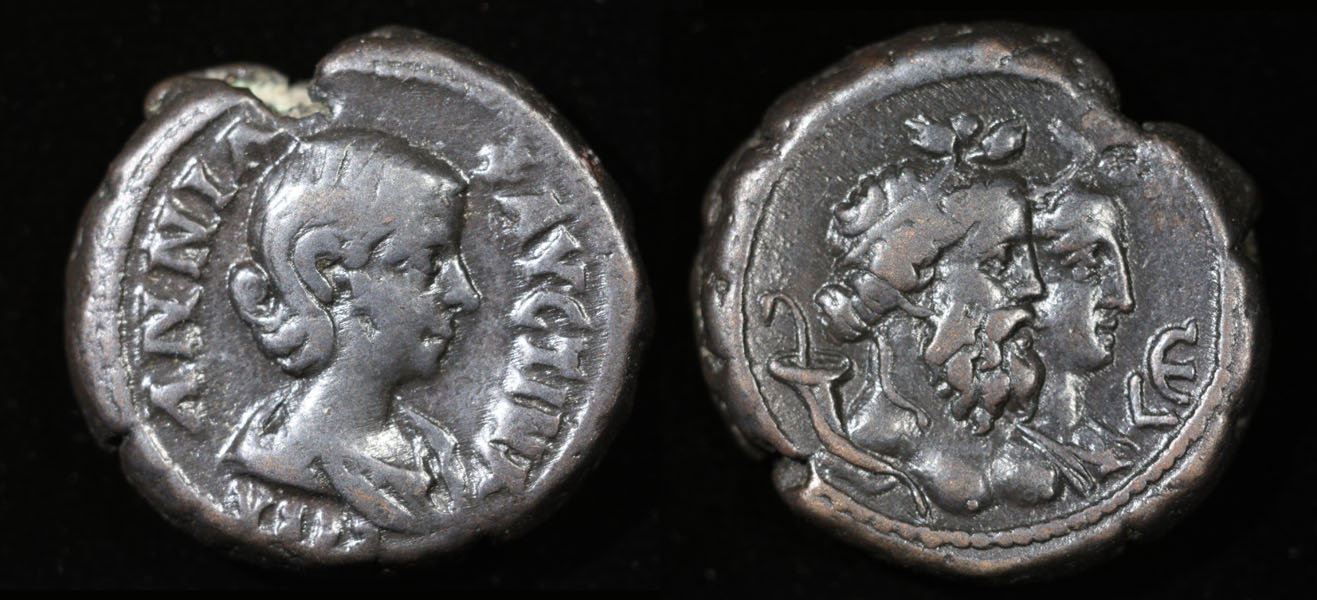
I cannot show an Imperial coin for this empress in any metal. However, I have a nice portrait piece in the form of a potin Egyptian tetradrachm. (It cost as much as a nice Claudian denarius, so I hope it will suffice.)
Potin Tetradrachm (24mm, 15.72 g, 12h).
Dated RegnalYear 5 (L Epsilon) of Elagabalus (AD 221).
Obv: Draped bust right /
Rev.: Conjoined busts of Nilus, (wearing grain ear wreath and with cornucopia), and Euthenia, (draped and wearing grain ear wreath) both facing right; L <epsilon> (date) to right.
Annia Aurelia Faustina was born and raised on her mother's estate in Pisidia, one of a number in that area called the "Cyllanian Estates". About 216, her father apparently made a political alliance with a Roman Senator of the gens "Pomponia" that ultimately resulted in her marrying Pomponius Bassus. By 218, her parents had died and Annia
inherited her mother's estate and their fortune, becoming a very wealthy heiress. Upon her marriage, they settled at her Pisidian estates, which were very large properties, established from the time of the dictator of the Roman Republic, Lucius Cornelius Sulla (c. 138-78 BC).
Pomponius treated Annia well and they both lived in domestic tranquility. She bore at least two known children during her marriage to him: a daughter, Pomponia Ummidia (born 219), and a son, Pomponius Bassus (born 220). Unfortunately, by the year 221 she was widowed due to the demise of her husband, who had been executed for subversion and treason. That same year powerful courtiers, led by the Emperor's grandmother, Julia Maesa, induced Elagabalus to end his highly controversial and politically damaging marriage to the Vestal Virgin Aquilia Severa. He was advised instead to marry Annia Aurelia Faustina in order to forge an alliance with the powerful clan represented by her blood connections with the prior Nerva-Antonine dynasty. The senatorial Roman ruling class was more receptive of this imperial marriage than the previous one.
Annia became Empress of Rome and it seemed for a time that the Nerva-Antonine dynasty rule had returned to Rome. Elagabalus gave her the title of Augusta. Supporters of Elagabalus had hoped that Annia, the mother of two small children would bear him a natural heir however, she bore him no children. It should not be a surprise that at the end of 221, Elagabalus, reasserted his previous course of action, divorced Annia Faustina and returned to Julia Aquilia Severa, remarrying her as his fourth wife. Due to the brevity of this her second marriage, there are no surviving sources describing Annia Aurelia Faustina's rule as a Roman empress.
Her marriage to Elagabalus now ended, Annia Faustina returned with her children to the Pisidian estate. She spent the final years of her life there. When she died, her daughter Pomponia Ummidia
inherited the estate, and her descendants had become various distinguished nobles and politicians in Roman Society.
The Imperial coinage issues in the name of Annia Faustina are of the greatest rarity, with only 6 attested surviving examples in silver, with a CONCORDIA (holding hands) denarius type. A sestertius with a similar reverse is also known. RSC notes a PIETAS type in silver with bust on crescent, but suggests it is a tooled Maesa double denarius. More examples are to be found among the Roman Provincial coinage, but anything in good condition is likely to exceed four figures. Still, there are interesting things out there.







 Posted 05/27/2017 11:47 pm





