| Author |
 Replies: 32 / Views: 4,505 Replies: 32 / Views: 4,505 |
|
|
|
Bedrock of the Community
United States
94367 Posts |
I wish you the best, though I am skeptical that acetone will help much. In any event, given the evident cleaning, I don't feel the coin is market-acceptable at the grade.  |
|
Pillar of the Community
United Kingdom
2145 Posts |
JJuliano
When you say that Xylene is non-polar, what does that mean and what difference does that make or what impact does that have, compared with a substance that is polar, please ?
|
|
Bedrock of the Community
United States
10065 Posts |
Polar vs non-polar and trying not to get technical (I hope)
Some gunk-to-be-removed will react better to polar substances than non-polar.
Polar: Having a (slight) charge on either end - poles - like a magnet
Picture the typical Mickey Mouse symbol made of three circles. The "head" is an oxygen atom. The "ears" are two Hydrogen atoms. Although the Oxygen and Hydrogen atoms are tightly bonded to each other in the molecule, approaching the bottom of the "Micky Mouse head side" of the molecule reveals a slightly negative charge there since only the Oxygen atom is encountered at that side. Approaching the "ears" side of the molecule a slightly positive charge is noticed since the combination of the two Hydrogen atoms are positioned there.
Hence one side of the molecule is slightly negative and the other positive. The molecule has a slight positive side and a slightly negative side -- it is something like a tiny magnet - it has two poles.
Polar substances dissolve by the charges on either end of the molecule reacting with the "gunk" to be dissolved. Picture little magnets pulling apart gunk-molecules off of a large clump of gunk.
Non-polar: Carbon dioxide is a molecule that has a straight-line shape -- picture three circles in a row. The middle is a Carbon atom, the two end ones are Oxygen atoms. Since the ends of this molecule are identical Oxygen atoms - the same kind of slight charge is on both ends. It has no "poles."
So how do non-polar solvents dissolve gunk?
Well... non polar molecules do not constantly have poles.
Non-polar substances technically can have a pole for very (very, very...) short moments. How? The electrons that bind the atoms together are constantly moving. When the electrons making up a bond just happen to be closer to the inside atom, then the outside atom's outer, exposed side will have a slight charge.
But as soon as the electrons align themselves again (think how fast they move!), that charge is gone. This micro (micro, micro...) amount of time the molecule has a charge affects the other molecules around it and you have a weaker affect (weaker magnets) pulling the gunk apart.
Some gunk is too toughly bonded to itself for a non-polar solvent's weaker "magnets" to pull it apart.
Non-tech as I can make it...after all, kids read these threads.
Want more? Look up dipole moments as a good place to start.
|
|
New Member
United States
34 Posts |
I wouldn't use Acetone... nasty stuff
there are other ways
|
|
New Member
United States
13 Posts |
I currently use wooden chopsticks to help handle coins in acetone. I also use my fingers, Ok I'm not recommending that at all, especially for nice coins (or nice fingers).  Tried plastic cutlery once but acetone was melting them quickly... won't those "CoinTongs" also melt in the acetone? Also, I have an awesome glass candy dish with lid that has a wide mouth so easy to access. Am I the only one who sometimes cleans gunk off of circulating coins, and then releases them back into the wild (spend em) just for the fun of it? Really helps you practice on different coins and substances with no downside. Edited by GaryLomax
07/22/2017 9:13 pm
|
|
Bedrock of the Community
United States
10065 Posts |
Different plastics are affected differently by acetone. The blue tongs I have are not affected at all. Plastic cutlery is (I think) styrene plastic which acetone will work on. The tongs, like the bottle the acetone is sold in, I think is a type of HDP plastic.
How much squash could a Sasquatch squash if a Sasquatch would squash squash? Download and read: Grading the graders Costly TPG ineptitude and No FG Kennedy halveshttps://ln5.sync.com/dl/7ca91bdd0/w...i3b-rbj9fir2 |
|
Moderator
 United States
196100 Posts |
Quote:
I wouldn't use Acetone... nasty stuff Not when handled correctly. It is perfectly safe for coins. |
|
Bedrock of the Community
United States
10065 Posts |
A saying I have posted on this topic before:
Acetone cannot meddle with the metal of your medal (or coin).
And the tons of young ladies who use it on a regular basis to clean off their nail polish show its noa health hazard. Fire - yes - but many items are we use all the time.
How much squash could a Sasquatch squash if a Sasquatch would squash squash? Download and read: Grading the graders Costly TPG ineptitude and No FG Kennedy halveshttps://ln5.sync.com/dl/7ca91bdd0/w...i3b-rbj9fir2 |
|
Pillar of the Community
 United States
4622 Posts |
Earle - that's not completely true (that Acetone doesn't affect coins).
There is a discussion raging about this ATS. There are some circumstances reported where acetone (damp environment with light) creates small amounts of ascetic acid, which does affect copper coins. It seems to be rare and very unpredictable.
Certainly it seems safe enough for silver and gold coins.
But remember, it only helps with organics and plastics it will dissolve (which shouldn't be on your coin anyway).
FWIW, I use nitrile gloves with acetone, even though it's not 'dangerous' to fingers, it does dry out the skin something fierce.
-----Burton 50+ year / Life / Emeritus ANA member (joined 12/1/1973) Life member: Numismatics International, CONECA Member: TNA, FtWCC, NETCC, EveryCountry (online) coin club Owned by three cats and a wife of 40+ years (joined 1983) Author: 3rd Edition of the Sample Slabs book, https://www.sampleslabs.info/ |
|
Bedrock of the Community
United States
10065 Posts |
Thanks for the clarification then.
I have used it on many (understatement) US cents with no ill affects, but am open to any new info.
I am a bit puzzled though and ask for help understanding. When my coins are immersed in acetone - sitting in the capped jar - I don't understand how I could possibly subject them to a damp environment? The light is obvious enough.
Or are you saying the problem comes at the point of remoiving the coin from the acetone -- from the residual acetone on the coin's surface being exposed to a humid environment (in the 1/2 second before it evaporates)? Is this when the acetic acid can form?
How much squash could a Sasquatch squash if a Sasquatch would squash squash? Download and read: Grading the graders Costly TPG ineptitude and No FG Kennedy halveshttps://ln5.sync.com/dl/7ca91bdd0/w...i3b-rbj9fir2 |
|
Bedrock of the Community
United States
11951 Posts |
Sorry .. for not checking back on this thread. Yes .. I put the ASE into the acetone to remove the baked on paint. I sometimes leave the coin for three weeks to get all the paint off. ---------------------------- Depending on the coin. I can gently slide the coin into the jar. And sometimes pour the coin out with the acetone. Sometimes I will gently scoop the coin out with a metal spoon. |
|
Pillar of the Community
United States
4622 Posts |
The paper referenced has the uncovered beakers placed in a water bath AND exposed to light. Allowed to evaporate (~17 hours). No light no acetic acid crystals.
-----Burton 50+ year / Life / Emeritus ANA member (joined 12/1/1973) Life member: Numismatics International, CONECA Member: TNA, FtWCC, NETCC, EveryCountry (online) coin club Owned by three cats and a wife of 40+ years (joined 1983) Author: 3rd Edition of the Sample Slabs book, https://www.sampleslabs.info/ |
|
Bedrock of the Community
United States
10065 Posts |
Thanks for the clarification. My coins are always capped inside a baby food jar so there will be no evaporation anyway.
|
|
Pillar of the Community
United States
4622 Posts |
It wasn't the evaporation that created the ascetic acid, it was the water vapor and the light.
The evaporation allows the researchers to see tiny blue crystals that they could analyze.
Still, if you skip days like yesterday morning where the relative humidity was 96%, you are probably fine.
-----Burton 50+ year / Life / Emeritus ANA member (joined 12/1/1973) Life member: Numismatics International, CONECA Member: TNA, FtWCC, NETCC, EveryCountry (online) coin club Owned by three cats and a wife of 40+ years (joined 1983) Author: 3rd Edition of the Sample Slabs book, https://www.sampleslabs.info/ |
|
Pillar of the Community
 United States
1789 Posts |
Did a 24 hour soak. Not really sure what to think, the PVC area does look better, but the coin has a "brighter" look to it. By the way, these pics are quite bad  . In hand there's only slight hairlines. Should I keep soaking it till all the green is off? Thanks. Before: 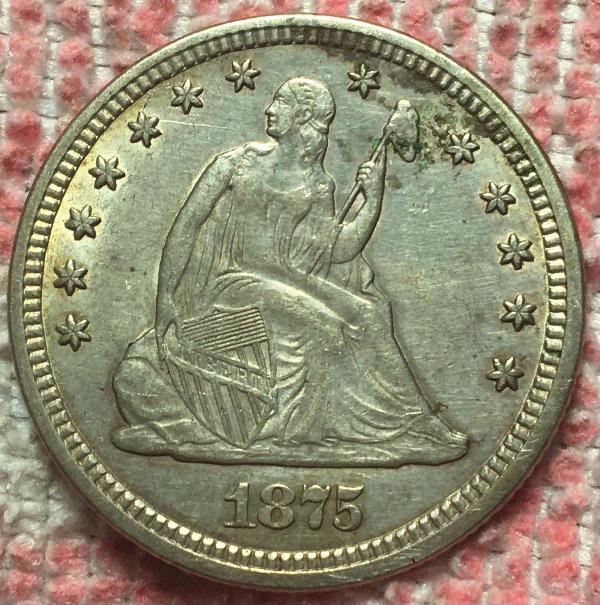 After: 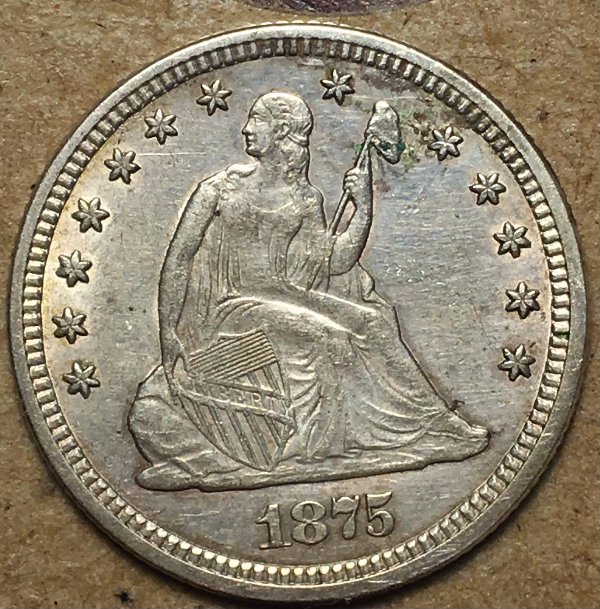 |
| |
Replies: 32 / Views: 4,505 |








 First Page


 Posted 07/22/2017 5:49 pm


