| Author |
 Replies: 24 / Views: 2,882 Replies: 24 / Views: 2,882 |
|
|
|
Pillar of the Community
 Canada
3234 Posts |
Well I've asked for expert input on this and I'm certainly receiving some. Just a great unique anomaly for sure.
Are we even certain that the foreign piece is actually wood ? I do understand that melting bronze should not allow any wood to remain in the strips..but what about some type of tough fiber ? I wouldn't think that it would survive either. I still believe that nothing was pushed into that cent.
Would that piece (and the air around it) cause the crack to form and slowly propagate with expanding pressure until at did indeed crack open ?
I do appreciate the input so far.. Lot's of developing theories..
Where are the metallurgists when you need them ?
I like Dave's input and glad that I brought this back for him.
Thanks all for taking the time to add your views on this weird one.
|
|
Pillar of the Community
Canada
1275 Posts |
I have to agree with SPP here. I don't understand how this could have come to be at any time pryer to or during the minting of the coin. If you look closely at the area SsuperDdave has circled you can see a small void on the left side of the foreign object. With the tons of pressure required to mint coins I wouldn't think there would be any void at all and it would be more imbedded into the coin. There is also a direction to the splitting in the planchet running horizontally in the picture as evidenced near the tip of the object, if you follow the path you can see it on both sides of the foreign object. The object is in a opposite direction to these lines and there is no evidence on the top of the object indicating a left/ right direction. I suspect if you could somehow look under the piece you would find these lines would flow uninterrupted. A more plausible explanation would be that someone a long time ago came across this coin and noticed the lamination problem running around the edge and decided to see if they could pry it open. It's quite evident from where the missing piece broke off that it was bent upwards and from the original photo you can see it cracked when bent back down. The section directly above the object also appears to be raised slightly and probably from the insertion of said object. The lamination on the 1888 pictured below is a coin that I'm quite sure I could insert a small sliver of wood under and replicate a similar appearance. Don't get me wrong this is a great coin and an real conversation piece but I don't think it left the mint with this piece inside. Cheers, Bill 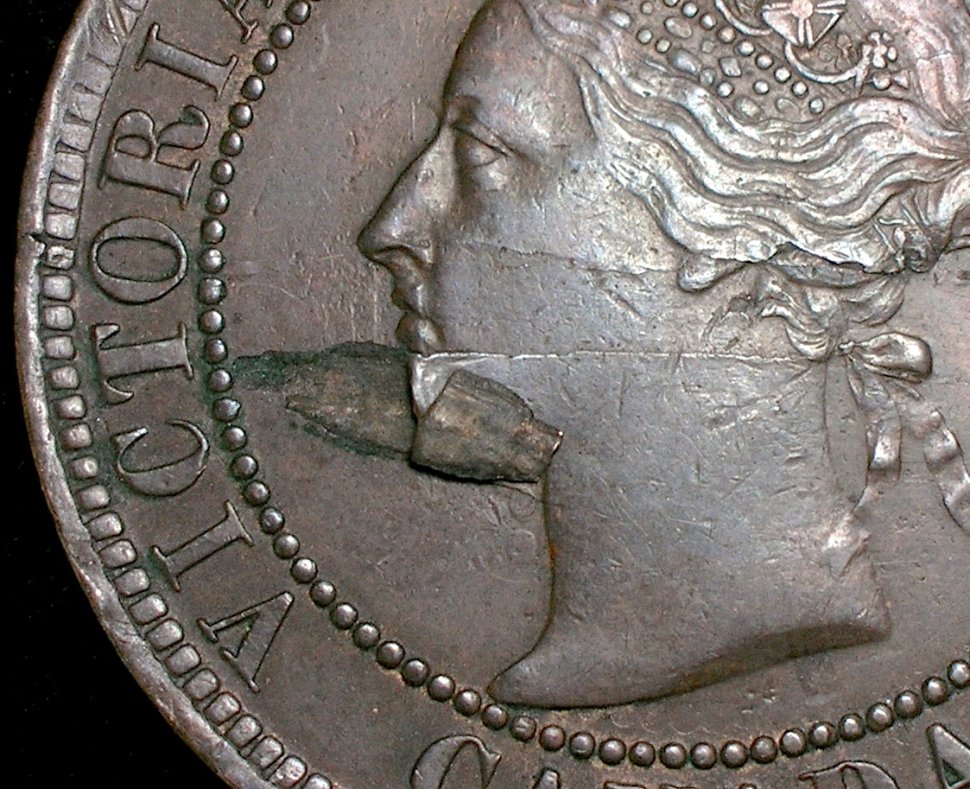 |
|
Pillar of the Community
United States
1101 Posts |
What if it were asbestos fibers as Okiecoiner mentioned in the old thread from a couple of years ago. It could have survived the heat and been rolled into the strip.
DEVLEC, maybe you should have a tiny bit of whatever it is analyzed to find out.
|
|
Moderator
 United States
23522 Posts |
A planchet lamination can involve an inclusion - foreign matter in the alloy mix - and either way it was a lamination on the roll/strip; it didn't develop after the strike. Over 100+ years of varying environments and temperature/humidity changes, there is ample opportunity for foreign substances even if in gaseous form to work their way into the lamination, and react with whatever inclusion was there. We know it's open at the rim.
One might slip a sliver of wood in there, but - as I mentioned in my last post - contemplate the thickness of what we're seeing. Can you slip a sliver of paper in there?
|
|
Pillar of the Community
Canada
3234 Posts |
Quote:
DEVLEC, maybe you should have a tiny bit of whatever it is analyzed to find out. It's bad enough that the seller picked at it (to our blessing) ..but I could never do that.. What kind of x-ray scan could possibly penetrate that surface a bit ?..hmmm My dentist always has the newest toys to scan our teeth with so maybe on my next visit..  |
|
Moderator
Canada
10477 Posts |
Quote:
I thought that they were rolled from small ingots, not rods. I think that the wood got in there in the "rolling" part. Maybe bosox can chime in on this one... but for the segregation of the brass 1859 strikes, you would need differential cooling to allow for segregation of alloys - I can see that happening in a long cast rod, but not a small ingot... "Discovery follows discovery, each both raising and answering questions, each ending a long search, and each providing the new instruments for a new search." -- J. Robert OppenheimerContent of this post is licensed under a Creative Commons Attribution-NonCommercial 3.0 Unported License. See: http://creativecommons.org/licenses...0/deed.en_USMy eBay store
|
|
Moderator
Canada
10477 Posts |
Quote:
One might slip a sliver of wood in there, but - as I mentioned in my last post - contemplate the thickness of what we're seeing Easy - if the wood that was driving against the surface was thick. Think of how the wood behaves when it is pressed against a sharp hand planer. It does not start as a paper-thin curl, but with enough force, and thick enough wood forced against it... If this coin slid along a hardwood countertop, with enough force, you could shove a shaving of wood in there... If it was there before the strike, given the annealing and striking process, this thing should have turned to charcoal and created a gas bubble in the planchet... "Discovery follows discovery, each both raising and answering questions, each ending a long search, and each providing the new instruments for a new search." -- J. Robert OppenheimerContent of this post is licensed under a Creative Commons Attribution-NonCommercial 3.0 Unported License. See: http://creativecommons.org/licenses...0/deed.en_USMy eBay store
|
|
Pillar of the Community
 Canada
5657 Posts |
I don't think that the annealing or striking process would get any where near the temp required to burn the wood.
|
|
Moderator
Canada
10477 Posts |
Quote:
I don't think that the annealing or striking process would get any where near the temp required to burn the wood. Flash point of wood is 300 Celsius... annealing is normally conducted within the temperature range of 500-750°C "Discovery follows discovery, each both raising and answering questions, each ending a long search, and each providing the new instruments for a new search." -- J. Robert OppenheimerContent of this post is licensed under a Creative Commons Attribution-NonCommercial 3.0 Unported License. See: http://creativecommons.org/licenses...0/deed.en_USMy eBay store
|
| |
Replies: 24 / Views: 2,882 |







 First Page


 Posted 08/25/2017 2:47 pm


