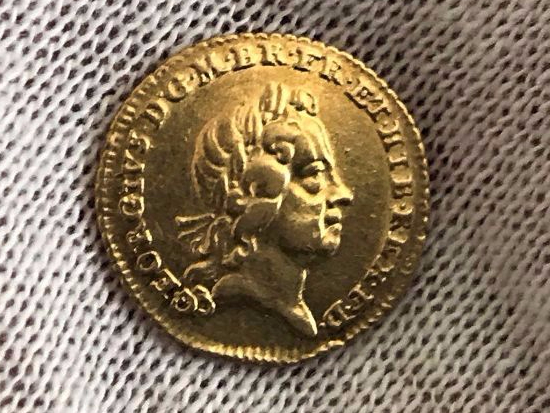
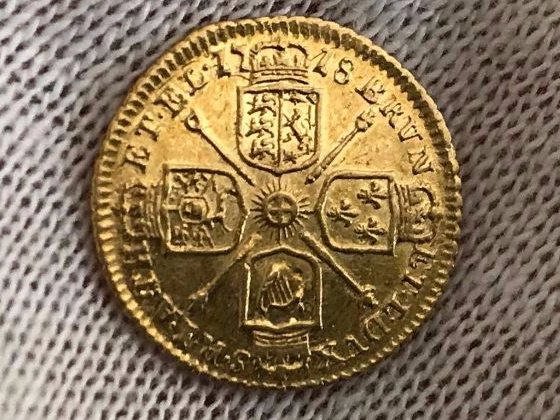
1718 quarter guinea
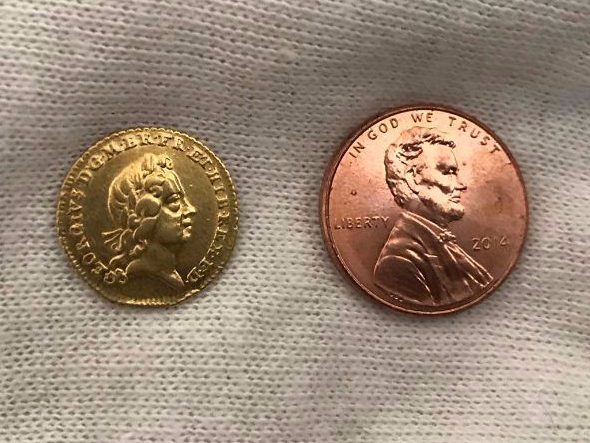
16mm diameter. 2.10 grams. 91.35% gold.
The quarter guinea was minted only in the years 1718 and 1762. As the name implies, it was valued at one-fourth of a guinea, which at that time was worth twenty-one shillings. The quarter guinea therefore was valued at five shillings and threepence. At the beginning of the reign of King George I (1714-1727) the price of silver had risen considerably, resulting in much British silver coinage being melted down and few silver coins being struck. Isaac Newton, the Master of the Mint, wrote a report on 21 September 1717 to the Lords Commissioners of His Majesty's Treasury blaming the rising price of silver on the overvaluation of the guinea at twenty-one shillings and sixpence.
This resulted in a Royal proclamation on 22 December 1717, forbidding the exchange of gold guineas for more than 21 silver shillings. Due to differing valuations in other European countries this inadvertently resulted in a silver shortage as silver coins were used to pay for imports, while exports were paid for in gold, effectively moving Britain from the silver standard to its first gold standard, rather than the bimetallic standard implied by the proclamation. In 1718 it was decided to strike a new gold coin equal to a quarter guinea to provide a useful coin worth approximately the same as the five-shilling silver crown.
The new coin had to be proportionate in size to the other gold denominations, and this resulted in a coin which weighed 2.1 grams and was 16 millimetres in diameter. It had not been realized at the time that a coin of this size was impracticably small to use, and would prove unpopular. 37,380 coins were minted, but many of them were put aside as keepsakes and many of the rest were lost. The coin was discontinued after 1718, and for the next few years there was an increased output of guineas and half guineas.
Despite its minuscule size, the coin took the form of a scaled-down version of the guinea and half guinea, including all the intricate cruciform shields on the reverse and all the king's Hanoverian titles. The coin is a fine example of the mint's work, although a magnifying glass is needed to properly appreciate it. The dies for all quarter-guineas of King George I were engraved by John Croker.
When George III came to the throne in 1760, the price of silver had again risen dramatically. Despite the unpopularity of the 1718 quarter guinea it was considered necessary to produce this coin again, to the same size and weight as before, to fill the gap between the low-denomination silver coins and the larger gold coins. Unfortunately it met the same fate as its predecessor and was only produced in 1762.










 Posted 09/20/2017 03:11 am


