| Author |
 Replies: 5,980 / Views: 455,813 Replies: 5,980 / Views: 455,813 |
|
|
|
Bedrock of the Community
 United States
10284 Posts |
Thank you jbuckster for your interest from page 1. I am almost done with my history book, I'm in the last chapter of this adventure anyway. Yes there are still a few medals I will track down eventually but I have to move on at some point. My next adventure will be finally posting ALL my Jefferson nickels after ALL these years. |
|
Bedrock of the Community
United States
10284 Posts |
I have never seen this Paul Revere 225th Anniversary 1775-2000 Silver Medal or "round" before. I can't find another anywhere, so that doubled my interest for acquiring it.  It is just a smidge larger than a Presidential dollar and I suspect it is 1/2 troy oz 999 pure silver. This makes for my second Paul Revere medal, both of which, I have never seen another offered up for sale. There are plenty of others and a lot of you know I am still going after the one by designed by Felix Schlag. For my other see this link http://www.coincommunity.org/galler...um=878&pos=8I wrote: Quote:
Paul Revere was an American silversmith, engraver, early industrialist, and Patriot in the American Revolution. He is best known for his midnight ride to alert the colonial militia in April 1775 to the approach of British forces before the battles of Lexington and Concord.
He did not cry "The British are Coming!"
Rather he spread the word to almost every house along the way from Charlestown to Lexington that "The Regulars are coming out."
The Old North Church, is the oldest standing church building in Boston, having first opened its doors to worshippers on December 29, 1723. Its 191 foot steeple is the tallest in Boston and, because of its prominence, would play a dramatic role in the American Revolution. It can be seen in the background of this picture of a statue monument of Paul Revere along "The Freedom Trail", A 2 1/2 mile long path through downtown Boston.  Edited by TNG
06/15/2018 11:31 am
|
|
Moderator
 United States
195559 Posts |
Quote:
I am almost done with my history book, I'm in the last chapter of this adventure anyway.
Yes there are still a few medals I will track down eventually but I have to move on at some point. It has been a great journey.  Quote:My next adventure will be finally posting ALL my Jefferson nickels after ALL these years. Yes, please!  Quote:
I have never seen this Paul Revere 225th Anniversary 1775-2000 Silver Medal or "round" before.
I can't find another anywhere, so that doubled my interest for acquiring it. Excellent!  |
|
Bedrock of the Community
United States
10284 Posts |
My 24th different Heraldic Art Medal
image taken through cello, will update.1969 Transcontinental Railroad
"Jupiter" Central Pacific's No. 60, is shown on the obverse of this medal and an Indian watches as his world shrinks with the white mans progress from a distance on the reverse.  Following the daring riders from the Pony Express and the construction of the transcontinental telegraph line in the late 1860s, two ferociously competing railroad lines, the Central Pacific Railroad and the Union Pacific Railroad, one building westward and the other eastward, opened up new territory to eager settlers. The railroad opened for through traffic on May 10, 1869 when Central Pacific Railroad President Leland Stanford ceremonially drove the gold last spike, often referred to as the "Golden Spike" with a silver hammer at Promontory Summit where Union Pacific's No. 119 and Central Pacific's No. 60 "The Jupiter" met in Box Elder County, Utah. Images of replicas of the original Engines and tenders. Jupiter on top and No. 119 below.  The coast-to-coast railroad connection revolutionized the settlement and economy of the American West. It brought the western states and territories into alignment with the northern Union states and made transporting passengers and goods coast-to-coast considerably quicker and less expensive.  
|
|
Pillar of the Community
New Zealand
526 Posts |
GB Bronze Medallion to commemorate the coronation of King George VI and Queen Elizabeth. The reverse depicts a portrait of King George VI wearing full coronation dress, with the circumscription 'GEORGE VI CROWNED 12 MAY 1937'. The obverse shows a portrait of Queen Elizabeth, also in full coronation dress, with the circumscription 'QUEEN ELIZABETH 12 MAY 1937'. Other size medallions were also issued, along with silver and gold examples. Diameter 32mm. 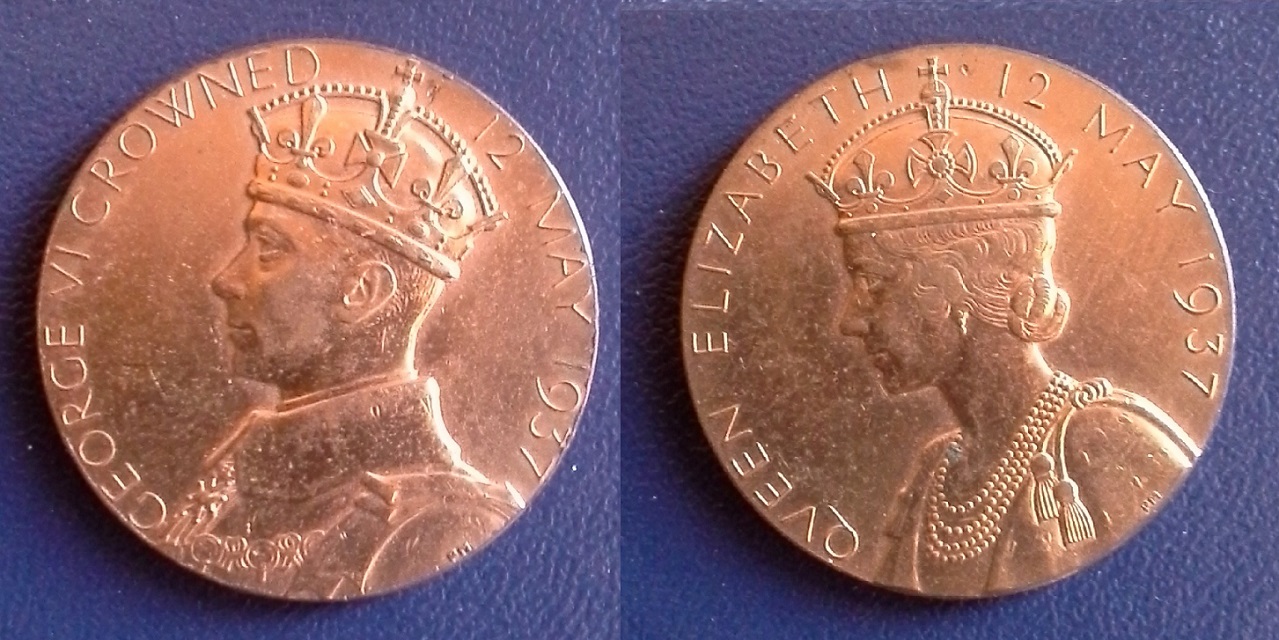 |
|
Pillar of the Community
Belgium
1185 Posts |
Quote:
I am almost done with my history book, I'm in the last chapter of this adventure anyway. history brings so much extra to a coin/medal collection so your book is a great idea |
|
Moderator
United States
195559 Posts |
Quote:
My 24th different Heraldic Art Medal
1969 Transcontinental Railroad Excellent!  Quote:
GB Bronze Medallion to commemorate the coronation of King George VI and Queen Elizabeth. Very nice! |
|
Pillar of the Community
Belgium
1185 Posts |
1836 Silver medal (1836) - diameter 28 mm weight 8,8 g Municipal Council of French town of La Rochelle, France engraver: CAQUE The OBV of this small medal shows a front view of the magnificent renaissance façade ("La Grande Galerie) of the old city hall, which was constructed between 1595 and 1605. The stair hall of honors (Escalier d'honneur) on the left is in its original version, today we can see a modified version, a smaller structure, erected in 1877 (see second photo below). The REV mentions in a succinct manner that this medal was made for the Municipal Council of La Rochelle. Why the year 1836 is not clear to me. Perhaps a small token of appreciation of the mayor for the duties delivered by council members in 1836?   This renaissance building is apart of the bigger city hall complex which contains a 15th century gothic part that surrounds the part displayed on the coin. Whenever you are in this part of Europe it is a monument from the rich history of France you can't miss.   later stairs structure  Edited by 1c5d7n5m
06/17/2018 12:06 pm
|
|
Bedrock of the Community
United States
10284 Posts |
Again, thanks Bas and 1c5d7n5m for the excellent posts.
|
|
Moderator
United States
195559 Posts |
Very interesting! |
|
Pillar of the Community
United States
1871 Posts |
I bought this OPA Blue Point a couple months ago but just recently got around to photographing it. I purchased a Red Point at the coin show yesterday to keep it company. 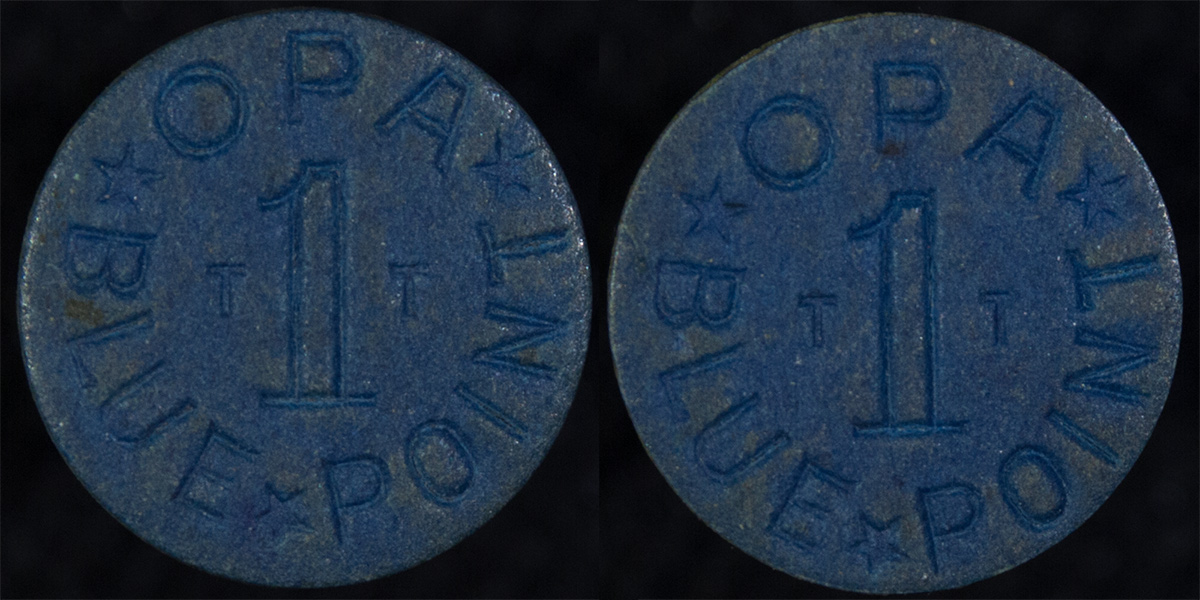 Edited by bd251
06/18/2018 10:22 pm
|
|
Moderator
United States
195559 Posts |
Very nice! |
|
Bedrock of the Community
United States
10284 Posts |
An Update for my WWI British War Medal posted here http://goccf.com/t/301479&whichpage=48#2738698Edge: PNR is an acronym for Pioneer - WW1 RE
and R.E. is an acronym for Royal Engineers
This medal was No. 93182 and was presented to J. Sneddon a Royal Engineer or "Sapper".  A sapper, also called pioneer or combat engineer, is a combatant or soldier who performs a variety of military engineering duties such as breaching fortifications, demolitions, bridge-building, laying or clearing minefields, preparing field defenses as well as building, and working on road and airfield construction and repair. They are also trained to serve as infantry personnel in defensive and offensive operations. A sapper's duties are devoted to tasks involving facilitating movement, defense and survival of allied forces and impeding those of enemies. Sappers in the First World War  The war of 1914-1918 relied on engineering. Without engineers there would have been no supply to the armies, because the RE's maintained the railways, roads, water supply, bridges and transport. RE's also operated the railways and inland waterways. There would have been no communications, because the RE's maintained the telephones, wireless and other signaling equipment. There would have been little cover for the infantry and no positions for the artillery, because the RE's designed and built the front-line fortifications. It fell to the technically skilled RE's to develop responses to chemical and underground warfare. And finally, without the RE's the infantry and artillery would have soon been powerless, as they maintained the guns and other weapons. Little wonder that the Royal Engineers grew into a large and complex organization. On 1 August 1914, the RE consisted of 1056 officers and 10394 men of the regular army and Special Reserve, plus another 513 and 13127 respectively serving with the RE of the Territorial Force. By the same date in 1917, it had grown to a total manpower of 295668. In other words, it was twelve times bigger than the peacetime establishment.
Edited by TNG
06/18/2018 10:52 pm
|
|
Bedrock of the Community
United States
12477 Posts |
Quote:
I purchased a Red Point at the coin show yesterday to keep it company. I still need a Red Point to go with the Blue. In Memory of Crazyb0 12-26-1951 to 7-27-2020
In Memory of Tootallious 3-31-1964 to 4-15-2020
In Memory of T-BOP 10-12-1949 to 1-19-2024
|
|
Pillar of the Community
New Zealand
526 Posts |
You learn a little every day.
Never knew about Red Point Blue Point tokens.....but here using the magic of google I discovered........
OPA stands for Office of Price Administration
Rationing was started in 1942. Items that were rationed include canned goods, meats, sugar, coffee, tires, gas and more. The Office of Price Administration used OPA stamps, coins and chits for rationing.
OPA coins (commonly called OPA's) were used for change for food.
OPA's were used by retailers to give change back for food bought with ration stamps.
Tokens used for rationing during World War II
There are 30 different red tokens and 24 blue ones.
They are all vulcanized fiber (celluloid) and 16 mm in size.
Blue ones read: OPA Blue Point 1 (with two different letters)
Red ones read: OPA Red Point 1 (with two different letters)
Blue tokens were used for processed foods; red tokens for meats and fats.
OPA's were first issued in 1944 - Stopped being issued in 1945
|
| |
Replies: 5,980 / Views: 455,813 |








 First Page
 Previous Page


 Posted 06/15/2018 10:26 am


