|
This page may contain links that result in small commissions to keep this free site up and running.

Welcome Guest! Registering and/or logging in will remove the anchor (bottom) ads. It's Free!
To participate in the forum you must log in or register. | Author |
 Replies: 27 / Views: 6,108 Replies: 27 / Views: 6,108 |
|
Pillar of the Community
 United States
8052 Posts |
I am not sure this is the right forum for this topic, but here goes. One of my collecting themes is coins that have images of Christian saints, as this hits a nice intersection between coins and the cult of saints in pre-Reformation Europe, an area which I find interesting. I've been approaching the subject somewhat haphazardly thus far (for anyone who was on the old ebay coin discussion board, you might have seen my thread where various contributors had added to a list we had of 60-odd saints who appeared on coinage, largely before 1700, but an occasional modern issue). I am wondering if anyone has ever run across any kind of article, monograph, or whatever on this topic. Some of the things I remain curious about are the "whys:" was this a conscious reimagining of similar practices from Roman coinage (symbol of civic authority on one side and spiritual on the other)? Why was it so extensive in some places (HRE and Italy) and nearly non-existent in others (England, Royal France, Spain). Thanks for any comments. Edited by tdziemia
03/01/2018 12:05 pm
|
|
|
|
Pillar of the Community
United States
6130 Posts |
It can be messy to try to draw parallels between Catholic theology and the late Roman theology, especially since the Roman state religion was mostly an amalgamation of cults, and there were still some very "pagan" aspects of early Christianity from the transitional period until the old Roman religion fizzled out in the early middle ages. I suspect that the concept of sainthood could be compared to the deification process within the imperal cult:
- It is reserved for the especially pious and righteous
- It must happen after death, by vote of a council, and usually requires a ceremony and/or "sign"
- It is in a sense a "better heaven" since the Catholics believe that the saints are holy enough to have some small level of sway over God's decision on how to answer prayers.
- Although Constantine was the last emperor with a specific deification coinage, emperors were sometimes deified after death up until the time of Anastasius.
|
|
Rest in Peace
10197 Posts |
The basis of images of saints is more a question of theological perspectives. It is a very lengthy discussion and I'm not even going to be able to expound on but a small portion. There are great theological differences between Catholics and Protestants, that today those lines have been almost eradicated. The Catholic would "venerate" a saint, a Protestant Christian would not. In short, what religion the Kingdom followed would determine if a man's image would be revered on a coin or not. The wars between nations had these differences at their core. If you want references, they will most likely be found in RomanCatholic Church sources, try googling the individual.
As a side note, when looking at both the Jewish and Islamic beliefs, their coinage hold NO images of a Creature of God on any...is a specific no-no.
Edited by Crazyb0
03/01/2018 12:34 pm
|
|
Pillar of the Community
 United States
8052 Posts |
@finn, thanks for the thoughtful comments. I wasn't necessarily trying to draw a parallel between the theologies of Rome and early Christianity. I was just observing that Roman coinage had an image of a civic authority on one side, and often a god on the other, and this pattern resurfaced later in western Europe (maybe it never disappeared in the Byzantine world? I'm a lot shakier there). Though as you say, that's even not so black and white because of the deification you mention.
There is a lot of good literature on the cult of sainthood throughout the history of Christianity ... My issue is with finding any literature on the numismatic angles. For example, one can learn about the first martyr, Saint Stephen, but it's a lot trickier to figure out why he shows up on medieval coins of Metz, Halberstadt and Passau. Often it has to do with the trade in relics in medieval times. If your town had relics, you could attract pilgrims, and trade. But I don't think that was always the connection.
Edited by tdziemia
03/01/2018 1:52 pm
|
|
Pillar of the Community
United States
8052 Posts |
@Crazyb0, I certainly agree that differing attitudes toward the cult of saints was one of many things that came out in the Reformation.
My interest and questions largely pre-date the Reformation, as which saints were tied to which place's coinage was largely fixed by the 16th century (the exception being the Papal States ... no surprise there!).
Maybe it will help if I try to re-state the questions I am puzzling through:
- was the placing of saints' images on coins through the medieval period part of an ongoing tradition from (pre-Christian) Roman times, or was it substantially different?
- why was it done in some places, but not in others in the CHristian world?
- are there any numismatic reference materials that address this topic?
|
|
Moderator
 United States
23731 Posts |
The coins of the Byzantine empire used images of Christ, Mary, and the saints up to and after the Iconoclast period. Their devout faith in the Eastern Christian Church was seen displayed everywhere on, coins, icons, paintings, clothes. etc.
|
|
Pillar of the Community
United States
8052 Posts |
Quote:
The coins of the Byzantine empire used images of Christ, Mary, and the saints up to and after the Iconoclast period Thanks for that insight. My collection is thus far limited to western Europe, though I was aware that Byzantine coinage would be an entire additional area. I am curious if you know roughly the timing for the first images of Christ on Byzantine coins? I had grabbed this image from an auction catalog, but have since lost the attribution. Maybe there were even earlier? (edit ... I think this is from Justinian II, late 7th century?) 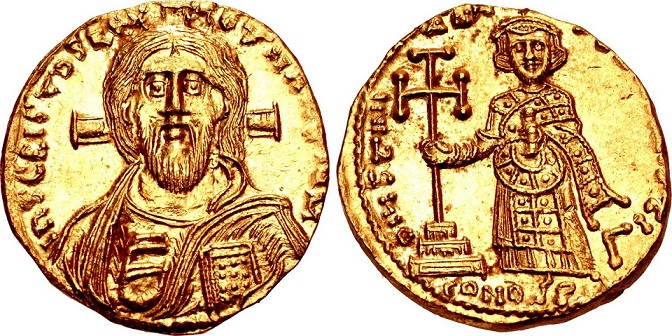 Edited by tdziemia
03/01/2018 4:52 pm
|
|
Moderator
United States
23731 Posts |
I haven't really done any research on it, but I believe the first appearance of Christ on Byzantine coins was during the rule of Michael III (the drunkard) mid to late 800's Mary showed up not to long after. However the Cross appeared very early in the series.
|
|
Pillar of the Community
United States
8052 Posts |
I've also seen St. George, St. Theodore and St. Demetrius on 12th - 13th c. Byzantine coins. St. George's cult spread pretty widely through Europe (he can be found on coins of Ferrara, ,Italy, Mesocco Switzerland, and Friedberg and Mansfeld Germany ... not to mention a latecomer to Britain) But I've not seen the others on Western coinage.
|
|
Moderator
Australia
16991 Posts |
Regarding the secular/spiritual coinage design, I believe this is incorrect. The Romans did not believe in the modern concept of "separation of church and state", but rather, the opposite: the unification of secular and religious authority, in the person of the Emperor. The Emperor was not just "imperator" (commander of the army), but "pontifex maximus" - the high priest of the Roman pagan religion. He appointed priests, took part in major religious rituals and was (in the middle period of the Empire) frequently venerated as a living god, though this tended to happen in the outer provinces rather than in Rome itself, where worshipping people while still alive was usually frowned upon.
Roman coinage was a masterpiece of propaganda: the primary purpose of the coinage design was to convey a message to everyone who used it. Usually the message was along the lines of "with me in charge, you've never had it so good", so symbols of peace, prosperity and military victory were commonplace. These often took the forms of "minor deities" or personifications, purely as an artistic convention rather than a religious declaration: it's difficult to draw what "peace" looks like, so they drew a picture of Pax, the minor goddess of peace.
There are some clear linkages between late Roman and early Christian symbolism: Victory was a minor deity, a pesonification - a winged female, who commonly appeared on coins as propaganda. This symbol eventually evolved into a Christian angel, and it is difficult to tell which one a winged figure on a late Roman or Byzantine coin is supposed to represent.
Back to the subject at hand: many cities and states in mediaeval Europe portrayed on their coinage their "patron saint": a saint whom they believed had a special connection with their city or country. This concept has a different origin but a similar goal to the ancient "local deity": in an age before the invention of jingoistic nationalism, having a locally-specific cult helped give people something to be proud of, something to fight for and in the name of.
Thus, Saint Mark (or his badge, the winged lion) is on coins of Venice (because Crusaders allegedly brought his bones back to Venice); Saint Eugenius is on the coins of Trebizond (they claimed he had been born there); Saint Blasius is on the coins of Ragusa (they claimed to have seen him in a vision that saved the city from invasion), Saint George is on the coins of England and Russia (as the "patron saint of soldiers", he was claimed by several warrior-kings), and so forth.
One should be aware of some "false flags". Coins of Monaco show a robed figure or two that look saintly, but they're not actual saints; those represent the soldiers dressed in monk's robes, who sneaked into the city and captured it in 1297; the current princes of Monaco claim descent from those sneaky soldiers.
Don't say "infinitely" when you mean "very"; otherwise, you'll have no word left when you want to talk about something really infinite. - C. S. Lewis
|
|
Moderator
United States
34549 Posts |
@tdziemia, by diligently reading through my copy of Sear, I can provide you with some information about Christian symbols and Byzantine coins. 1. On the coins of the very first Byzantine Emperor, Anastasius I (491-518 AD) there are symbols of Christianity. Specifically, his coins have crosses, Chi-Rho symbols, and the goddess Victory is portrayed nimbate on some coins and with wings that can only be described as angelic on others. 2. During the reign of Justin I and Justinian I (April to August of 527 AD), both co-emperors are shown nimbate. I believe that this is the first occurrence in Byzantine coins. 3. The first Byzantine Emperor to place an image of Christ on his coins is, as you already knew, Justinian II (during his first reign of 685 to 695 AD). Here is what David Sear says: Quote:
In religious matters he showed his devotion by placing the image of Christ on his coinage, the first emperor to do so. "If you climb a good tree, you get a push."
-----Ghanaian proverb
"The danger we all now face is distinguishing between what is authentic and what is performed."
-----King Adz
|
|
Pillar of the Community
United States
8052 Posts |
@sap, thanks for those insights. I am still thinking the medieval coins might not be so different from the Roman ones in the "propaganda" intent you mention, a difference being that the lord and the bishop are in cahoots on the propaganda. Often, we have a duke or count's portrait (or insignia) on one side, with the reminder that his authority comes from God. On the other side we have the patron saint, who has the ability to intercede in matters where the duke's power doesn't reach. Still something along the lines of "between us, we've got you covered."
@spence. Thanks very much for that list of firsts. What you've pointed out about Justinian I is especially interesting, if I understand correctly. There is a category of royal saints from medieval times (Louis IX of France, Holy Roman Emperor Henry II, Wenceslas of Bohemia and many more), but they have in common being recognized as saints only after their death. I am aware Justinian I is recognized as a saint in the Eastern church. Is this depiction of a current emperor nimbate unique to him? Again, probably my ignorance of the entire Byzantine era is showing.
Thanks to everyone for the good discussion.
|
|
Pillar of the Community
Belgium
1194 Posts |
I think you have to see an image on a coin with the eyes of the century .
In Greek coins , there was a cult in every city for a certain god/goddess . If you make a coin , the most simplest way to recognize your coin is to put your symbol on it : this can be a god/goddess : see Athens , the most beautiful exanple .
A few honderds year later , we have Alexander the Great : from the classical Macedonian coinage of his father , he only keeps his image of Heracles on the obverse , and Zeus on the reverse . He kept Heracles ,because in his opinion , he was a descendent of this half-god , on the reverse , he put Zeus on a trone .The picture of Zeus was common on Greek coins , Baal(=Zeus)on a throne was common in the Persian empire, so the political interest is evident .
For Greek coins , there is IMO not only interest in the religeous importance , but especially a practical interest .
For Roman coins : on every denarius till about 150 BC , you find the head of Roma : Roma is the name of a goddess of the town and of the city of Roma . On AE coins , you find the head of Mercurius ... indicating the value : so the image of the god/goddess had a specific purpose .
For the imperial coins : on the reverses , there are plenty of deities : if you see for what reason and at what time the coin has been emissed , then often you find an historical event that is liable to the representation : pe a Victory ...It was the only possibility to communicate in that time .
In the medieval coinage in Western Europe , there are in my opinion two tendencies . I write only what I see on the coins I have and I know .In Italy , Germany you have images of God or Saints , for Italy , it is normal , for Germany , it is the prolongation of the Roman empire and they took this representation again to make a connection with the Roman empire as heir of Carolus Magnus.
In the dark ages and later in France , they make mention of God on every coin and this until the 19th century .This significance reference to God has made an evolution with the time : in the beginning it accentuated the existence of one God , as in late Roman coins , and this concept/idea evoluated in time over the 12-13th century, where there was no theological problem to the 16th century , where the religious'problems began and resulted in a political war : see the Netherlands , Germany , Switserland .
So I think that every representation of God on a coin has not only a religious sence , but was most of time a practical solution .
I honestly say I don t know nothing of other civilizations , but I think you can compare it with Western Europe . albert
|
|
Pillar of the Community
United States
8052 Posts |
Given the seasonality and the topic of the thread, I thought I would post these today: 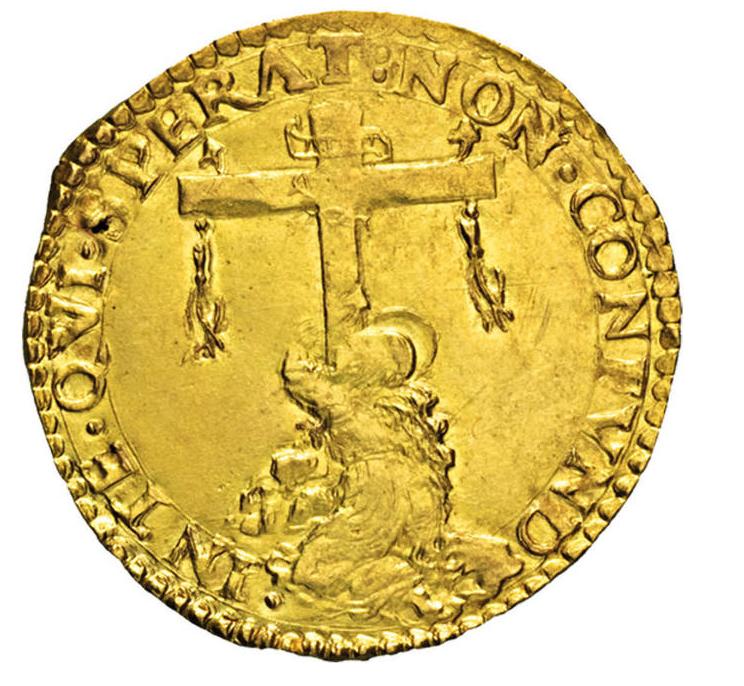 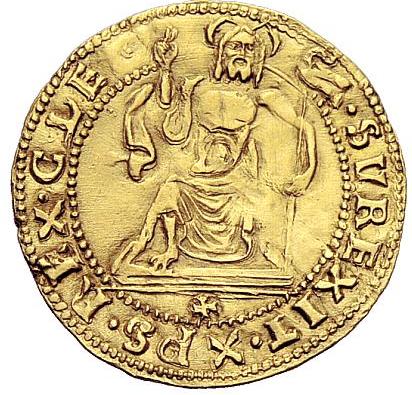 |
|
Pillar of the Community
Belgium
1185 Posts |
Quote:
the first martyr, Saint Stephen, but it's a lot trickier to figure out why he shows up on medieval coins of Metz, Halberstadt and Passau. .... and Nijmegen and Breisach a thread about Sanctus Stephanus Proto Martyr would already be very cool https://www.coingallery.de/Heilige/S/Stephanus.htm |
|
Pillar of the Community
United States
8052 Posts |
Thank you for that great link, 1c5d! However, I will need to get it translated, as German is not one of my languages. The medieval iconography of St. Stephen includes some things that are generic to any saint (the halo), or to martyrs (holding a palm frond). Then there are things that are specific to the position of St. Stephen in the church (deacon): his haircut, his vestments, and the presence of a book. Last, there are the instruments of his martyrdom (he was stoned to death). On the second Halberstdt bracteate, and on the Breisgau dicken, we see a scene of his stoning. In several of the thalers, he holds three stones. The Serbian example stands out as the only one where he his holding a book. I wonder if this could have been some laziness on the part of the moneyer? This is a well-known type borrowed from Venice, in which the doge is depicted being blessed by St. Mark, who (as an evangelist) was depicted carrying a book. It looks as though this was copies closely, and only the legend was changed to indicate it is St. Stephen. The only one of these in my collection is the Metz gros, which unfortunately is the least rich in symbols (but also the least expensive to acquire  ) |
| |
Replies: 27 / Views: 6,108 |
To participate in the forum you must log in or register.
Disclaimer: While a tremendous amount of effort goes into ensuring the accuracy of the information contained in this site, Coin Community assumes no liability for errors. Copyright 2005 - 2026 Coin Community Family- all rights reserved worldwide. Use of any images or content on this website without prior written permission of Coin Community or the original lender is strictly prohibited.
Contact Us | Advertise Here | Privacy Policy / Terms of Use
|
| Coin Community Forum |
© 2005 - 2026 Coin Community Forums |
| It took 0.53 seconds to rattle this change. |
 |
|
| |
| |







 Posted 03/01/2018 12:29 pm


