| Author |
 Replies: 17 / Views: 2,818 Replies: 17 / Views: 2,818 |
|
Rest in Peace
10197 Posts |
Every single 1889 "V' nick I have and the few others I've seen have all been dark, seemingly affected by some form of ED. I spent a bit on these two, attempting to "clean" them. I did use some harsh methods including chemicals and steel wool! This was a test to see just how much of the metal was effected...just the fine surface or deeper. Only thing I can conclude is it is the metal itself that has changed, not just surface level corrosive effects. Maybe I just happen to have some involved in a fire, heat changed, IDK. Or is this something possibly related to planchet materials? Any experiences here like this? 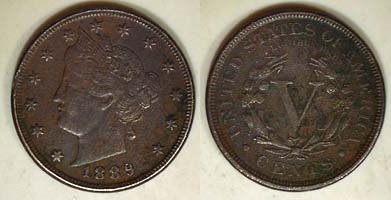 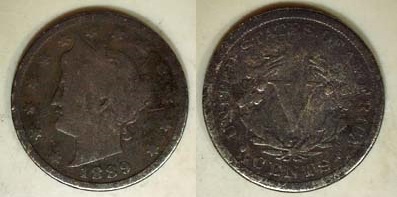 |
|
|
|
Moderator
 United States
34539 Posts |
@crazyb0, while I understand what you were hoping to accomplish, I still need to give you a head slap for the use of steel wool on your two coins.  My 1889 V nickel is in pretty poor shape (completely slick on the rev), but does have a pleasant grey color. I'm sure someone more knowledgeable than I am can weigh in on whether the mint had any transient issues with feed stock alloy variation in 1889, but as a n=1, mine seems to be ok. 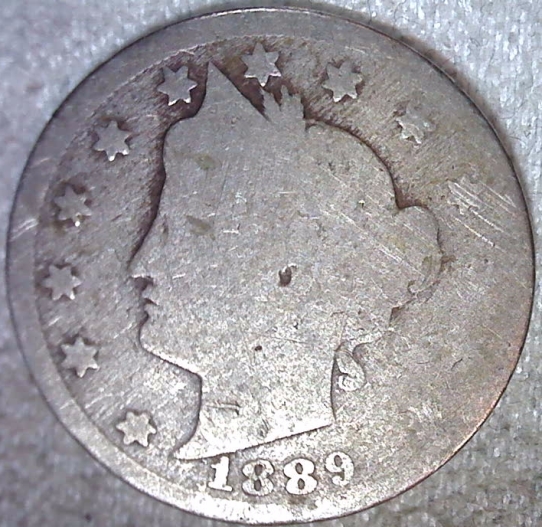 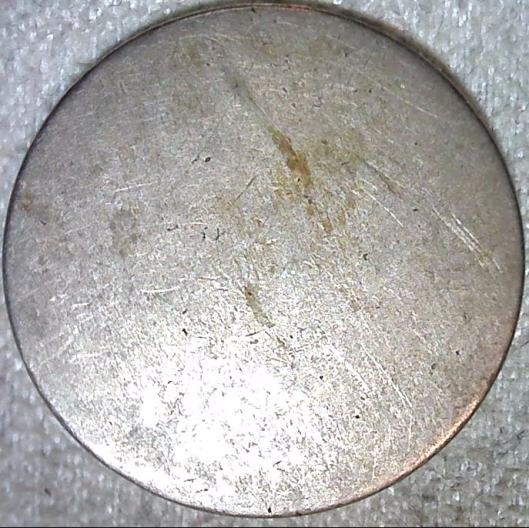 "If you climb a good tree, you get a push."
-----Ghanaian proverb
"The danger we all now face is distinguishing between what is authentic and what is performed."
-----King Adz
|
|
Rest in Peace
United States
18456 Posts |
I too have some dark colored V-Nickels but also some Buffalos that display the same thing . I can only theorize that the copper and Nickel composition of them in early years didn't fare to well in natural or unnatural environment . If I'm wrong then someone please explain why this happens .  |
|
Rest in Peace
 10197 Posts |
Quote:
This was a test to see just how much of the metal was effected Dave, I said test, I am a big boy, I know what I am doing! As far as I am concerned these are culls anyway and will be replaced ASAP with a better, natural one if found and the old one scraped unless someone wants a "hole-filler details coin. In science, a subject must at times be sacrificed to determine the premise! |
|
Moderator
United States
34539 Posts |
Quote:
I am a big boy Yep I know dude, but I still gotta cry a tear for a coin 129 years old being scrubbed like that. I hope that we get to the bottom of your question as more folks weigh in!  "If you climb a good tree, you get a push."
-----Ghanaian proverb
"The danger we all now face is distinguishing between what is authentic and what is performed."
-----King Adz
|
|
Rest in Peace
10197 Posts |
Dave, LOL, look what we do to clean the ancients! and that isn't called "drastic"!
|
|
Moderator
United States
34539 Posts |
Ok yep point taken. To bring us back to your question about how much of the metal was affected and therefore dark...one destructive test that we could do is to section the coin and then perform metallography on that section: embed it in Bakelite, sand, polish, and then etch the cross section of metal to see if the grain structure changes from the surface to the inside. Additionally, we could put the mounted specimen in a Scanning Electron Microscope and perform an elemental analysis on different regions (such as near the surface and then roughly in the middle). In this way, we could see if the alloy is noticeably different. We could even take microhardness measurements across the coin to see if the heat treatment was complete or only affected the surface (to be honest, I'm not sure that the planchets for these nickels were heat treated, so that is somewhat of a theoretical possibility). I'll dig around tomorrow in the scientific literature and see if I can find someone who has already done this for V nickels (there was a time when I had access to much of this equipment, but those days are behind me). "If you climb a good tree, you get a push."
-----Ghanaian proverb
"The danger we all now face is distinguishing between what is authentic and what is performed."
-----King Adz
|
|
Rest in Peace
10197 Posts |
Thanks Dave, that's kinda what I was asking, I too have other older nickels, Shields to Buffalos that have the dark deal, and as so often are just lumped into the ED category. Where they may well belong, but after playing Garage imp myself over the years, heat does may things to coins other than shrivel like prunes! Darkening through a partial temper is an effect I did on Jeffersons but it is my understanding both process of manufacture and materials were a bit different by then...I no longer can prove that on older coins now by destroying a few Buffs!
Edited by Crazyb0
04/22/2018 01:27 am
|
|
Bedrock of the Community
United States
20753 Posts |
I too have had many different Nickels that have turned dark to really dark. I've tried Acetone, Lacquer thinners, Alcohols and even stuff like Lemon Juices to attempt to get rid of that dark tone. Nothing works. I suspect that the darkness goes all the way through the metal. These were all really coins in bad shape so experimenting seamed OK.
|
|
Bedrock of the Community
United States
94367 Posts |
Late to the picnic, but must say in 50-odd years of collecting I've certainly seen a lot of dark V-nickels, but certainly that number is in the tiny majority. They seem to occur about as often (proportionately) in the Shield nickel series. Having dug more than a few similar Buffalos, I've always just assumed this darkness was primarily due to ED. Are you suggesting this phenomenon is more frequent in V-nickels?  |
|
Rest in Peace
10197 Posts |
Frog, not necessarily among strictly V nickels, for yes, ED and heat can effect any composition nickel, particularly the older ones. My question zeroed in on the 1889 year specifically. I have seen more dark samples in the past few years, yes some lighter but far less frequent. My question relates to actual planchet composition, could this be a factor on specific years or periods? 1890's are often dark as well. Just my head scratching... |
|
Bedrock of the Community
United States
12057 Posts |
It is certainly possible that the planchets used for coins struck in 1889 and 1890 were of inferior quality and contained more impurities or contaminants in their alloy. This would explain why it only effects V nickels since they were the only coin using that composition in 1889 excluding the ultra-scarce 1889 3 Cent Nickel piece. The composition was 75% copper and 25% nickel. Nickel itself is an interesting and unusual element. Nickel-bearing sulfide minerals such as pyrrhotite and pentlandite (with iron) are often found alongside chalcopyrite (an ore of copper) and stannite (tin ore) as products of the decomposition of cooling sulfide melt deposits, along with stibnite (antimony) and other minerals. The early smelters and refiners discovered nickel mostly by chance mainly because its presence and that of antimony in the mined ore stocks kept frustrating their attempts at smelting good copper. Joseph Wharton's mine, conveniently in Pennsylvania (now Nickel Mines, PA) was the largest producer of nickel in America (and the only one of any significance) in the latter part of the 19th c. By the late 1880s, the pyrrhotite ore veins in the Pennsylvania mines had been largely depleted of high grade ore, and the quality of the remaining ore was noticeably poorer and more difficult to extract, with higher proportions of undesirable components such as arsenic and lead making refining and smelting at the New Jersey Wharton furnace a dangerous and increasingly unprofitable challenge. Since Wharton's mines were the main supplier of the US Mint, and had been since 1865-1866 when he convinced the US (and the world) of the desirability of copper-nickel coinage, it is likely that the Mint would have noticed the increasingly poor quality of the bar stock being purchased for making planchets. Furthermore, the development of producing nickel mines in South America and the discovery of large workable deposits near Sudbury (Ontario) created supply pressures on the price of Wharton's nickel; by 1893 Wharton's mines were boarded up and mostly backfilled with the tailings. There was additionally a collapse in copper prices in the late 1880s after collusion and price-fixing among firms and traders was broken up, which led to further economic damages since copper was "right there in the mix" with nickel mine output. I can't prove it but I suspect that the "dark nickel" problem in these years may be related to that same inadequate ore from Wharton's nickel mines and the resulting difficulty in smelting clean ingots and bar stock due to high levels of other sulfide contaminants (e.g. arsenopyrite, nicollite/nickelene) which may have darkened the color of the alloy by their presence. A metallurgist, chemist, or assayer might be able to contribute more on that subject; you could do XRF or spectroscopy to assay the quality of the alloy used for planchets in those years and differentiate their elemental composition. Member ANA - EAC - TNA - SSDC - CCT #890 "Most of the things worth doing in the world had been declared impossible before they were done." -- Louis D. Brandeis Edited by paralyse
04/24/2018 10:59 pm
|
|
Rest in Peace
10197 Posts |
Paralyse, thank you. That give a reasonable and feasible answer to my question. I unfortunately have no access to such equipment nor financial resources necessary to further delve into this hypothesis tho. Ever since considering the hypothesis of cobalt content being a possibility of the Bluish/black luster of the Jefferson anomaly "Black Beauty", I have considered the different alloy problems that possibly may cause peculiar effects. Great info, thanks.
|
|
Bedrock of the Community
United States
12057 Posts |
You're welcome. I'm no expert, but a hobbyist mineral collector.
Cobaltite (the main ore of cobalt) is reddish-silvery white to gray in color. Cobaltite (and many other pyrites and related minerals) are found with copper and nickel; however, the trademark "cobalt blue" color as used in glassware and ceramics is a blue powder made from combining cobalt + aluminum oxide (alumina) at high temperature and pressures.
(You can make it yourself for use in pottery and ceramic crafts provided you happen to have convenient access to a 1200 degree (Celsius) ceramic pressure sintering setup...gee, who doesn't have one of those in the living room?)
Member ANA - EAC - TNA - SSDC - CCT #890 "Most of the things worth doing in the world had been declared impossible before they were done." -- Louis D. Brandeis |
|
Pillar of the Community
United States
4233 Posts |
It's interesting that when you search sold items on Heritage, the majority that jump out as "black" are proofs.
|
|
Rest in Peace
10197 Posts |
kbbpll, I think you are seeing a "reflection" of the product, if you catch my drift!  |
| |
Replies: 17 / Views: 2,818 |










 Posted 04/21/2018 9:34 pm


