| Author |
 Replies: 64 / Views: 8,550 Replies: 64 / Views: 8,550 |
|
Valued Member
United States
160 Posts |
Hello all. I am a metal detectorist and -- as such -- a "mild" coin enthusiast (though certainly nothing close to a "numismatist" with the experience of most of you here). My questions surround "war" nickels. I'm familiar with the basic facts surrounding these nickels, when/why minted, etc., and that the "stated" composition that was arrived at (though apparently Congress originally approved a 50% silver, 50% copper alloy for the "war" nickels) was a 35% silver, 56% copper, 9% manganese alloy. Apparently, this alloy was the one ultimately chosen, as it was apparently an alloy that would work properly in vending machines, as I understand it? In any case, on a metal detector, a "war" nickel will generate an ID number very, very close to a "regular" 75% copper, 25% Jefferson nickel -- i.e. within about one ID number (and this is consistent across metal detector brands/models). This ID number is MUCH lower than where a dime, or pre-'83 95% copper penny, will ID. HOWEVER, and this is where it gets interesting, there are rare occasions where a detectorist will receive an ID for an in-ground target that suggests a penny/dime type target, and upon digging, it very surprisingly turns out to be a "war" nickel. As I said, this is rather rare, but there are nonetheless many documented cases from many states, where these extremely high-reading War Nickels have been found. For instance I can document that twice this year, one of my detecting partners has found TWO of them (both 1943) that were ID'd by his detector up in the "penny" range. He later tested both of them, out of the ground, on a DIFFERENT detector, to verify the readings. I can state with near certainty that this is almost positively suggestive of a different metal composition within a small subset of "war" nickels. Metal detectors operate on the principle whereby they receive, and then "read," an electromagnetic field generated by electrical "eddy currents" that have been induced on the surface of a metal target by the electromagnetic field transmitted by the detector. In other words, The detector transmits EM energy, and when that energy contacts a metal object, electrical current is induced in the object. This object's "eddy current" then generates its OWN electromagnetic field, that is DIFFERENT from the field transmitted by the detector. The detector receives this "new" electromagnetic information generated by the metal target, and through the "magic" of electronics and software, "computes" ID information about the target. So, bottom line, the metal detector's ID of a target is (roughly speaking) a sort of "conductivity measurement" of whatever metal/alloy the target is composed of. Based on how detectors operate, and based on my experience in both the hobby of detecting and in my career as a scientist, the only logical explanation I can hypothesize for this, is a metal alloy in these "high-reading" War Nickels that is substantially more "conductive" than the copper/silver/manganese alloy. My GUESS is that some nickels WERE minted with that 50% silver/50% copper alloy that Congress originally approved (or perhaps a "mistake" in the creation of the alloy in certain batches of planchets, where the manganese was barely, or not at all, included). That would completely explain the "high ID" characteristics of this "rare breed" of War Nickels; I can confirm that silver/copper alloys read "high" on a metal detector, while the normal copper/nickel alloy of regular Jefferson nickels reads "low." Also, like a copper/nickel alloy, the silver/copper/manganese alloy that was "officially" used in "normal" War Nickels also reads "low" on a detector. The reason that I bring this up is that I have never seen any information stating that there were ever any War Nickels minted with any alloy ASIDE FROM that copper/silver/manganese alloy. So, I was hoping that someone here has some information to that regard, and could shed some light on this. Perhaps this is a "known" fact in numismatic circles, and I'm just ignorant. However, if not, and if no one knows of any "official" information that a different alloy was ever used, I feel I may be onto something here, because I would state with 99% certainty that there absolutely are some reasonable number of "war" nickels out there that are of a different, or at least incorrectly forumulated, alloy -- presumably the silver/copper alloy WITHOUT the manganese (or at least, a lesser amount of manganese). They are rather rare, judging by the frequency they are found by detectorists, but not EXTREMELY rare (as they are found MUCH more often than, say, a 1916-D Mercury dime...) Thoughts? Steve Edited by sgoss66
05/22/2018 08:07 am
|
|
|
|
Pillar of the Community
United States
1696 Posts |
Wouldn't it be simpler to assume an error on the part of the detector than an error on the part of the US Mint? In my metal-detecting days, I also was surprised to get strange readings for War Nickels. |
|
Moderator
 United States
56855 Posts |
What are the chances that the coin would change composition from being in the ground? John1  |
|
Bedrock of the Community
United States
62064 Posts |
Edited by coop
05/22/2018 2:01 pm
|
|
Pillar of the Community
United States
6130 Posts |
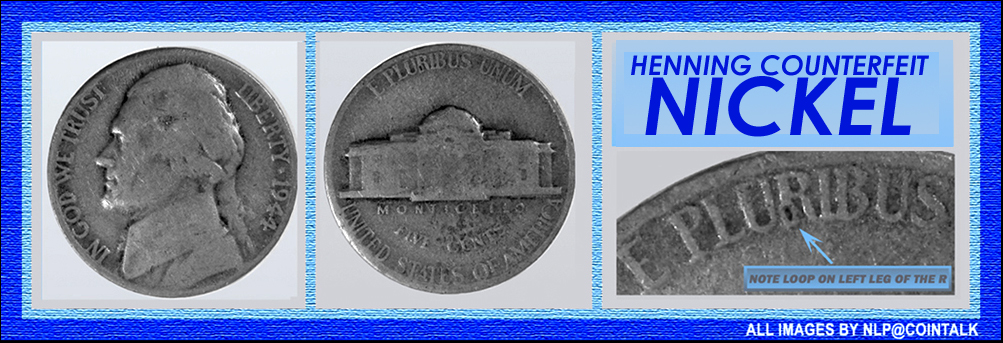
Do you have any images to share? War Nickels are rather characteristically a light charcoal grey, presumably from the manganese. A 50/50 nickel would be a markedly different color, just like any of the .500 fine silver coins used anywhere in the world. A jewler would be able to test it easily. The first thing that pops into my mind is a Henning nickel - made by a "genius" criminal in the early 50s who rigged up a garage minting operation to mass-produce nickels for like 1 cent profit per coin. He forgot to put a mint mark on the 1944s he made, and got busted pretty quick, but not before he got tens of thousands of coins into circulation, and not before he managed to hide up to a million more that still are not accounted for. His composition, IIRC was about 80% copper, 15-19% nickel, and the balance iron. He was only prosecuted for the 1944 nickels, but we now know he made other dates that are not so easy to detect. |
|
Bedrock of the Community
United States
62064 Posts |
|
|
Bedrock of the Community
United States
17884 Posts |
Would the eddy currents and EM signal of the War Nickel possibly vary depending on the physical orientation of the nickelto the field generated by the detector coil? For example laying flat as compared to on edge, and if on edge parallel to the coil field or perpendicular to it. Would an oblique angle affect it? |
|
Pillar of the Community
United States
2376 Posts |
Depending on ground conditions , I'm sure , different halo sizes that have developed around the individual nickes plays a factor
|
|
Valued Member
 United States
160 Posts |
THANKS for all the replies, folks! Here is a pic, for those who asked, taken by my hunting partner earlier this year -- the day he found it. 1943-S (interestingly, both of the high-reading ones he found this year were 1943-S; I found one a week ago that was 1945-P, but it read "normally" -- like a nickel...I'm not sure if the "high-reading" ones are all from the same year, or same mint facility; I haven't compiled that data yet).  Aristarchus -- no, it's not an error on the part of the detectors. Today's detectors are pretty good -- and these specific, high-reading nickels have been verified by different brands and models of machines. I am 100% positive this is not a mistake on the part of the detectors. John1 -- I think that is not a complete impossibility, but almost certainly not the reason for a detector reading certain of these nickels "high." First of all, I have dug thousands of coins -- ranging from those that have been in the ground over 200 years, to those dropped very recently. With only very few exceptions (zinc-based Memorial cents which will "decay" in the ground, and thus their ID as reported by a detector will change), being in the soil -- soil of ANY type -- doesn't change the way a coin "reads" on a machine to a significant degree (from a "coin-altering" perspective). BUT -- the bigger "proof" that it's not the soil is this...if it were soil affecting the coins chemically, you would expect ID readings on the machine to be "all over the map," each time you dug a War Nickel, depending upon the different soil effects on the coin. Instead, what we see is a coin that either ALWAYS reports with low "nickel-type" numbers, or ELSE, on rare occasion, ALWAYS reports with high "penny-type" numbers. On one machine I use for instance, users of this machine report War Nickels to read 13-14, EXCEPT for this one "rare breed" of War Nickel, which always reads 24-26. That's it, no "in between" IDs... coop and Finn -- the Henning counterfeit angle is interesting; I have heard of the Henning counterfeits before, and I guess that's one possibility. The issue I have with that is that these are definitely found more frequently by detectorists than, say, a 1916-D Mercury dime, and those dimes had about 264,000 mintage; based on the rate these "strange" War Nickels are found, ratios would suggest a MUCH larger mintage than the 1916-D. Still, this may be at least one POSSIBLE explanation. Conder and Stoneman -- YES, the orientation in the ground can slightly affect the way a detector reads it, and soil conditions can also have an effect on in-ground ID readings of coins. However, I know of several of these "high-reading" War Nickels that were then tested OUT OF the ground, lying flat (what we detectorists call an "air test" -- which is a way of getting a "standardized" reading on a particular coin), and they still registered a "high" ID up in the penny range. Again -- and please don't think I say this lightly -- I am nearly 100% certain that what is going on here are "war" nickels minted with a DIFFERENT alloy than the "official" 35% silver, 56% copper, 9% manganese. I really believe the detecting community is "onto something" here -- and it may be something not previously known in numismatic circles? There may have been no reason to ever suspect, and thus test for, such a thing. Steve Edited by sgoss66
05/22/2018 11:36 pm
|
|
Valued Member
United States
254 Posts |
I can imagine that the sheets that the blanks were punched out of had slightly different composition,we've all seen cents that were close to bronze
|
|
Valued Member
United States
160 Posts |
Giwalsh -- I agree, but "slightly different composition" won't be enough to result in the differences being seen by the detectors. For instance, 99% of all Jefferson nickels I dig with one particular machine I have will "air test" at solid 13. I dug one about two weeks ago that was a solid 12. No matter what I did, it air tested 12. Period. I could -- and have, in my mind, chalked THAT up to "slightly different composition" arguments. But, the idea that 90-some percent of all War Nickels read as "nickel" readings, by various machines, across various machines, by various detectors, in various types of soil OR in air tests, and then there are this small subset that read solidly like a penny... There is something else going on here, and I am willing to put money on the idea that SOME of these have been minted WITHOUT the manganese... If this has never been officially known/recorded in U.S. Mint documents, or has never been discovered by numismatists, then to me, this is something significant for the numismatic community. Of course, this could be verified with XRF -- but that's expensive, as far as I know. If there was a way to have that done "free," for "posterity's sake," in the interest of the numismatic community, I am certain I could get my hands on one of these unique "specimens." My hunting partner who has a couple of these has already said he'd send it to me, if I could find a way to have this tested/documented... Steve |
|
Bedrock of the Community
United States
62064 Posts |
There is a test that works that won't cost much at all. It is called a tissue test. When you take a single layer of facial tissue and lay it over the coin, the more silver coins will show a whiter color: 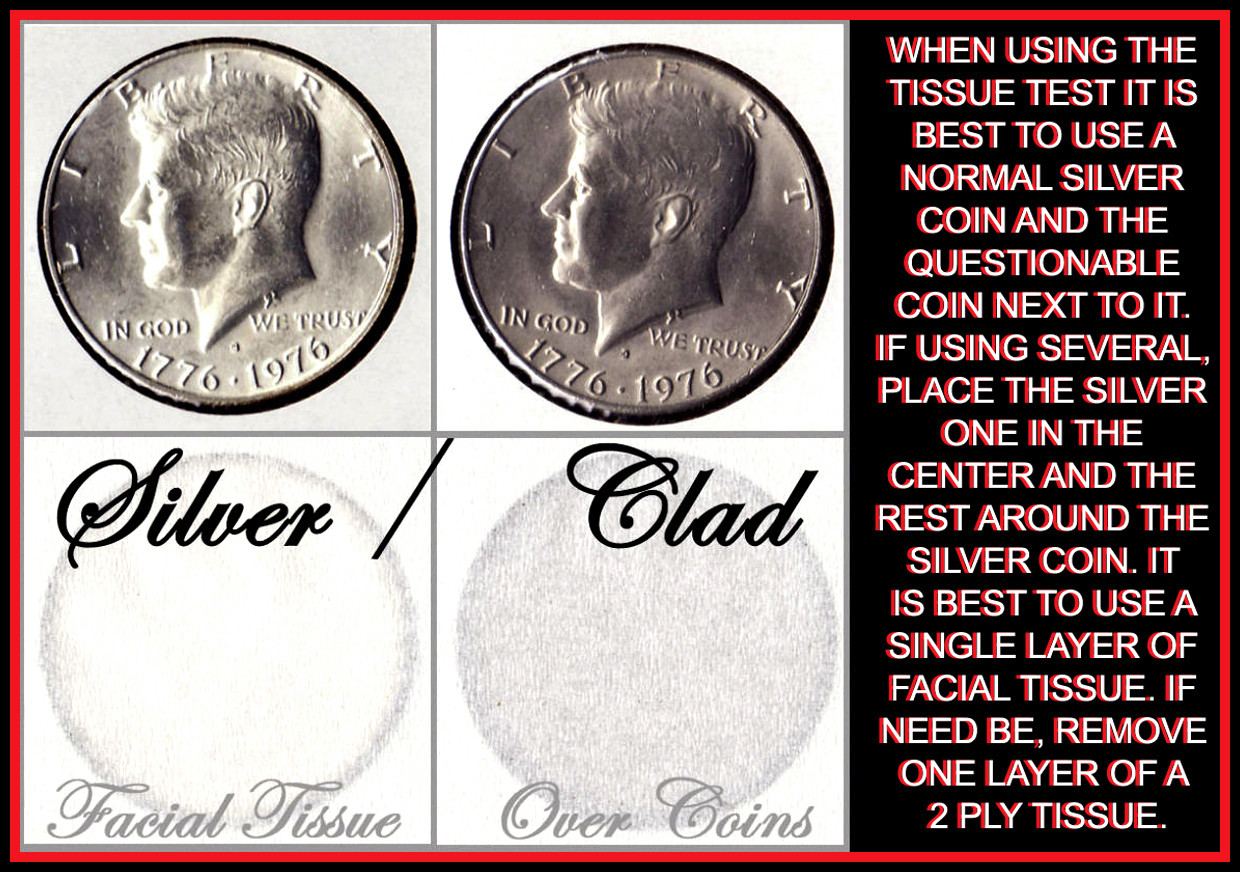 as long as the coins are silver colored, this might be an inexpensive to tell if they are silver or not. You can't use toned coins/stained coins. They need to be white in color. This might save a lot of money with this test. |
|
Valued Member
United States
160 Posts |
Interesting, coop. I had not heard of that test. I am almost certain that these "odd" coins are definitely a different alloy, and my hypothesis is that they are missing the manganese. This is what I'm seeking to prove. Tell me this -- I am interested in opinions here. IF I am correct in my hypothesis (and I am going to be pursuing this -- including collecting a database from detectorists as to dates and mint marks of any of these "high-reading" nickels), and presuming I eventually could PROVE it, would this finding (that some coins were minted of, say, a 50/50 silver/copper mix without the manganese) be a significant, new finding in terms of numismatics, and the numismatic community? Or, would it likely be no more than a "ho-hum," minor thing that garners very little interest? To me, it would seem to be potentially pretty substantial, if it could be shown conclusively to be the case. There would be some interesting history there, I would expect, and it would suggest a small, rather rare batch of coins in existence that were previously unknown, in terms of alloy composition. I would THINK that these "different alloy" coins -- if proven -- would then become more "collectible" than "regular" War Nickels, and thus of higher value, sort of like a "mint error" type of thing. But I could be way off base here. Certainly, if this has the potential to be somewhat substantial, numismatically, it would push me to continue to pursue this until I have "answers." Steve Edited by sgoss66
05/23/2018 01:29 am
|
|
Rest in Peace
10197 Posts |
It seems that composition of 50% silver would be more costly to produce than a copper/blended material. I'll toss in the "theory" of the 1950's Black's Beauty. These are thought to contain more trace elements of cobalt than other mixes/of alloy plate stock. The jury is still out, a full spectrum analysis is needed to determine if they are indeed a miss-matched mix or as some think an annealing error. This effects color, I have no idea or way to test with a detector either way. The only way to prove your hypothesis,would be through a core samples analysis and elemental breakdown in comparing a standard War Nickel, yours and good in the post war composition for good measure. That would be interesting to note. It can be proven. As to whether it is a big deal, probably not UNLESS you can definitively prove a higher silver content. Us war nick hoarders would go ape **** over that!  |
|
Valued Member
United States
160 Posts |
CrazybO -- I never have heard of a "Black Beauty," so it looks like I have some Googling/reading to do! YES, I agree, the 50% silver coin I am hypothesizing would have been more expensive to produce than most other alloys, with lesser silver composition. BUT -- the interesting thing is that apparently, when the need to remove nickel from the "nickel" for the "war effort" was decided upon, requiring the U.S. Mint do produce a "different" nickel, the type of coin Congress initially authorized was (apparently, according to what I've read) a 50% silver/50% copper "nickel" (or, in the "fine print," some other mix of metals, as necessary). SO -- based on the legislation passed by Congress, such a "50/50 War Nickel" WAS "legal;" whether or not some were made that way is the question. But, this -- and the way the "high-reading" War Nickels register on a detector, is why I am hypothesizing that some WERE made 50/50... The other possibility (at least one of them) would be that these "high-reading" War Nickels were still 35% silver, but 65% copper (i.e. with copper replacing the 9% manganese). That would still give a coin that would "read high" on a metal detector. And yes, for a " War Nickel" hoarder, higher silver content WOULD matter. But it sounds like at least in your opinion, there would not be much numismatic significance if it were suddenly discovered that some "small" number of " War Nickels" were minted from a different alloy, but which was thus far unbeknownst among numismatists? Steve Edited by sgoss66
05/23/2018 02:59 am
|
|
Rest in Peace
10197 Posts |
Here's some info on Black Beauty's:(why I know so much  ) http://goccf.com/t/288744Numismatic interest, some, but as such a niche interest I would imagine. You might pose this question to some real "experts" in the field, particularly of error coins, I suggest Mike Diamond at http://www.error-ref.com for one along with JC Stevens may be able to add insight and direction for you. It is , well to me, an interesting train of reasoning. These anamolies may be as/you say short on a substance or possibly long on another. The reason cobalt was thought to be a possibility is it can be a part of the mined nickel, from specific areas of the world(source) or the addition of other elements (alloy). Plate stock has been know to vary, especially with a variety of contracted suppliers. Keep at it, I'm pretty sure tho some of those high ping finds will have to be martyred to get to the bottom of this!  |
| |
Replies: 64 / Views: 8,550 |
To participate in the forum you must log in or register.
Disclaimer: While a tremendous amount of effort goes into ensuring the accuracy of the information contained in this site, Coin Community assumes no liability for errors. Copyright 2005 - 2026 Coin Community Family- all rights reserved worldwide. Use of any images or content on this website without prior written permission of Coin Community or the original lender is strictly prohibited.
Contact Us | Advertise Here | Privacy Policy / Terms of Use
|
| Coin Community Forum |
© 2005 - 2026 Coin Community Forums |
| It took 0.44 seconds to rattle this change. |
 |
|







 Posted 05/22/2018 09:20 am