| Author |
 Replies: 29 / Views: 3,175 Replies: 29 / Views: 3,175 |
|
Valued Member
United States
405 Posts |
It looks like pre to me because the design elements show within the gouge and I would expect that if it was post-strike damage, that would not be the case. My best guess is a piece of excess metal was rolled into the planchet and later fell out prior to strike? 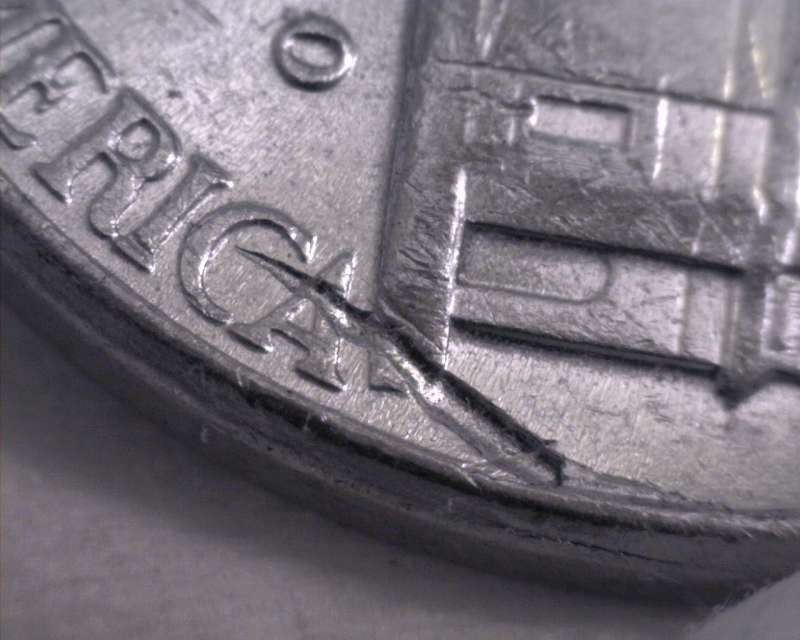 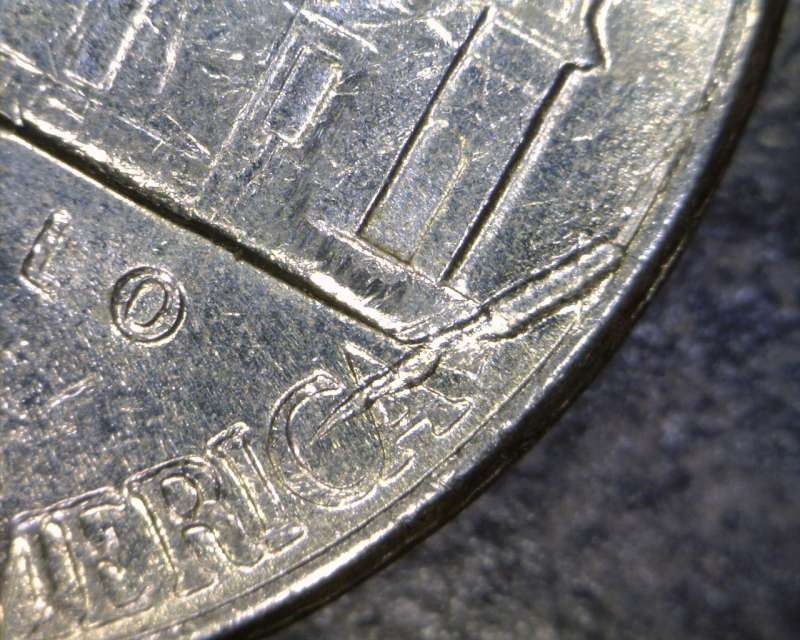 Edited by seattleMD
06/23/2008 9:33 pm
|
|
|
|
Moderator
 United States
6563 Posts |
Looks like a very Large die crack.
Looking forward to some other opinions on this one
|
|
Valued Member
 United States
405 Posts |
To be clear, it's a gouge - not a mound (as would be present in a die crack).
|
|
Bedrock of the Community
United States
62064 Posts |
Looks like a strike though error. Maybe wire from cleaning/polishing the dies.
Edited by coop
06/23/2008 12:18 pm
|
|
Valued Member
United States
405 Posts |
Coop - how to tell the difference between a strike-through like you mention and a gouge that was already in the planchet prior to the strike (as in the case where a piece of stray metal was rolled into the coin and fell out prior to striking)?
|
|
Bedrock of the Community
United States
62064 Posts |
A gouge will only affect the fields, not the devices. In the case of the strike through wire, the fields & devices Are affected. The wire usually only makes it through one strike as it sticks to the planchets as they are softer than the die. The metal on the planchets indents and the die isn't affected as the steel in the die is stronger than the planchet.
|
|
Valued Member
United States
405 Posts |
I don't understand how a gouge would not affect the devices. Wouldn't the devices require metal to be available evenly across the planchet so that when struck, the metal flows into the die and the devices fully form? If a gouge is present, there would be no metal to press into the die at the gouge location. Right?
I need some playdough and a die :)
|
|
Rest in Peace
United States
1943 Posts |
Post mint damage gets my vote. Between the base of Montecello and the rim the gouge has an edge higher than the field. Also I think I can see design lines in the gouge at the A and at the building base. I wouldn't expect to see this if the planchet was gouged before striking.
|
|
Bedrock of the Community
United States
62064 Posts |
The out side edge of a die is the fields. When a clash or a cleaning or damage happens to a Die, The fields are the part this happens on. The devices are located on the inside of the die. You have to think like a mirror on this. The lowest point on a coin is the fields, these are on the outside of the die. The devices shape the metal into the higher points of the die. So they are recessed into the die. If you look at a die, the devices are reversed and sunk into the die. So when a gouge happens it usually only affect to outer part of the die. The devices are hidden into the die where contact usually doesn't happen.
|
|
Pillar of the Community
United States
3640 Posts |
I'm curious. If a Cud extended out to the devices would it not also cover them ? If so, then I call it a Cud. If not I still think strike damage. I notice the terms Pre / Post mint damage mentioned a lot. Not being a wise guy but if it was pre mint damage that must mean something happened to the materials on the way to the mint. Long before any striking was done. Maybe change that Pre mint term to strike damage. |
|
Rest in Peace
United States
1943 Posts |
Coop, I understand what you are saying. But I think you are talking about a gouge in the die. I was referring to a gouge in the planchet before it was struck.
|
|
Valued Member
United States
405 Posts |
pyrbob, I think that is the point of confusion as well. We were talking about a gouge on the planchet and Coop was talking about a gouge on the die itself.
There are definitely design lines in the gouge, but per my original post, I'm not sure how these would be there if the damage was post-strike / post-mint. If anything I think they would indicate the opposite as post-strike damage would not leave behind remnants of the strike in the walls of the gouge - the walls would be uniform matching the contour of the object that gouged the coin. Notice also the the gouge narrows at the point where the devices are, which would hint at metal attempting to flow into that recessed area of the die.
Edited by seattleMD
06/23/2008 3:12 pm
|
|
Rest in Peace
United States
1943 Posts |
I have been thinking about this and if the finished coin was dinged by something softer than the coin itself (aluminum maybe?) then it would leave a mark. It would hit the higher devices first (the A and the building base) and as the softer material traveled into the coin would be damaged as well as the coin. It would not push into the devices as deep as the field because it would be deformed here first. The devices ( the A) would leave an imprint in the softer material before it hits the field so that when it continues into the field and then comes out it leaves a slight impression of the devise. Also it would push metal up at the mark it makes which is what I see on the coin at the edge of the gouge. This is wordy but I didn't know how else to explain it. I still think post damage. Does this help?
|
|
Valued Member
United States
405 Posts |
I see what you're saying which would be indicative of an item being pushed vertically into the coin's face. I had been thinking along the line of an object being dragged through the face horizontally across the face. I still feel it's pre-strike damage and I don't see the raised edges that you refer to -- i'll check it out when I get home and take some inclined photos to show any elevation that might be there.
|
|
Bedrock of the Community
United States
62064 Posts |
Seattle: I'm talking about the movement of metal by the softest item, which would be the planchet. The steel wire and the steel dies would not yield. The coin would have a mark the length of the wire through both fields and devices as the planchet would give first. The die would remain un-damaged, the obstacle (Wire or what ever) would probably stick to the planchet or drop off after striking. The rest of the run of coins would not show that mark as the die remain un-changed.
|
|
Valued Member
United States
405 Posts |
I understand that Coop - my question to you was how to tell the difference between a strike-through and a gouge that existed on the planchet prior to being struck with the die?
|
| |
Replies: 29 / Views: 3,175 |





 Posted 06/23/2008 12:05 pm





