Quote:
Although interesting, your math is suspect. How do you have a result with two more digits of uncertainty than the reported value?
The simple answer is that I did not try to round off consistently (sorry).
Quote:
In fact, show your work - would love to know how you came up with this.
I can show my work - but just from my notes, so may not be intelligible to someone looking at it.
The first bit of data I needed was the thickness of the clad layers along with the tolerances. I found this in the patent:
United States Patent Office 3,466,157
Patented Sept. 9, 1969
COMPOSITE METAL CONTAINING COPPER FOR CONAGE PURPOSES
Philip B. Neisser, Alexandria, Va., and Morris V. Boley, Bethesda, Md., assignors to the United States of America
as represented by the Department of the Treasury Filed Oct. 22, 1965, Ser. No. 502,738 Int, C. B23p 3/20
U.S. C, 29-199 13 Claims
Filed Oct. 22, 1965
This was also my source of information for the composition of the clad layers and the tolerances of the ratios of the metals in the alloys.
I found that the cupro-nickle clad dime and quarter and the silver clad half were included. However, the cupro- nickel clad half was not included, so I made the assumption that the thickness would be the same as for the silver clad half and the composition would be the same as the dime and quarter cupro-nickel clad.
This information pertains to the composite strip out of which blanks are punched. When transposed in terms of weight, I assumed that information would carry over to the minted coins. The thickness of the composite strip is not as thick as the minted coins because those coins have been through the upsetting mill which created a rim thicker than the composite strip.
The weights of the elements come from the densities of those elements from the Periodic Table in g/cubic mm.
So here are some representative notes which I kept as I was doing the calculations:
Quote:The thicknesses of the elements of the composite strip out of which blanks are punched:
Dime clad layer (75% +/- 2.5% Cu and 25% +/- 2.5% Ni) = 180.34 µm (+/-25.4 µm)
Dime Copper Core (pure copper) = 688.34 µm (+/- 25.4 µm)
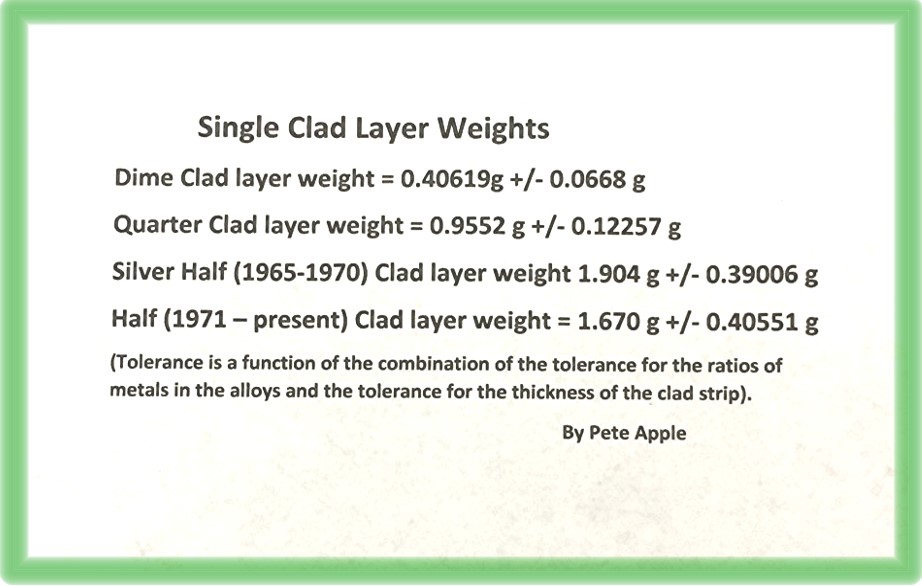
Total weight, one clad layer Dime = 0.5433 g
Diameter = 17.91 mm (17910 µm) Area = 251.80 mm² Vol = 45.41 mm³
Clad layer weight = ~0 .4250 g (Calculated by deduction)
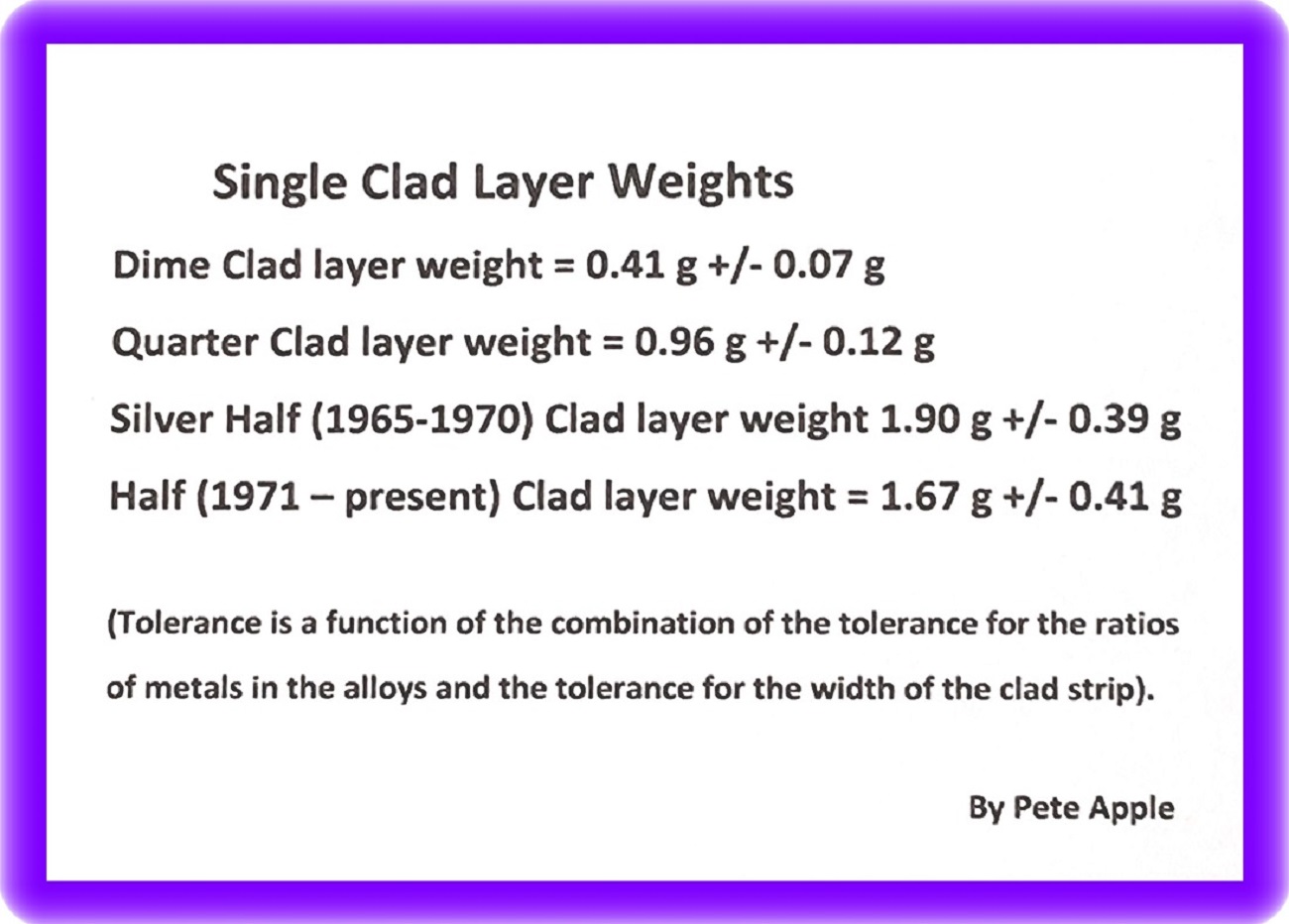
Clad layer weight = .40619g (
Quarter
The thicknesses of the elements of the composite strip out of which blanks are punched:
Quarter clad layer (75% +/- 2.5% Cu 25% +/- 2.5% Ni) = 231.14 µm (+/- 25.4 µm)
Quarter Copper Core (pure copper) = 916.94 µm (+/- 25.4 µm)
Quarter total thickness: 1.75mm reeded (or milled) edge. (I think the reason this dimension is not quite as thick as the coin is after minting is that the blanks have not yet been cut or passed through the upsetting mill.)
Diameter = 24.26 mm (24260 µm) Area = 462.01 mm² Vol = 106.79 mm³
(75% +/- 2.5% Cu and 25% +/- 2.5% Ni) = .00936 g / 1mm³
Clad layer weight = 0.9552 g
Half
Kennedy half dollar coins dated 1965-1969 contain 40% silver
Half clad layer (80% +/- 0.6% Ag and 20% +/- 0.6% Cu)
Thickness = .254 mm +/- 0.0254 mm (254µm) per side +/- .0508 mm (50.8 µm)
Half Copper Core (21.5 +/- 0.6% Ag and 78.5 +/- 0.6% Cu)
Thickness = 1.1684 mm (1168.4 µm) +/- 0.0508 mm (50.8 µm)
Clad = (8x10.5)+(2x8.96)/10 = 10.192 g/cm³ 0.010192 g/mm³
Half Diameter = 30.61 mm
Area = 735.52 mm² Vol Clad Layer = 186.82 mm³
Weight Clad layer = 1.904 g
Kennedy half dollar coins dated 1970 to date
(Extrapolated from data for a Silver Clad Half)
Half clad layer (75% +/- 2.5% Cu 25% +/- 2.5% Ni)
Thickness = .254 mm +/- 0.0254 mm (254µm) per side +/- .0508 mm (50.8 µm)
Half Copper Core (21.5 +/- 0.6% Ag and 78.5 +/- 0.6% Cu)
Thickness = 1.1684 mm (1168.4 µm) +/- 0.0508 mm (50.8 µm)
Diameter = 30.6 mm Area = 735.04 mm² Vol = 186.70 mm³
Clad layer weight = 1.670 g
Here are my tolerance calculations. I do not know whether my notes are adequate to follow along or not - (!!)
Quote:
Tolerance Calculations
Dime clad layer (75% +/- 2.5% Cu and 25% +/- 2.5% Ni) = 180.34 µm (+/-25.4 µm)
Area = 251.80 mm² x 0.0254mm = volume of tolerance = 6.39572mm³
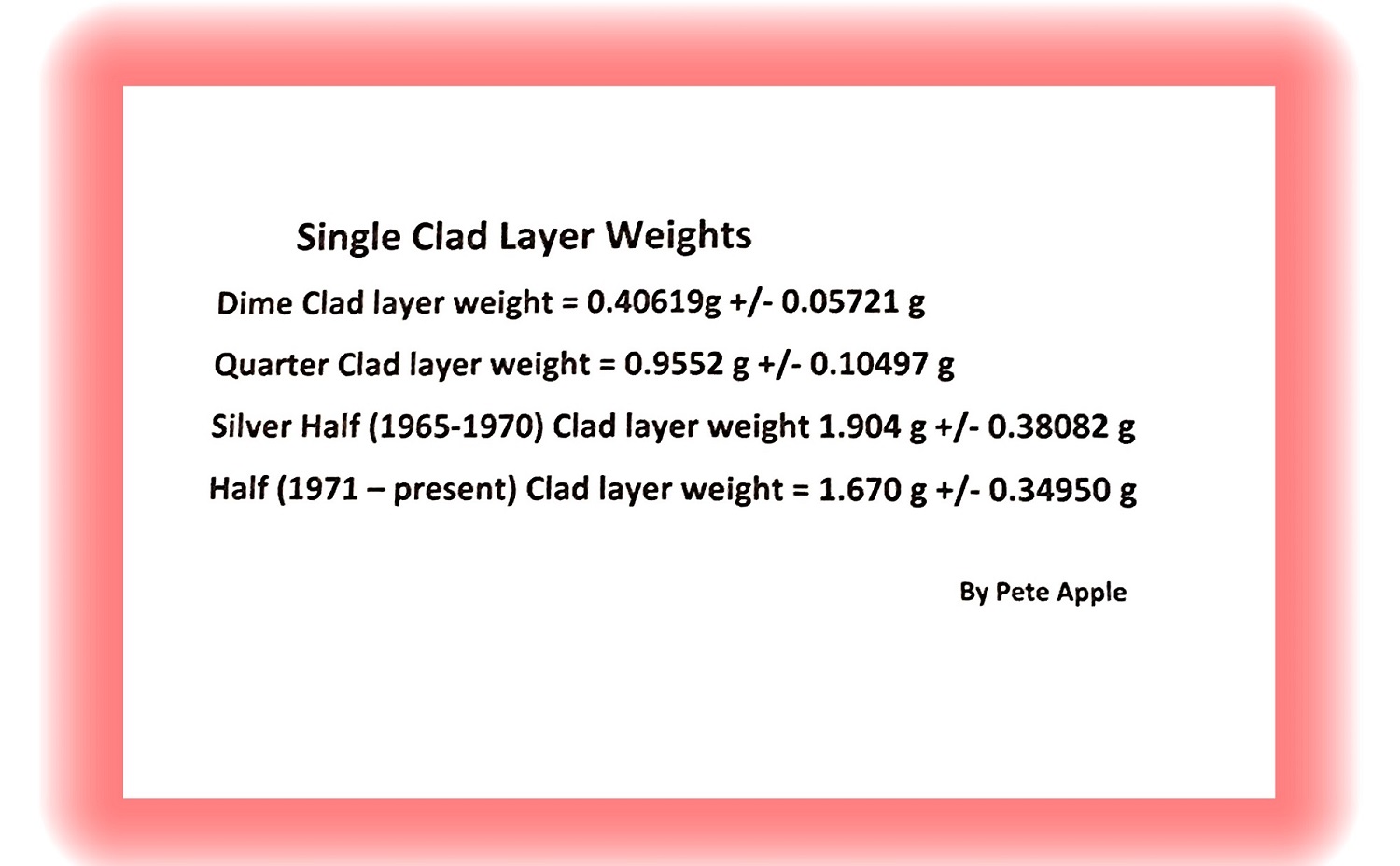
0.008945g/mm³ 75%Cu and 25%Ni Weight of tolerance = +/- .05721 g
******************
Quarter Area = 462.01 mm² x 0.0254mm = volume of tolerance = 11.73505 mm³
Weight of Tolerance = 0.10497 g
*********************
Silver Half Single Clad layer Area = 735.52 mm²
Tolerance = +/- .0508 mm Volume tolerance = 37.36442 mm³ x 0.010192 g/mm³
0.38082 g
Half 1970 after
Area = 735.04 mm² x .0508 mm = 37.3400 mm³ x .00936 g / 1mm³
.34950 g tolerance
Metal Ratios
Dime volume of tolerance = 6.39572mm³ add 0.00959 g
Quarter volume of tolerance = 11.73505 mm³ add 0.01760 g
Silver Half Volume tolerance = 37.36442 mm³ add 0.00924 g
Half Volume of tolerance = 37.3400 mm³ add 0.05601 g
0.06 g/mm³ x 0.025 = .0015 g/mm³
Ag Cu
10.5-8.96 = 1.54 g x .006 = 0.00924 g
I would welcome any guidance/corrections to my math, methods, or assumptions!












 Posted 06/04/2018 3:21 pm