| Author |
 Replies: 12 / Views: 1,721 Replies: 12 / Views: 1,721 |
|
|
New Member
United States
7 Posts |
Hello all, I'm new to the forum and I'm also new to coin collecting. I'll be honest, I didn't know how intrigued I was by all of this until I saw a 1927 penny in my piggy bank the other day. But I was wondering if you all could help me to see if this 1971 nickel is a proof or not. And if someone can explain to me how to notice the difference. 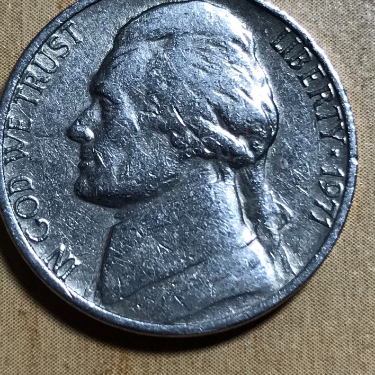 |
|
|
|
Moderator
 United States
34572 Posts |
@Cjwuman, first welcome to CCF. Second, that coin is not a proof, but rather a business strike. It is true that every once in a while a proof coin circulates, but those are somewhat unusual. From our glossary (link is in the upper left part of your screen), here is a good definition of proof: Quote:
Proof
A coin usually struck from a specially prepared coin die on a specially prepared planchet. Proofs are usually given more than one blow from the dies and are usually struck with presses operating at slower speeds and higher striking pressure. Because of this extra care, Proofs usually exhibit much sharper detail than regular, or business, strikes. PCGS recognizes Proofs (PR) as those struck in 1817 and later. Those coins struck prior to 1817 are recognized as Specimen strikes (SP). "If you climb a good tree, you get a push."
-----Ghanaian proverb
"The danger we all now face is distinguishing between what is authentic and what is performed."
-----King Adz
Edited by Spence
09/02/2018 07:15 am
|
|
New Member
 United States
7 Posts |
Thank you very much for the reply. I appreciate it
|
|
Moderator
United States
198004 Posts |
 to the Community! |
|
Moderator
United States
16008 Posts |
to the CCF Concur your coin is a business strike and not a proof strike. Take a look at my other hobby ... http://www.jk-dk.art |
|
New Member
United States
7 Posts |
Thanks for the warm welcome. I'm gonna be sharing a lot of coins here in the near future. You guys have a great eye for them, which I hope to develop.
|
|
Moderator
United States
34572 Posts |
Quote:
I'm gonna be sharing a lot of coins here in the near future. Lookin' forward to seeing more of your coins and watching you develop your numismatic skills! "If you climb a good tree, you get a push."
-----Ghanaian proverb
"The danger we all now face is distinguishing between what is authentic and what is performed."
-----King Adz
|
|
Rest in Peace
United States
18456 Posts |
To CCF , A proof 1971 would have an S mint mark , yours doesn't . Also a proof would have mirrored fields , yours don't . If your intending to stay with the hobby , pick yourself up a new edition of the Red Book ( a guide book of United States coins ), A must for every U.S. coin collector .  |
|
New Member
United States
7 Posts |
Awesome! Thank you, I will look to get one.
|
|
Bedrock of the Community
United States
80422 Posts |
Not a Proof Strike. Just a normal Business Strike. It can be safely spent, since it was meant for circulation.
Errers and Varietys.
|
|
Pillar of the Community
United States
2294 Posts |
Welcome aboard.
We'd see this question a lot more often but the '71-P has become a very scarce date. It's not only the low mintage but the huge attrition of nickels. There wouldn't be too many of these left even if the mintage were a lot higher.
The real trick is to find a nice evenly worn specimen in VF or better.
Time don't fly, it bounds and leaps.
|
|
Valued Member
United States
392 Posts |
I took the advice of the Forum and went to Ollies and got a Mega Red Book for a few bucks. They say theprices inside are just guidelines so last years book is OK with me. Mega Red is full of pictures too. |
|
Bedrock of the Community
United States
20753 Posts |
When and if you buy a copy of the Red Book, you could save a lot of money by looking for one that is a few editions old. Not much difference except not a lot of real late year coins. And the difference in price for that book a few editions old is a lot, lot cheaper. |
| |
Replies: 12 / Views: 1,721 |
|




 Posted 09/01/2018 10:41 pm





