| Author |
 Replies: 9 / Views: 2,190 Replies: 9 / Views: 2,190 |
|
|
Pillar of the Community
United States
6130 Posts |
Bought this one a few weeks ago in a CNG lot. I recognized the type in the photos; didn't expect a scarce reverse! Central Asia, Southern Soghd (Uzbekistan) C. 1st century BC - 1st century AD? AR small unit (11mm 0.63g) King Hirkod (Hircodes, Hyrkod etc) Obv: Bust of king right, (YP)KωΔ behind (Hirkod) Rev: Forepart of horse, uncertain Greek legend around  I can't find a whole lot, so I'm hoping Kushanshah can come save the day! I was able to find eight examples on Zeno: https://www.zeno.ru/showgallery.php?cat=2712Of the coins of southern Soghd, a number are of the Hirkod type, named for the Greek inscription on the obverse. These types however mostly have a standing soldier reverse, but a handful have the Forepart of a horse. As far as I can tell, Hirkod is not a ruler known to history. We can infer a few things: - The artistry and language tells us that this coin predates the zenith of the Kushan empire, and possibly contemporary to the Bactrian Greeks. - I believe that ω began to replace Ω around the turn of the 1st century BC - The issuers of these coins bear a striking resemblance to the Yueh-chi or early Kushans, compare vs. "Heraios"  Welcoming any insights! E: Never research when tired, people! Fixed some mistakes in the original post. Edited by Finn235
09/11/2018 12:38 pm
|
|
|
|
Pillar of the Community
United States
1554 Posts |
It's a known type, apparently less common than the archer.
Just to put a reference number with your coin, it's Mitchiner ACW 361. Mitchiner gives them the fanciful attribution 'Dahae of Choresmia, Kings of the Dahae following Artara, 130-1 BC'. He translates KωΔ as "the Dahaean" (!?). Mitchiner is very useful in terms of assigning a number to a coin for ease of reference but his attributions are sometimes bizarre and often just plain wrong.
Everyone else seems to go with "Hyrcodes" (Hirkod, etc), South or Southwestern Sogdiana (Bukhara), c. 1st to 4th century AD.
I googled "Hycodes horse protome coin" and found a few references to the type in passing. I would start with a similar search. Now that you have my curiosity, if I find anything more, I'll post.
Edited by Kushanshah
09/11/2018 01:43 am
|
|
Moderator
 United States
23731 Posts |
Interesting and obscure type, glad we have KS here his help and knowledge is well appreciated.
I have copies of Mitchiner's 9 volume set Indo-Greek and Indo-Scythian coinage but not his books. KS do you have the books?
|
|
Pillar of the Community
United States
7067 Posts |
Edited by Kamnaskires
09/11/2018 09:47 am
|
|
Pillar of the Community
 United States
6130 Posts |
Thanks all! I don't know how I missed the zeno page with a bunch of other examples - guess I was too tired to be doing research.
Thanks for the links Bob and KS!
|
|
Pillar of the Community
United States
1554 Posts |
Both coins linked by Bob L are actually ACW 361. According to Mitchiner, #360 has an "Aramaic" (Sogdian) legend on reverse. #361 is Greek both sides.
@echizento I have ACW (Ancient and Classical World) and World of Islam but not Non-Islamc States and Western Colonies.
Edited by Kushanshah
09/11/2018 12:56 pm
|
|
Pillar of the Community
United States
6130 Posts |
Saw these two on ebay going (relatively) cheap, and won both with no competition. 1. Hirkod / Hyrcodes AR "drachm" (15mm, 2.68g) Obv: Portrait right, YPKωΔ behind Rev: Soldier/deity standing, wearing heavy coat, holding spear and hand on hips, flames on shoulders, badly garbled Greek legends 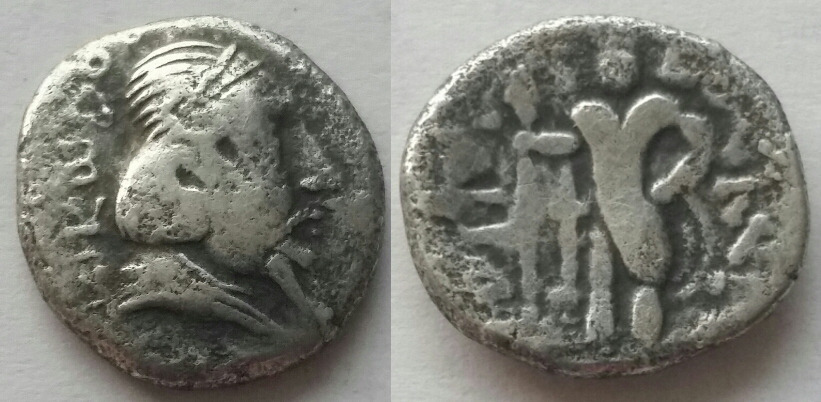 2. Same type, either a hemidrachm, or more likely a posthumous issue struck to a reduced weight standard. 15mm, 1.05g Obv: Portrait right, no legend Rev: Soldier/deity standing, wearing heavy coat, holding spear and hand on hips, flames on shoulders, badly garbled Greek legends 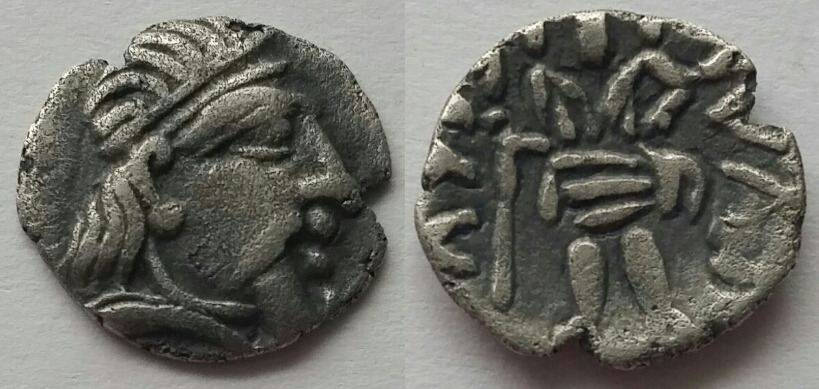 |
|
Pillar of the Community
 Spain
2752 Posts |
Nice pick ups Steve!
Especially like the posthumous issue..Lovely detail..
Just out of curiosity whats the significance of the flames on shoulders?
Paul
|
|
Pillar of the Community
United States
6130 Posts |
Thanks Paul.
From my cursory research, it has been suggested that the figure on the reverse may be Pharro, the Kushan/central Asian god of royal glory. He is often depicted with flaming shoulders. I have no idea what sort of significance that entails.
|
|
Pillar of the Community
United States
1554 Posts |
Nice coins. I almost pulled the trigger on them myself :) In order to avoid doing actual work, I poked around a bit on Google searching for "shoulder flames". I came across a cylinder seal in the Boston MFA collection, dated to the 3rd millennium BC, said to depict a deity with shoulder flames (I think said deity is mostly out of the photo but perhaps shoulder flames are visible at upper left) https://www.mfa.org/collections/obj...-seal-163734. The earliest ruler to depict himself with shoulder flames may be the Kushan king Kanishka I. The shoulder flames seem to represent divine authority, similar to a halo or nimbus. 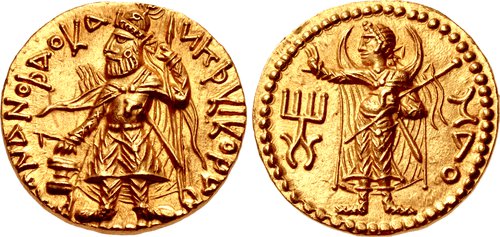 https://cNGCoins.com/Coin.aspx?CoinID=256504 https://cNGCoins.com/Coin.aspx?CoinID=256504Edited by Kushanshah
09/24/2018 5:45 pm
|
| |
Replies: 9 / Views: 2,190 |
|










 Posted 09/11/2018 07:55 am


