| Author |
 Replies: 59 / Views: 9,415 Replies: 59 / Views: 9,415 |
|
|
|
Pillar of the Community
Belgium
1185 Posts |
very interesting piece and great discussion !
the nightmare modern NF that bothers me (if it could be done without leaving traces): a high quality replica of a 1766 8R produced starting with an ugly or worn but authentic 8R host piece from the same period; SG and XRF would of course indicate it is a genuine piece; I hope this is virtually impossible to achieve; but when not done perfectly, al kinds of traces of the host coin could be expected
when the artifact was generated in 1776, which I like to agree with, it would be great to better understand what could be a plausible mechanism; first thing I would like to understand is the mirrored 1765
Edited by 1c5d7n5m
12/28/2018 5:56 pm
|
|
Pillar of the Community
 Australia
653 Posts |
Thank you for the insightful comments "colonialjohn and 1c5d7n5m
Yes, to come closer to solving the mystery of the raised and mirrored 1765 date on the reverse of my 1766 Eight Reale coin will be one of my ambitions for the coming year 2019. Maybe that could involve an overseas mission to Mexico...
Wishing all the helpful Coin Community Forum members a very happy New Year 2019
Thank you for all the invaluable feedback and assistance during our CCF communications over the past year
Squire
Edited by Squire Wilson
12/30/2018 7:51 pm
|
|
Valued Member
Spain
125 Posts |
I really hope you can solve the mistery... I don't really like errors which have no clear explanation, although your coin seems legitimate for me. The 1765 date is in high relief? Law said that no valid coins should be melted, not restrike.
I just want to ask you about one point. Why do you all consider the observe of the coin the pillars side? The observe of the columnarios is the shield side, same as peinsular 8 reales. The pillars are the reverse. This point has always struck me :)
Regards and nice coin!
|
|
Pillar of the Community
Australia
653 Posts |
Thanks for the insightful comment regarding the identification of obverse and reverse on the columnario 8 Real coins txabs  That is very helpful Squire PS. the 1765 mirrored date appears to have a subdued relief. The numerals project out slightly from the surface of the coin. The relief of these numbers is a lot less than that of the script corresponding to the 1766 design of the coin Edited by Squire Wilson
12/31/2018 4:40 pm
|
|
Pillar of the Community
Australia
653 Posts |
I have made another interesting discovery regarding 1766 "Mo" Mexican 8 Real pieces. Aside from the inverted and raised "1765" date on the obverse (opposite the pillar face) of the coin in my posession there is also an area of excess metal. I have attached an image showing this. The inverted and raised 1765 date is shown in the yellow rectangle. The area of excess metal is shown in the red rectangle. Note that other 1766 Mexican 8 Real coins also have this "excess metal" issue. This is shown on the web page at coins.sudokone.com/pages/study2.htm The author mentions that "excess metal appears to have occurred during the striking process" and "the upper edge of the excess metal is finely serrated forming a perfect inverse of the denticles along the rim" and "the upper edge appears to have formed by a sticking process". Note that for the coin in my possession the excess metal is finely serrated forming a perfect inverse of the denticles along the rim. Examination of the rim areas annotated by the small black arrows in the attached image shows that these serrations can be seen along the rim of the coin within the yellow and red rectangles, but not along the "normal" rim as defined by the light blue rectangle. This indicates that the "raised inverse 1765 date (in the yellow rectangle)" and the "excess metal area (in the red rectangle)" have been generated by a single process. Looks like there were some interesting happenings at the Mexican mint during 1766  Squire 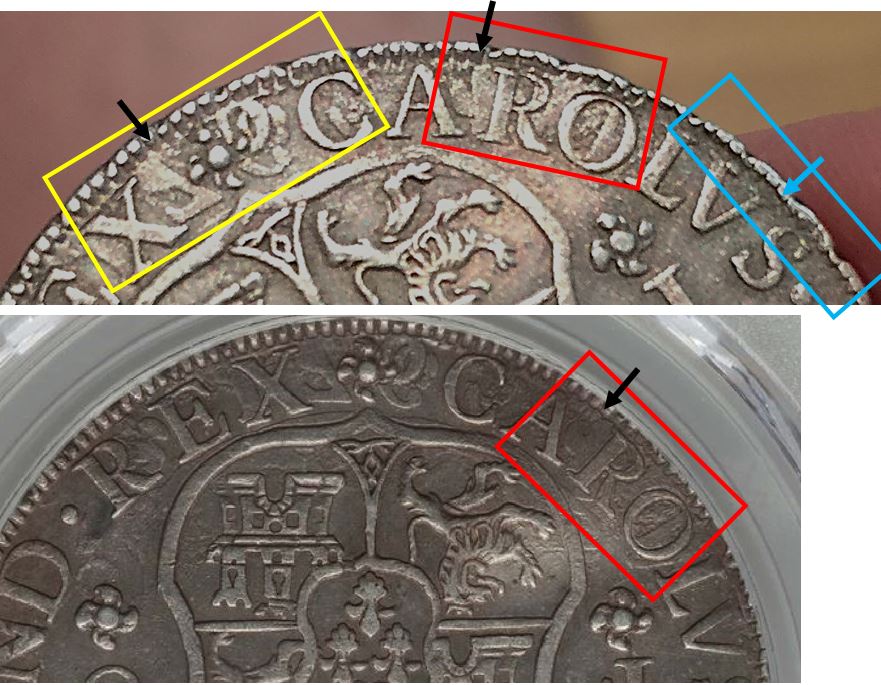 |
|
Pillar of the Community
United States
1962 Posts |
Squire, it's your coin now so you're obviously a captive audience, but this was very good detective work. I went through almost every 1766 in major auction archives(and many 1765 also) I could find back when we were discussing this and found little-to-no hint really of any appreciable clashing (recessed or raised). Funny, too, this is ppm-inc from ebay, who I've bought from... and I've almost certainly held this coin in person as I looked through his material at a show in Philadelphia this past summer. |
|
Pillar of the Community
Australia
653 Posts |
Thanks for your interest realeswatcher  I find that the large part of the fun of collecting coins involves the historical sleuthing that I conduct during the lay-by period and after purchase. This 1766 8 Real coin posed a riddle that I have found hard to resist and this contributed to my buying it. The mental exercise of imagining how the inverted and raised numerals and letters on this coin and similar coins may have formed still has me scratching my head.  From your post I assume the ppm-inc is a reputable dealer so that is good news  As I am indeed a "captive audience member" I will keep investigating and will forward my findings to the CCF forum Squire . Edited by Squire Wilson
02/16/2019 01:30 am
|
|
Pillar of the Community
Australia
653 Posts |
...another interesting 1766 Mexican 8 Real piece. This time from the web link at https://www.numiscorner.com/collect...ilver-km-105A contrast enhanced image of the interesting part of the coin is attached. The bottom of the reverse side of the coin shows a raised feature within the red rectangle. It shows an incused feature within the light blue rectangle. Any comments from CCF members would be much appreciated Squire 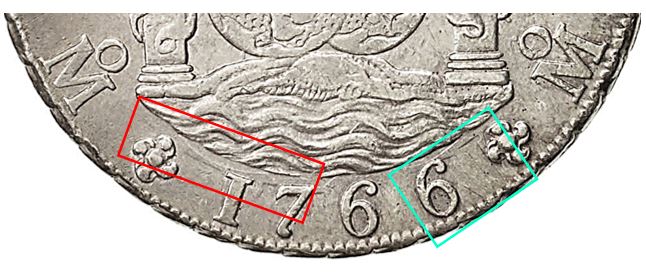 |
|
Pillar of the Community
 United States
906 Posts |
This is a very interesting coin, and quite the mystery as to how the mirrored 1765 came to be raised. Someone had indicated that the 6 in 1765 appears to have been repunched. As strong as that impression is, you would think you would see the top loop of the 6 if that were the case. To me, there appear to be raised remnants of other devices below the lower part of the 176 of the date, so I would offer that as an alternative to a repunched 6. I have no idea if that is true, or how one would explain it if it was.
|
|
Pillar of the Community
Australia
653 Posts |
I need to give this some more thought.
Squire
Edited by Squire Wilson
02/25/2020 03:14 am
|
|
Pillar of the Community
Australia
653 Posts |
...
Edited by Squire Wilson
02/28/2020 11:25 pm
|
|
Pillar of the Community
Australia
653 Posts |
Over the holidays I have found a third example of the 1766 Mo 8 Reale coin with raised and inverted script. This was sourced from PicClick but unfortunately I could not recover the original source of the coin. You will note the inverted "AR" as circled. I believe this is from the text "CAROLUS" which is located on the obverse of the coin. Picture attached. On the basis of the three different coins displaying this "raised and inverted" script with this current one from the China Trade, I do believe this is strong evidence that the "error" is genuine. However, I am still at a loss to explain how this error was created Squire 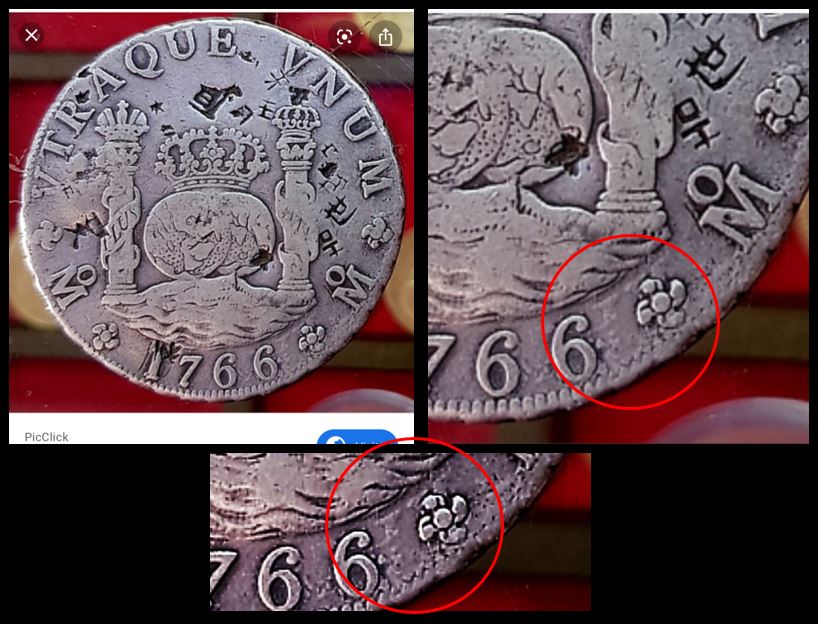 |
|
Pillar of the Community
United States
1761 Posts |
Well during my first post I was a bit lazy so I decided to spend a little more time with this oddity. I may be wrong but having some experience with errors in the U.S. Colonial, U.S. Mint and Foreign markets there are some differences between colonial issue errors and U.S. Mint errors and sometimes things can be different and sometimes the rules a bit twisted. Following this thread there seems to be some errors on error definitions. When dies clashed the reulting images appear INCUSE or below the surface plain of the coin. In this case the transplated motifs are RAISED which then leads to a brockage possibility. When examining the images at Heritage and seeing the FULL COIN we do not see a partial brockage but we see a 100% brockage occuring IMO! For example we see in HISPAN the "R" of VTRAQUE. This appears as an "P" but this can't be ... its an "R" ... look closely. We see "*1766*" and we see in CAROLUS the Mexico City Mint and on the other side of the retrograde 1766. The question then is how did this occur? Somehow this coin received a FULL obverse brockage image on the reverse and was then struck again normally with reverse dies - possibly. Remember we see signs of a FULL obverse imaging 360* all around - some strong/some weak. With screw presses during this period we do not expect 100% transfer of ALL images all the time. A previous struck coin was probably STUCK on the reverse die - this coin then gets fed IN and receives a normal obverse strike from the upper hammer die and a brockage obverse impression from the first coin sitting on the reverse anvil die. So with the reduced force at this time for a screw press AND a two planchet scenario these images are SPORADIC - seen this before on U.S. Colonial Coin brockages. The die sinker discovers this and gives the coin a normal obverse/reverse impression at this time? No signs of a double impression on the obverse not even a die chatter appearance - so no coin rotation in the chamber so to speak. This then creates the underlying 360* brockage elements of the obverse seen on this specimen for its reverse side with the normal obverse impression. We then do an XRF assay and find it has trace aluminum ... just kidding. Interesting piece and controversial ...
P.S.: People still think that William Anton Mott Token Error is a fake - it could be? LOL.
John Lorenzo
Numismatist
United States
Edited by colonialjohn
03/06/2020 3:10 pm
|
|
Pillar of the Community
Australia
653 Posts |
Thank you very much for your knowledgeable response "colonialjohn". This is much appreciated.  .  A few points of summary from my perspective and some "open speculation" From my analysis of the 1766 Mo 8 Real coin that is the subject of this post and as mentioned earlier: Weight 26.98 grams, average diameter 37.92 grams, Specific Gravity 10.3, XRF analysis 95.6 - 96.8% Silver, 3-3.75% Copper, 0.1% Gold, 0-0.1% Lead (apparently no Aluminium  ) In an earlier post "swamperbob" mentioned that on the basis of this information the coin is likely to be either genuine or a superb numismatic forgery of a type unknown at present. Determining the origin of the "inverted and raised" date on the coin has become a mild obsession with me. For this reason I will study the feedback from "colonialjohn" very carefully. Following in my "mild obsession" I have been surfing the web looking at 8 Real Mexican coins minted during this time with these features. To date I have only found three examples of these "inverted and raised' features. All of these are on the 1766 8 Real Mo coins. Finally, I wonder if this "aberration" in coinage during 1766 has anything to do with the troubled times, in particular the 1766 Real del Monte strike? Maybe there is a connection with the 1765 / 1766 overdate Mo 8 Real coin also? Squire Edited by Squire Wilson
03/07/2020 01:37 am
|
| |
Replies: 59 / Views: 9,415 |






 First Page
 Previous Page


 Posted 12/30/2018 7:49 pm


