Since I cannot recall the last time or subject that I wrote about a national bank note that means it has been way to long.
Let me begin this with a postcard I purchased in October depicting the north side of the square in Lineville sometime between 1904-1925.
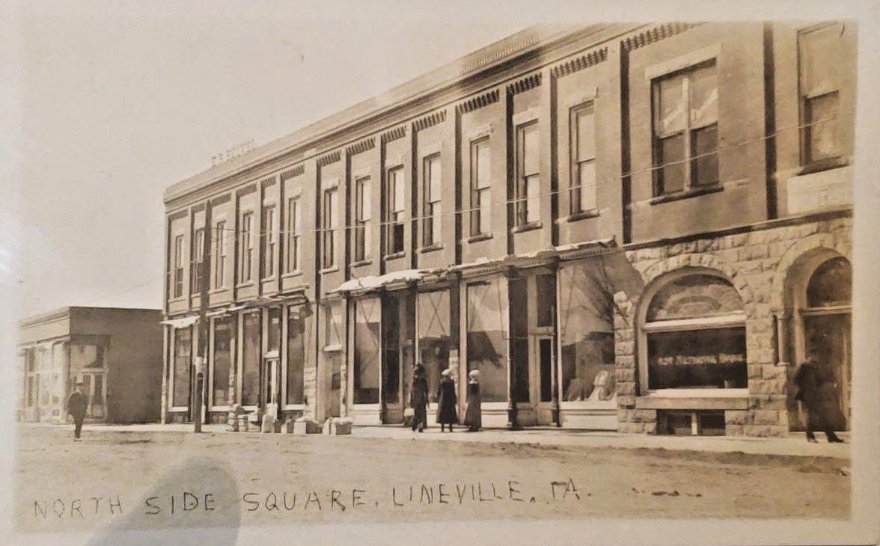 The First National Bank is the right-most building with the stone facade
I visited Lineville, Iowa in the summer of 2007 or 2008 when they were having annual festivities including a classic car show and parade. I didn't know that the town once hosted a national bank as I was mainly interested in Missouri banks. The building was occupied at the time as a branch of Great Western Bank.
Like many towns, the square was once an active, thriving place however as time creeps on, buildings stand vacant and deteriorate-- one in the block either falls down or is torn down (for safety reasons) and it's a domino effect. Google Maps street view in Nov. 2015 shows the bank building as a grassy area.
The First National was organized in April 1904 capitalized at $25,000. The Series of 1902 had commenced for newly organized banks and re-chartered ones as well.
The inaugural notes for Series 1902 bore a red Treasury seal, a pair of red Charter numbers and blue serial serial numbers. Denominations printed were $5, $10, $20, $50 and $100. Bank serial numbers began at 1 and increased whereas the Treasury serials "indicates the running total of such sheets printed on a country-wide basis for all banks" [Source 1]
Returning to the subject of the First National Bank, the bankers elected issue $10's and $20's only. These notes would bear red overprint and a bank serial number in the lower left of 1 to 300. The bank would have received these as uncut sheets of 10-10-10-20, unsigned. The President (or Vice-President) and Cashier would have signed the notes and the sheets cut apart.
It's a remote possibility that the first sheet delivered to the bank was saved by the President or Cashier as a souvenir or that a single number 1 was saved if the sheet was cut apart. No Red Seals have come to light as far as I find.
The bank also received 4,439 sheets of Series 1902 Blue Seals. The first version of these were Date Backs which had "1902" and "1908" in green ink. The front carried wording "secured by bonds or other securities" as a result of a law passed.
Later, the green ink dates were dropped from the backs giving rise to the final version of Series 1902 Plain Backs. These also likely carried the "or other other securities" clause even though it was a moot point as the plates were still usable.
I've misplaced my Kelly
National Bank Notes so I'm unable to look up the information on the sheet numbers associated with each type of the blue seals.
A receiver was appointed for the FNB on April 9, 1927. Circulation outstanding on that date was $24,300. Total deposits at the bank were $205,239. The reason given for its failure was "local financial depression from unforeseen agricultural or industrial disaster" [Source 2]
The Kelly census CD shows a lone Plain Back $10 as the only note reported on this bank.
Thanks for reading.
-MV
Source 1: Friedberg and Friedberg
Paper Money of the United States 19th Edition 2010
Source 2: Comptroller of the Currency Annual Report 1928, page 288







 Posted 12/08/2018 06:02 am





