











 Posted 02/14/2019 7:04 pm


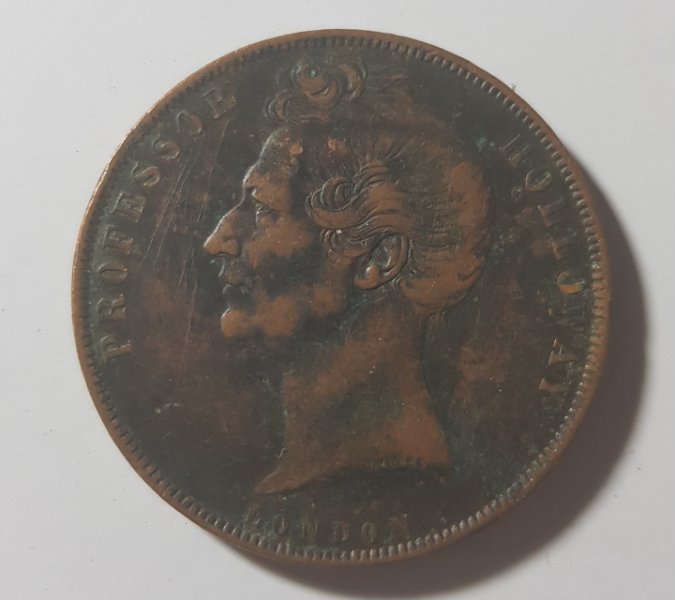
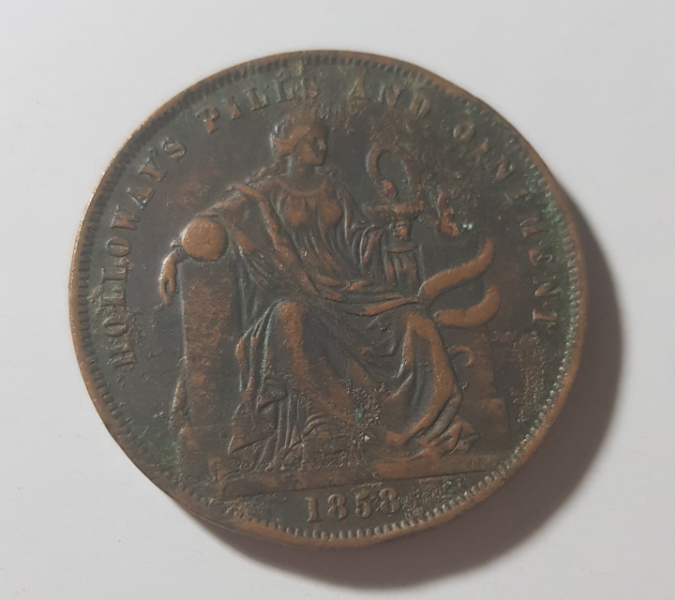
They are technically "advertising pieces", rather than "tokens". They were originally made for use in England, where "tokens" were illegal in the 1850s. As advertising pieces, they would have been given away in stores, rather than being used as money, to get around the legal ban on tokens. However, on hearing of the coin shortage in the Australian colonies and that tokens were not illegal there, Holloway realised his advertising medals could serve as substitute coins and so arranged for shipments of tokens to be sent out here. They presumably also saw limited circulation in other colonies where sterling coinage was scarce, such as Canada.
"Professor" Holloway was not actually a professor, but what we would today call a marketing genius, single-handedly turning his homemade pills and ointments into the "Coca-Cola of their day" throughout the British Empire - all without a single active ingredient. Chemical analysis of surviving pills show them to be made of sugar, beeswax, charcoal and other non-beneficial substances. He was selling the placebo effect.
The tokens were designed by Joseph Moore, the same Joseph Moore who had struck the bimetallic "model pennies" in the 1840s. We don't know which mint actually made them, though it is suspected they were struck by Heaton and Sons, Birmingham, which made numerous other tokens and medals designed by Moore. I don't think we know the total mintages, nor the total amounts that were officially and unofficially shipped to Australia. It is further complicated by some of these tokens being on the Dunbar when it went down off Sydney Heads in August 1857; those tokens would have been salvaged in the late 18th and early 19th centuries and never actually saw circulation here. Most of the badly damaged examples, such as yours, are likely from that shipwreck.
"Professor" Holloway was not actually a professor, but what we would today call a marketing genius, single-handedly turning his homemade pills and ointments into the "Coca-Cola of their day" throughout the British Empire - all without a single active ingredient. Chemical analysis of surviving pills show them to be made of sugar, beeswax, charcoal and other non-beneficial substances. He was selling the placebo effect.
The tokens were designed by Joseph Moore, the same Joseph Moore who had struck the bimetallic "model pennies" in the 1840s. We don't know which mint actually made them, though it is suspected they were struck by Heaton and Sons, Birmingham, which made numerous other tokens and medals designed by Moore. I don't think we know the total mintages, nor the total amounts that were officially and unofficially shipped to Australia. It is further complicated by some of these tokens being on the Dunbar when it went down off Sydney Heads in August 1857; those tokens would have been salvaged in the late 18th and early 19th centuries and never actually saw circulation here. Most of the badly damaged examples, such as yours, are likely from that shipwreck.
Don't say "infinitely" when you mean "very"; otherwise, you'll have no word left when you want to talk about something really infinite. - C. S. Lewis


