


Coin Community Family of Web Sites Join Thousands of Coin, Bullion, & Money Collectors
Royal Canadian Mint products, Canadian, Polish, American, and world coins and banknotes. Specializing in Modern Numismatics Vancouvers #1 Coin and Paper Money Dealer Royal Estate Auctions - $1 Coin AuctionsCoin, Banknote and Medal Collectors's Online Mall 300,000 items to help build your collection! Join Thousands of Coin, Bullion, & Money Collectors


Username:
Password:
Save Password
Forgot your Password?


This page may contain links that result in small commissions to keep this free site up and running.

Welcome Guest! Registering and/or logging in will remove the anchor (bottom) ads. It's Free!

"Early Release" Transition Varieties - How Common?

To participate in the forum you must log in or register.
Author Previous TopicReplies: 5 / Views: 780Next Topic  
Pillar of the Community
kbbpll's Avatar
United States
4233 Posts
 Posted 02/26/2019  8:00 pm Show Profile   Bookmark this topic Add kbbpll to your friends list Get a Link to this Message Number of Subscribers
This thread today http://goccf.com/t/341356 enabled me to learn that a Lincoln Cent reverse design change intended for 1989 was actually implemented in 1988 using a handful of new dies, creating an "early release" transition variety.

It caused me to wonder - how common was it that a design change attributed to a particular year actually appeared the prior year on a small number of coins, creating a scarce type? This Wexler article http://doubleddie.com/58348.html lists some of them, but not all are an "early release". What I see as "early release" are:

1988 cent "reverse of 1989".
1992 cent "reverse of 1993" " Close AM".
1964-D quarter Type C "reverse of 1965".

Wexler then lists a couple more that are "late to the party" varieties:

1940 nickel "reverse of 1938".
2008-W ASE "reverse of 2007".

Are there more?

I find the "early release" ones particularly intriguing for some reason, but I suppose both the early and late ones fundamentally have the same explanation - they had the dies so they used them.
Bedrock of the Community
coop's Avatar
United States
62064 Posts
 Posted 02/26/2019  8:22 pm  Show Profile   Bookmark this reply Add coop to your friends list Get a Link to this Reply
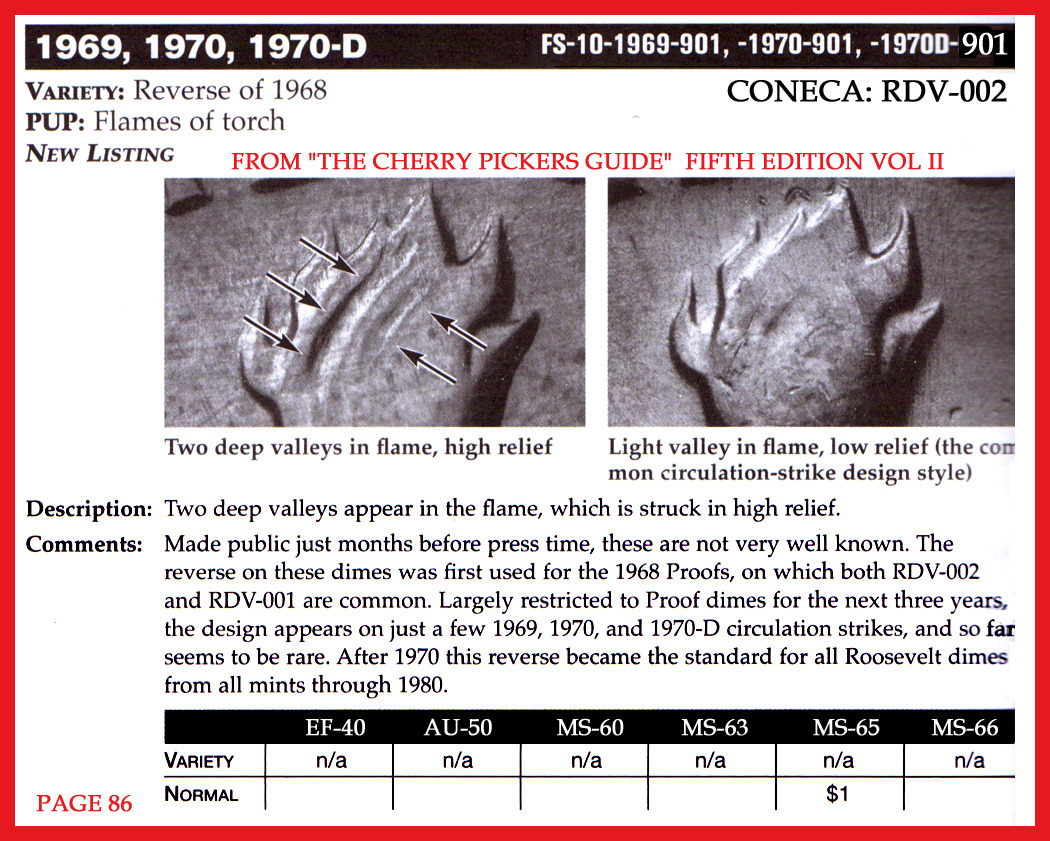
Reverse of 1970 on Dimes:

Pillar of the Community
CoinHunter27's Avatar
United States
5887 Posts
 Posted 02/26/2019  8:30 pm  Show Profile   Bookmark this reply Add CoinHunter27 to your friends list Get a Link to this Reply
The dimes Mr. Coop is talking about, in case your interested, have no extra premium unless in mint state or sold in bulk. Specifically the 1970-D dimes are very easy to locate. I still save them.

-CH27
Collector of U.S. Coins, Varieties, and Colonial Coinage
Bedrock of the Community
Errers and Varietys's Avatar
United States
75179 Posts
 Posted 02/26/2019  8:48 pm  Show Profile   Bookmark this reply Add Errers and Varietys to your friends list Get a Link to this Reply
They are not usually that common. The 1988 RDV-006 is pretty scarce. I have only found two of them so far. My first one I had was traded in a trade with Jim0815. The second one I found was in etheir high AU or in a low MS condition.
Errers and Varietys.
Pillar of the Community
kbbpll's Avatar
United States
4233 Posts
 Posted 02/26/2019  10:47 pm  Show Profile   Bookmark this reply Add kbbpll to your friends list Get a Link to this Reply
Thanks coop, an example of exactly what I was looking for! That's a strange one though - early relative to the circulation release, but late relative to the proof use. Makes me think a proof die escaped into regular production in 1969 and 1970, but that means it "escaped" from SF to Denver and Philadelphia.

I've become interested in this from Barber dimes, where 1901 saw a mix of two reverse types, but there it seems intentional. 1901 also had both used for proofs, like your 1968 example.
Bedrock of the Community
Conder101's Avatar
United States
17884 Posts
 Posted 02/27/2019  4:27 pm  Show Profile   Bookmark this reply Add Conder101 to your friends list Get a Link to this Reply

Quote:
Makes me think a proof die escaped into regular production in 1969 and 1970, but that means it "escaped" from SF to Denver and Philadelphia.

All the dies were made in Philadelphia, it is more of an error in where the die was sent to and used. dies were hubbed using a hub intended for proof dies but which was then sent to the production line in Denver or Philadelphia. Same type error that resulted in the 1998, 99, and 2000 Wide AM cents, and the same mistake in reverse that created the 1998-S, and 1999-S Close AM proof cents. A die hubbed with the business strike hub was sent to San Francisco frosted, polished, and used to strike proofs.
  Previous TopicReplies: 5 / Views: 780Next Topic  

To participate in the forum you must log in or register.


Disclaimer: While a tremendous amount of effort goes into ensuring the accuracy of the information contained in this site, Coin Community assumes no liability for errors. Copyright 2005 - 2026 Coin Community Family- all rights reserved worldwide. Use of any images or content on this website without prior written permission of Coin Community or the original lender is strictly prohibited.
Contact Us  |  Advertise Here  |  Privacy Policy / Terms of Use

Coin Community Forum © 2005 - 2026 Coin Community Forums
It took 0.28 seconds to rattle this change. Forums