| Author |
 Replies: 16 / Views: 2,848 Replies: 16 / Views: 2,848 |
|
Pillar of the Community
United States
4497 Posts |
|
|
|
|
Pillar of the Community
 United States
8945 Posts |
|
|
Bedrock of the Community
United States
94367 Posts |
|
|
Bedrock of the Community
United States
18873 Posts |
|
|
New Member
United States
45 Posts |
|
|
Rest in Peace
United States
18456 Posts |
|
|
Pillar of the Community
United States
1361 Posts |
|
|
Pillar of the Community
United States
3723 Posts |
Classic Buff head-scratcher. Thank you for sharing the challenge with us!
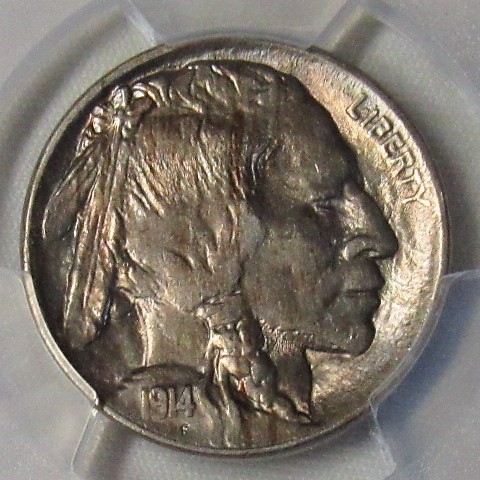
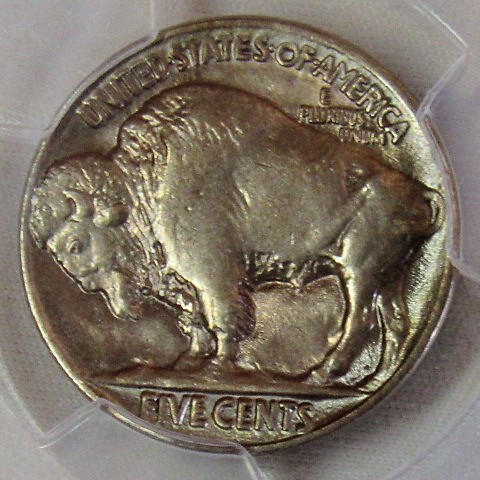
When I talk about Buffs with mismatched die states, this one is a poster child. The obverse is late die state. The reverse is early middle die state. The obverse die shows evidence of heavy die clashes and extensive polishing to reduce the clash marks. This reverse wasn't the die that c;lashed heavily with this obverse die. Add a weak strike into the mix and heavier contact marks on the obverse than the reverse, and this one is a grading challenge.
The obverse has the weak LIBERTY of 1913-14-15. That is a design issue, and irrelevant for grading these three years. Virtually the entire right rear leg of the buffalo is visible as a clash extending into the "BER" of LIBERTY. The chin / EPU clash has been polished (severely) below the chin. The second feather / buffalo's head clash has been polished to the point of abrading away parts of the tip of the second feather. The date / "ED" of UNITED clash resulted in polishing that weakened the date. The top if head / ground level clash resulted in polishing that obliterated part of the hair and made the second feather rachis incomplete. A weak strike flattened the first feather, hair above the braid, braid, eye, nose, lips, and chin. The late die state is evident from the heavy metal flow away from the central design elements and toward the edge. Multiple contact marks exist on the forehead, chin, jaw line, hair above the braid, neck, date, and long feathers. There is some disruption of luster on the obverse (especially where the hair meets the cheek), but this disruption seems to be from album storage rather than circulation. There is no matching disruption on the reverse. By technical grade, the obverse would hit MS-63. I see a two-point deduction for strike weakness and post-clash die polishing, for an obverse net of MS-61.
The reverse is better. the early middle die state reverse masks the weak strike a bit, by having sharper peripheral elements than the obverse. The legends are strong, and do not have evidence of much polishing to eliminate clash marks. That said, the weak strike leaves the buffalo with about half the hair on the head and back, significant loss of detail on the beard, shoulder, and front left leg, and little detail on the rear legs. The rounded appearance of the flank shows the strike weakness. On the other hand, the reverse has fewer contact marks than the obverse, and they are mainly on the highest points of the shoulder and side. By technical grade, the reverse could hit MS-65, but strike weakness would cap the reverse at MS-64.
Overall, I could see this coin net grading at MS-62.
|
|
Bedrock of the Community
United States
94367 Posts |
Thanks for that analysis!  |
|
Pillar of the Community
United States
7271 Posts |
 Thank you to fortcollins (bookmarked) so I can understand these Buffs better....  |
|
Rest in Peace
United States
18456 Posts |
fortcollins > ,you should write a book on Buffalo nickels . Explaining in detail the different dies used for each date and mint , how to tell the difference between weak strike and a coin with wear , Design flaws , Errors & varieties , ETC . The Forum appreciates your contribution you have given to this series .   |
|
Bedrock of the Community
United States
94367 Posts |
Indeed, that was quite a schooling!
|
|
Bedrock of the Community
United States
18873 Posts |
everytime fortcollins provides an assessment I think the entire CCF is schooled on these. speaking for myself I've learned more since we've been privileged to read them than in over 50 years of collected. Thanks fortcollins you are indeed an asset and wealth of information for our forum.
|
|
Valued Member
United States
160 Posts |
Thank you fortcollins for taking the time to teach me something.
|
|
Pillar of the Community
United States
9807 Posts |
I too am with fortcollins on this one. lower end MS grade is probable, unless there is more than the photos can show us here. Buffs are so hard to grade from static photos even in hand many are just plain tough to tell. I had a really nice NGC AU58 1923-S that I was convinced was really MS but could never get it into a holder as MS, offered it with MS pricing - it didn't ;ast long in my inventory after a Buff collector saw it, lot's of luster and fairly well struck. Worth the price difference? I thought so and was laughed at by many dealers, until a serious collector finally appreciated just how hard it was to find a coin like it, and was purchased no argument that it was a nice coin regardless of the grade. One of my tougher coins to grade I've ever had.
"Buy the Book Before You Buy the Coin" - Aaron R. Feldman - "And read it" - Me 2013! ANA Life Member #3288 in good standing since 1981, ANS, Early American Coppers Member (EAC), Colonial Coin Collectors Club member (C4), Conder Token Collector Club member (CTCC), Civil War Token Society (CWTS) member, Liberty Seated Collectors Club (LSCC) & Numismatic Bibliomania Society member (NBS), USMex, Member in good standing, 2¢ variety collector. See my want page: http://goccf.com/t/140440 |
|
Pillar of the Community
United States
8137 Posts |
|
| |
Replies: 16 / Views: 2,848 |









 Posted 12/12/2019 12:43 pm





