| Author |
 Replies: 15 / Views: 7,140 Replies: 15 / Views: 7,140 |
|
|
New Member
United States
31 Posts |
|
|
|
|
Pillar of the Community
United States
791 Posts |
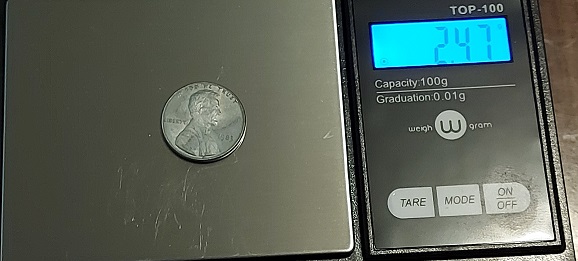
Weight is close to 2.5g so it's very possible you have an unplated zinc cent.
EDIT: Make sure that the scale is calibrated correctly.
Edited by josephm99
09/11/2020 7:13 pm
|
|
Valued Member
Trinidad And Tobago
89 Posts |
look like it was dip in acid nothing special there
|
|
Pillar of the Community
United States
791 Posts |
I'm going to have to disagree with you here. Acid damage would usually distort the devices as well as the color. The weight would also usually be significantly under mint tolerance, which this coin isn't. The color is also correct.
|
|
Bedrock of the Community
Australia
21792 Posts |
It could be a zinc plating over
a regular copper plated zinc penny.
|
|
Pillar of the Community
United States
791 Posts |
That would add more weight to the coin. This coin is under the specified 2.5g for copper coated zinc cents, but not by much.
|
|
Pillar of the Community
United States
4680 Posts |
Could also just be painted. Try soaking in acetone and see if anything comes off.
|
|
New Member
 United States
31 Posts |
How would being painted make it weigh less then it should? Wouldn't it weigh more?
|
|
New Member
United States
31 Posts |
@josephm99 I did a couple different test weighs of various items and all were correct :)
|
|
Pillar of the Community
United States
3744 Posts |
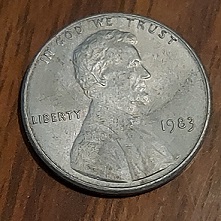
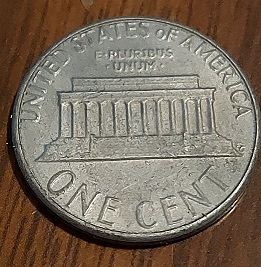
First,  There are two possibilities here. You could have a cent struck on an unplated planchet. You could have a cent that was reverse plated. Reverse plating a zinc cent is a common chemistry lab experiment. It is commonly combined with a potato battery. All that is required is reversing the anode and cathode, to strip the thin copper layer from the cent. The zinc surface of your cent seems a bit fresh for a 37-year-old coin. Zinc gains a thin oxidized layer that usually gives it a grayish color, which is part of the process that makes zinc useful for galvanizing. One way to tell is to look at the edge of your coin. On zinc cents, the supplier of the blanks (ARTAZN, formerly called Jarden Zinc) uses a patented process to apply a double copper plating to the edge and a single copper plating to the obverse and reverse. When schools do the reverse plating experiment, there usually will be traces of the copper remaining on the edge. A second way to tell is in the field of the coin adjacent to the inside of the rim. On the lab experiment coins, there may be a very small trace of the copper in the angle where the rim raises from the surface. The area between the "U" of UNITED and the "O" of ONE on the reverse of your coin has a shadow that could be a trace of copper. |
|
New Member
United States
31 Posts |
This was folded up with the coin, I tried looking online for info on it but nothing. Maybe one of you might be able to find something. 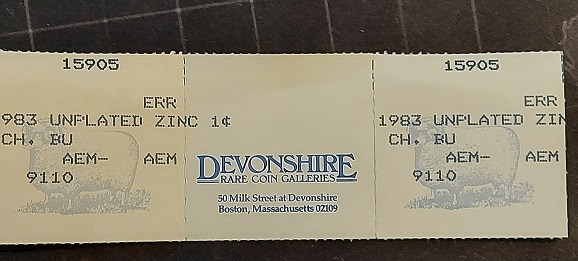 |
|
Moderator
 United States
34563 Posts |
"If you climb a good tree, you get a push."
-----Ghanaian proverb
"The danger we all now face is distinguishing between what is authentic and what is performed."
-----King Adz
|
|
Bedrock of the Community
United States
17884 Posts |
Pictures are too small and not sharp enough to be sure but I strongly suspect this piece has been altered.
|
|
New Member
United States
31 Posts |
So I used a magnifier and looked around the edges of the coin and on the "U" and "O" and did not see any tracing of copper. The coin itself is a dull grey color in normal lighting, it has no shine to it. Also when looking through the magnifier I examined the fields, its all even, no ruts or craters, nothing that any chemical would leave behind.
|
|
Bedrock of the Community
United States
19613 Posts |
Close in, high resolution, full photos of obverse and reverse would be welcome. Agree with others, this is not an 'acid job'.
|
|
Bedrock of the Community
United States
17884 Posts |
The problem is, if these coins are dull and not showing mint luster, there is no way to prove they were originally non plated planchets and not later altered. As such I do not believe any of the TPG's will certify one that doesn't show mint luster. And without certification, any buyer of a dull piece like this is going to assume that it is altered. Making it a case of even if it is real, no one will accept it as real. |
| |
Replies: 15 / Views: 7,140 |
|







 Posted 09/11/2020 7:01 pm





