








 Posted 10/19/2020 2:06 pm


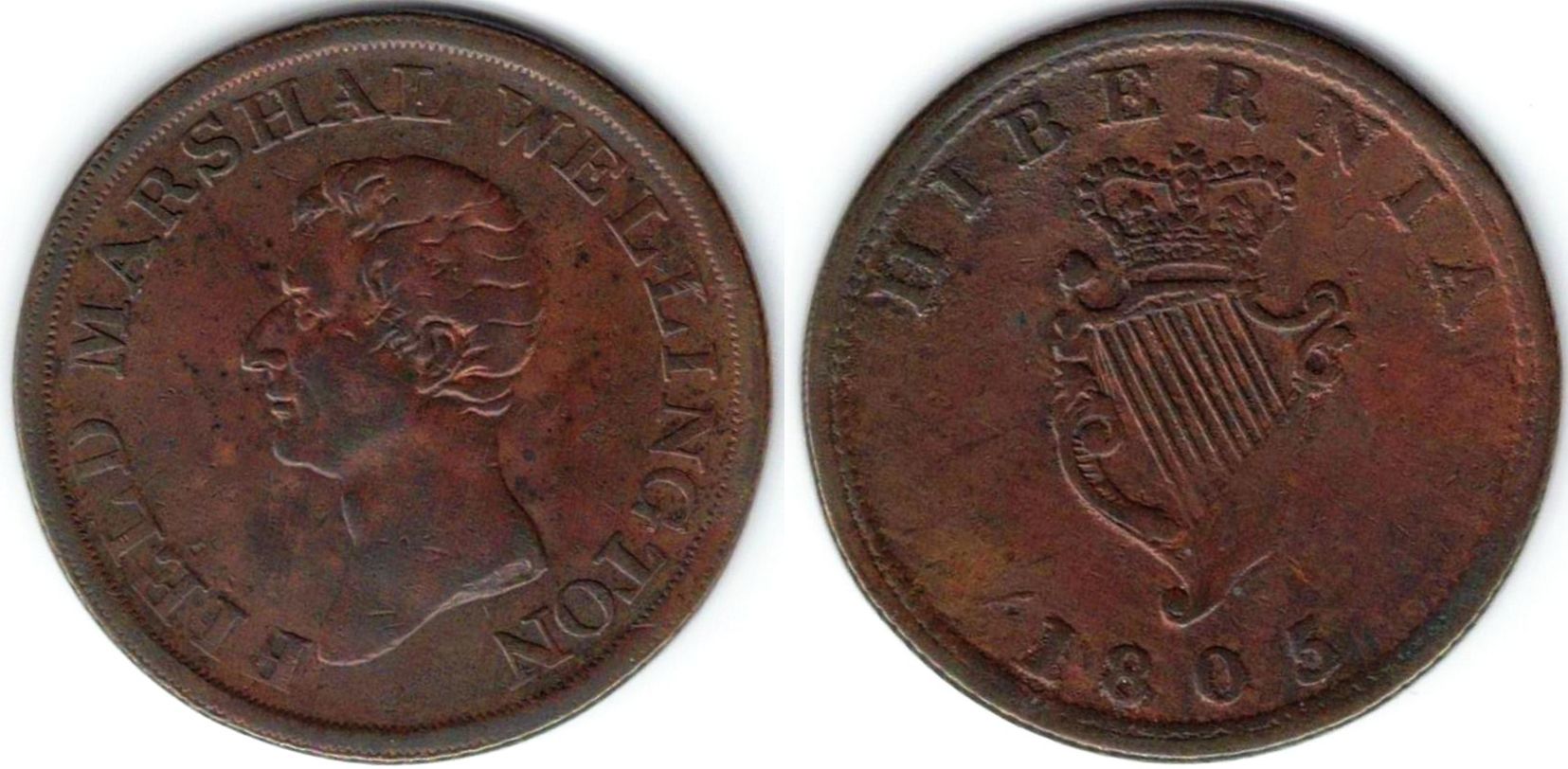
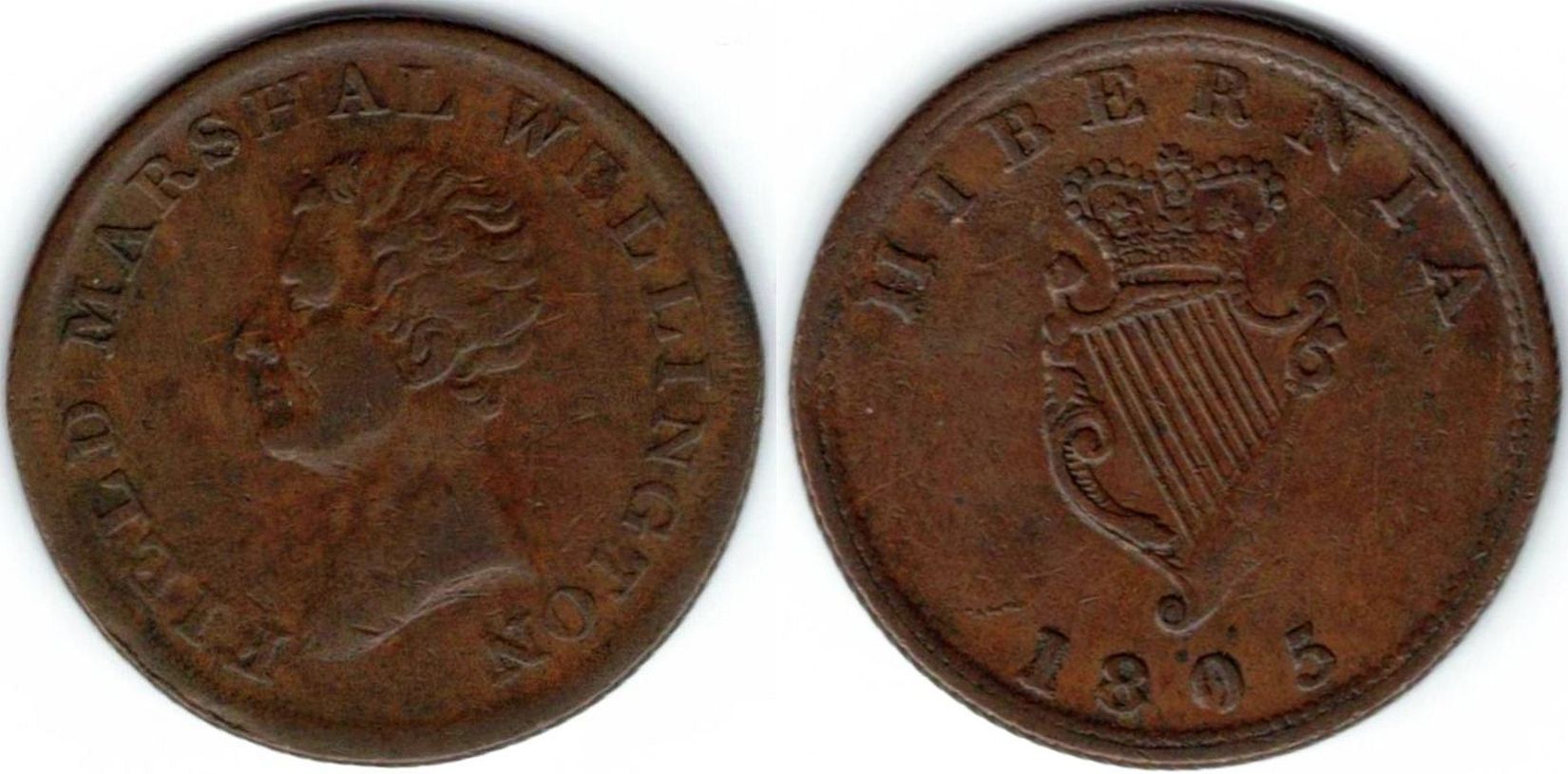
These tokens are very interesting and continue to elude my collection! (In the right condition for the right price, that is) They seem scarcer than most people give them credit for; those with medal alignment especially so. As for more information, here goes ...
Their key characteristic is that they share the reverse die of regally-issued 1805 Irish halfpence struck at the Soho Mint of Birmingham, run by non other than Boulton and Watt.
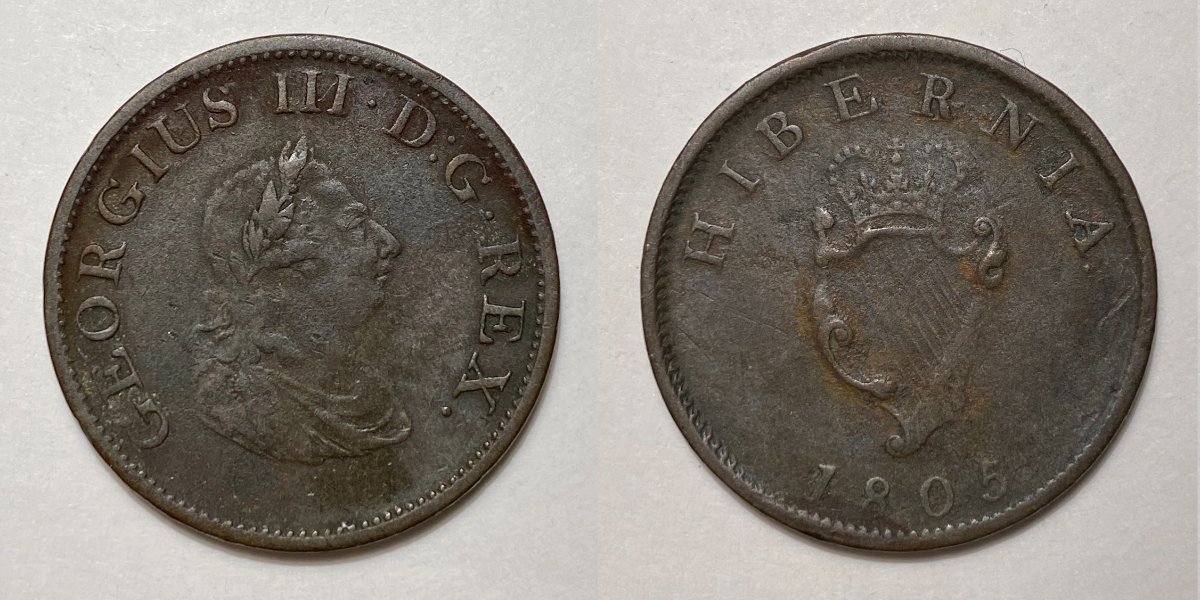
It is apparent that the die is in a old and rusted state by the time examples of Br 973 (WE-5) are struck, yet it outlasts two obverse dies.
The first mention of this token that I am aware of (at least with relation to Canadian Numismatics) is in Alfred Sandham's Coins, Tokens and Medals of the Dominion of Canada (1869). He lists it, among other Wellington tokens, in his "Miscellaneous and Doubtful" category.
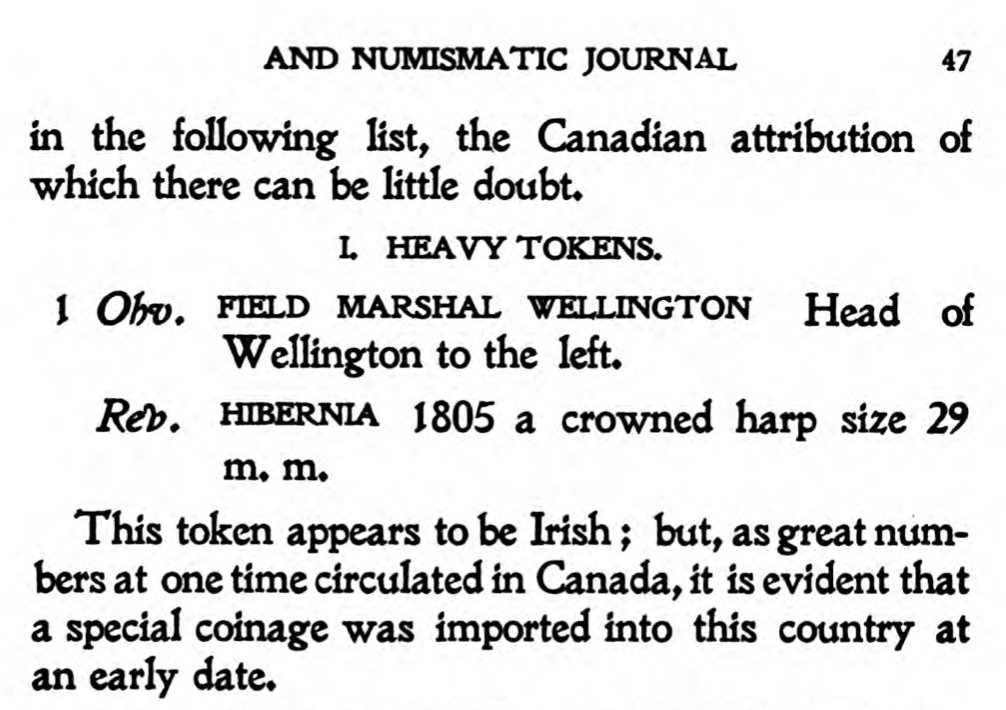
McLachlan expounds on Sandham's listing in a 1902 article of the Canadian Antiquarian and Numismatic Journal titled "The Canadian Wellington Tokens", in which he groups by weight, and thus by percieved order of emission, what he views as "Canadian Wellingtons", ie. those struck with the purpose of circulation in Canada. About WE-5 he has this to say:
 .
.
Courteau's 1914 article "The Wellington Tokens Relating to Canada" in The American Journal of Numismatics, making no mention of McLachlan's article, comes to a similar conclusion of the Canadian origin of this token. In addition he makes the observation that is described in the original post, where Wellington's promotion to Field Marshall was no earlier than 1813, and thus that the token was struck much later than the 1805 date.
Strangely enough, neither McLachlan nor Courteau seem to make the connection that the reverse die is the same as that used for the regal Irish strikings of that date. In a response to Courteau's article in the November 1915 issue of The Numismatist, McLachlan reasons the date as follows:
"The date which they bear may be accounted for in this way. A rush order having been received by the coiners, and the reverse die having given out before any of this coinage had been struck, an old reverse die made for an Irish coinage of the date it bears was brought out and refurbished for a reverse for the Canadian token. So durable was this old die that it outlasted two new obverses."
I am not entirely sure what to make of McLachlan's response, but it does not appear that he recognized the 1805 reverse as a product of the Soho Mint. McLachlan's comment on the durability of the die is in line with the high quality of their products, and suggests that the designers of the obverse die (and strikers) of WE-5 were not of the same cailbre.
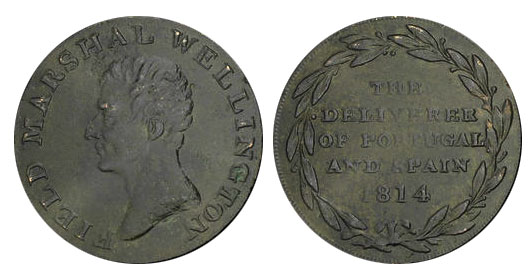
This implies that some other firm got ahold of the discarded Soho die in order to strike WE-5. A further connection made by Courteau (1914) is the use of the same obverse (the large letters WE-5A obverse) on a rare English medal presumably issued by the same firm. Below is an image from coinsandcanada.com
That is the extent of what I have to offer, and I apologize for the length of my response! This post was a breath of fresh air that I very much needed!
Their key characteristic is that they share the reverse die of regally-issued 1805 Irish halfpence struck at the Soho Mint of Birmingham, run by non other than Boulton and Watt.
It is apparent that the die is in a old and rusted state by the time examples of Br 973 (WE-5) are struck, yet it outlasts two obverse dies.
The first mention of this token that I am aware of (at least with relation to Canadian Numismatics) is in Alfred Sandham's Coins, Tokens and Medals of the Dominion of Canada (1869). He lists it, among other Wellington tokens, in his "Miscellaneous and Doubtful" category.
McLachlan expounds on Sandham's listing in a 1902 article of the Canadian Antiquarian and Numismatic Journal titled "The Canadian Wellington Tokens", in which he groups by weight, and thus by percieved order of emission, what he views as "Canadian Wellingtons", ie. those struck with the purpose of circulation in Canada. About WE-5 he has this to say:
.Courteau's 1914 article "The Wellington Tokens Relating to Canada" in The American Journal of Numismatics, making no mention of McLachlan's article, comes to a similar conclusion of the Canadian origin of this token. In addition he makes the observation that is described in the original post, where Wellington's promotion to Field Marshall was no earlier than 1813, and thus that the token was struck much later than the 1805 date.
Strangely enough, neither McLachlan nor Courteau seem to make the connection that the reverse die is the same as that used for the regal Irish strikings of that date. In a response to Courteau's article in the November 1915 issue of The Numismatist, McLachlan reasons the date as follows:
"The date which they bear may be accounted for in this way. A rush order having been received by the coiners, and the reverse die having given out before any of this coinage had been struck, an old reverse die made for an Irish coinage of the date it bears was brought out and refurbished for a reverse for the Canadian token. So durable was this old die that it outlasted two new obverses."
I am not entirely sure what to make of McLachlan's response, but it does not appear that he recognized the 1805 reverse as a product of the Soho Mint. McLachlan's comment on the durability of the die is in line with the high quality of their products, and suggests that the designers of the obverse die (and strikers) of WE-5 were not of the same cailbre.
This implies that some other firm got ahold of the discarded Soho die in order to strike WE-5. A further connection made by Courteau (1914) is the use of the same obverse (the large letters WE-5A obverse) on a rare English medal presumably issued by the same firm. Below is an image from coinsandcanada.com
That is the extent of what I have to offer, and I apologize for the length of my response! This post was a breath of fresh air that I very much needed!


