sel_69l you were certainly on the right path, something is definitely going on underneath the patina.

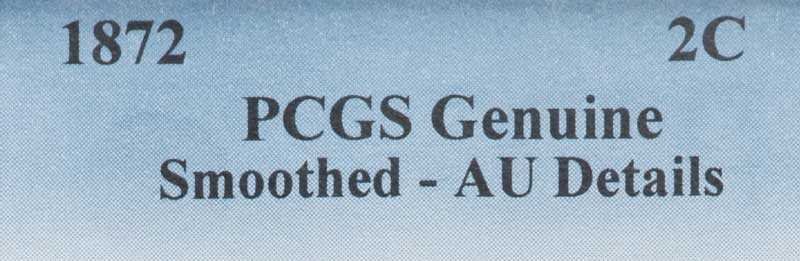
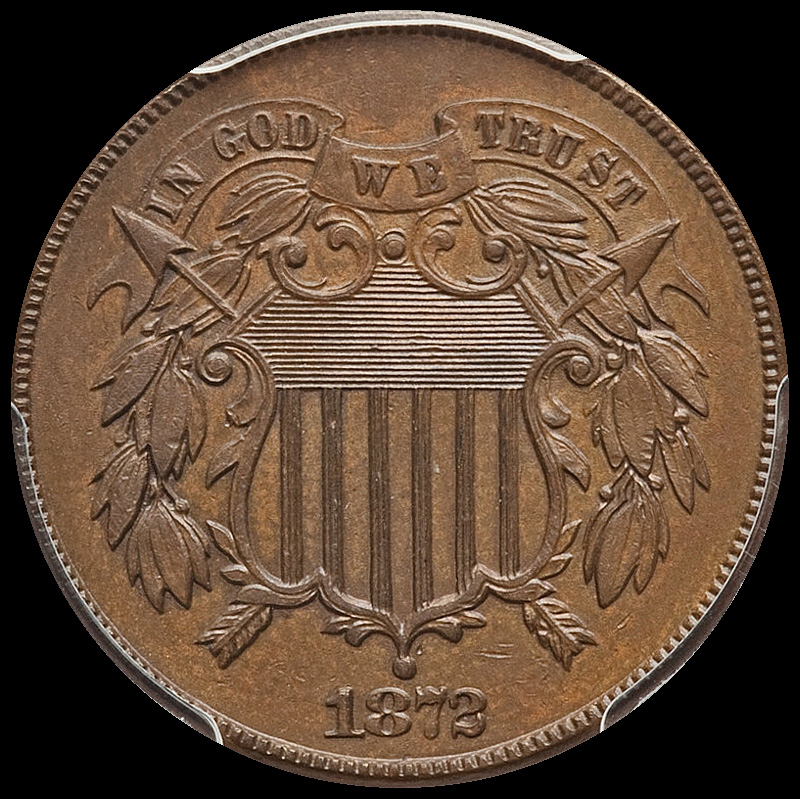
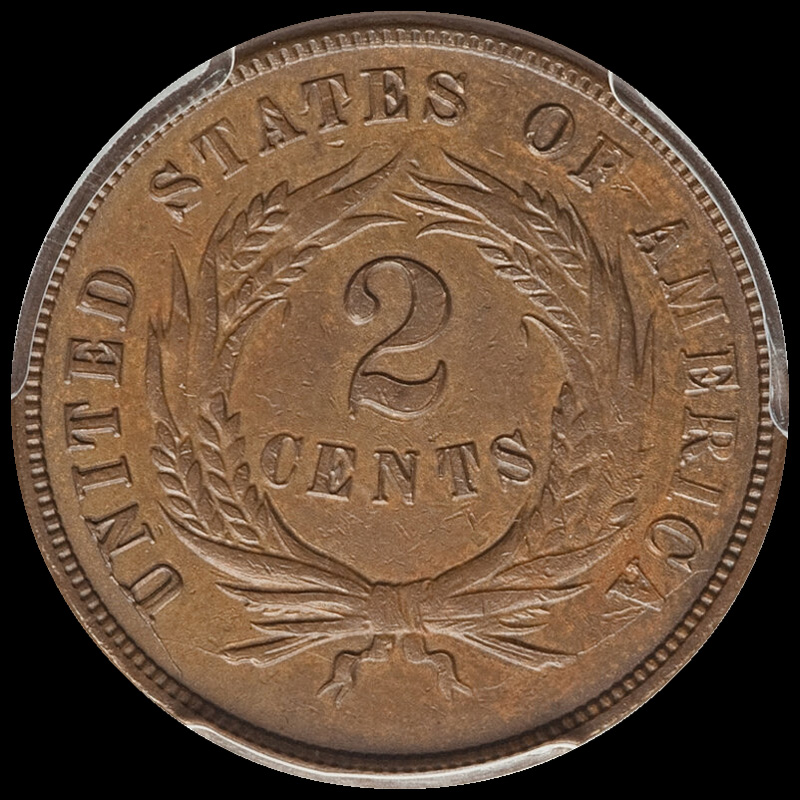
This Deuce was smoothed/burnished. SMAT45 and Grape I'll give you each a quarter point.

yhbearcats, trust your eyes, yep it's doubling not machine though, the best kind (HUB Doubling)! I know the photos weren't great for really telling it, but the give away point is the N in "IN", the W in "We" and the R & U in "TRUST" at least you can really see the separation more at those areas.
It is the FS-101
DDO and a really nice example of it too. I didn't end up buying it but came close. It recently (in the past 60 days) sold in auction for just over $1K. If I had to put a numerical grade I'd also go AU55BN. The other key identifiers for the FS-101
DDO are the die cracks at the "IN GOD" and the reverse Die Cracks (obvious to see at the bottom of the Wreath).
There is actually another "ultra rare
DDO" 1872, I've only seen a VF example in low resolution B&W scans back in 1994, supposedly there are 3 known and all are VF or lower grade. Which is why I try to look at every single business strike 1872 trying to locate a better (or any) example for myself.
This
DDO FS-101 is actually the most common die pairing in 1872, so it shouldn't command much of a premium though many dealers and sellers price it as it should. Now if you were to come across the ultra rare
DDO then a premium would be in order. The common
DDO FS-101 was discovered by Kevin Flynn, or at least he was the one to first note it in print in his first numismatic book "Getting your
Two Cents Worth" back in 1994. As common as these are (relatively) I'm surprised Breen didn't list it in his formative Encyclopedia.
The 1872 business strikes are one of the hardest in the series to find. Proofs abound in the market but a super nice business strike will cost you dearly these days. Back when I was building my #1 collection of high grade examples, I kept upgrading as I found better looking coins, I think I went through half a dozen coins before I settled on a superb example, way more than other dates anyways. According to Kevin Flynn's later research only 4 dies were used in the making of 1872 business strikes (it may be 5 including the new
DDO if proven).
I wanted to see if anyone would call the details on this coin. It's almost impossible to tell as the smoothing effect was done by a real expert coin doctor. If you look on the reverse one thing that helps identify the effect is note how low relief the hits are around the numeral 2 to the left side, then look into the wheat sheaves, see how much deeper they are, they should appear that way in the field as the deep as they do in the devices.
But whomever did the work on this coin did a phenomenal job and makes it a very deceiving coin. Heck I might even get fooled 6 out of 10 times looking at ones this well doctored. Also the fact the color is so even and no splotches were remaining after the work, another amazing part of the trickery. This is why you don't want to mess about on high dollar coins without a guarantee or some expert advice, and even some of us would get it wrong on a coin like this.
Nobody guessed the details at all. Though to be fair, it was probably one of the hardest trick grades I've ever plied you all with.

"Buy the Book Before You Buy the Coin" - Aaron R. Feldman - "And read it" - Me 2013!
ANA Life Member #3288 in good standing since 1981, ANS, Early American Coppers Member (EAC), Colonial Coin Collectors Club member (C4), Conder Token Collector Club member (CTCC), Civil War Token Society (CWTS) member, Liberty Seated Collectors Club (LSCC) & Numismatic Bibliomania Society member (NBS), USMex, Member in good standing, 2¢ variety collector.
See my want page:
http://goccf.com/t/140440








 Posted 11/02/2020 7:46 pm





