@Tanman
Quote:This argument for computerized grading disguised as a breakdown of misattributed
Kennedy half varieties completely falls apart when your key point (and only point) can be refuted by the fact that the graders do not attribute the coins.
I do not understand how this paper was a disguise as at the beginning I mentioned computerized grading and also at the end. I do wish I had separated them though.
BTW - the paper does mention PCGS used a computer grading system in 1990 which they said was 90% acurate. It also mentioned Ron Barth (former PCGS president) said the "best" graders only get it "right" 85% of the time.
PCGS got rid of computer grading (as told int he paper) b/c people int the 90's were not trusting of computers. But they knew the system was more accurate back then - think of modern computers next to Win '95.
Quote:
Your explicit argument seems to be that PCGS's graders aren't qualified because they so often misattribute these No-FG halves (correct me if I'm wrong). But as pointed out earlier, the graders do not attribute the varieties. An attributer attributes varieties. One guy/gal. If a mistake is made there is no one to correct it. Understandably, PCGS does not guarantee attributions because of that. They should definitely be more transparent about this, but that's not your argument.
I freely admit I was unaware of this b/c I did not see it included in the paragraph PCGS has about how they grade coins.
Quote:
...PCGS does not guarantee attributions because of that...
I would ask to please know where PCGS specifically states they do not stand behind their attributions if you can provide it please. This way I can make corrections.
Also, now that I have been told by two CCF Family members that PCGS does not consider its variety attributions something they can stand behind, I see an even larger problem:
At
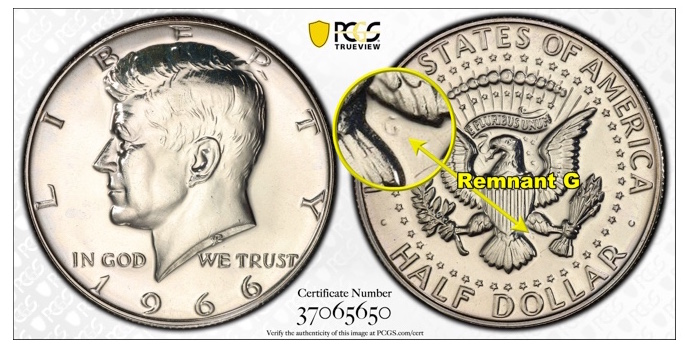
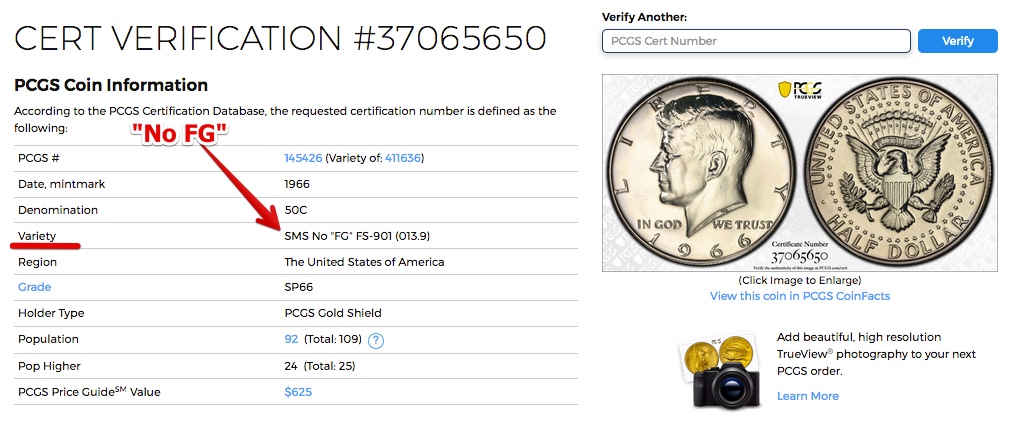
https://www.PCGS.com/prices/detail/.../most-activeA normal PCGS slabed MS65 1972-D is priced at 16.00. But the attribution of No FG on the 1972-D MS65 is $3,000.00!
I know PCGS does not set these prices, but:
1. These grading companies are seen as "THE EXPERTS"
2. People pay them for the "best possible opinion" of their coin.
3. The companies know (according to the above statement) that these very expensive coins may or may not be what is claimed.
4. The company is willing to allow their name on possible wrong items people spend thousands on.
5. The company is allowing this kind of non-ethical practice to continue without mentioning it or upgrading their system to get a competent variety department.
6. The company does not make it abundantly clear that al they do is GRADE and a person paying for a variety attribution has to HOPE the attribution is right.
Al of this just, to me adds up to much worse non-respectable business practices (nice way of saying they don;t care about people being ripped off).
Quote:
Your explicit argument seems to be that PCGS's graders aren't qualified because they so often misattribute these No-FG halves (correct me if I'm wrong).
Not really.
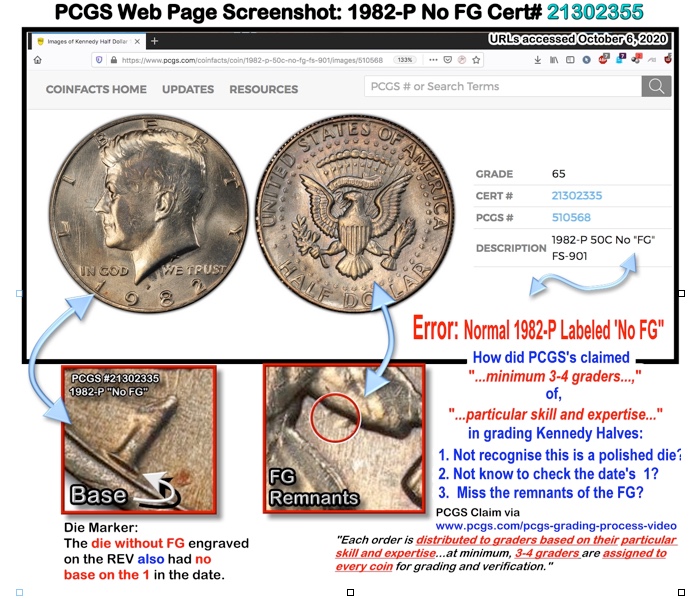
I was pointing out major problems are happening that shed some doubt on their own claims cited as to how, specifically, they grade the coins sent to them.
I find it hard to see how three graders could let these errors slip through. I find it hard to see how coins assigned by type to graders having expertise in those areas could be mislabeled with three specialist (expertise) graders for that type of coin.
Now if variety attribution is not done by the graders, as you have said, and I don't know why that is not mentioned in the detailed grading process outline on their website(

). Now we still have the major problem of people PAYING money to (what they consider) THE EXPERTS and not getting what they are paying for.
Quote:
And with that copy-pasted article you put at the end, I can see that your implicit argument is that graders cannot be relied upon to be 100% consistent and may give the same coin a different grade when resubmitted
Fact - Former president PCGS president ROn Guth, "Even the best grader only get it right 85% of the time." See ppaer for reference.
Quote:
so a computerized system, or 'scientific system' as you say, may potentially be a more desirable method to grade coins in the future due to the value given to the grades themselves.
Just like PCGS abandoned in the 1990s - see their own claims about the system back then (see paper for reference).
Quote:
Grading is and has always been subjective.
What goes up must come down - until Voyager 1.
Quote:
10 people can give the same coin a different grade and none of them will be wrong.
leads to the profit game of cracking and resubmitting.
Quote:
People have different preferences in luster, toning, circulation, etc. There is fundamentally no such thing as an 100% accurate grade.
Actual damage assessment can be calculated per unit of square area at the nanometer level if desired (used to do it with plastic parts in a plastic plant in the 90s). A level would need be agreed upon (such as they do now by saying to use a 5X loupe to grade) b/c absolutes are
fantasy. But the standards used in industry every day could be applied within a reasonable amount.
Luster, eye appeal, toning, all are already left up to the buyer. Nothing in this area changes if a technical analysis of the coins wear is performed. Look at all the ugly looking high MS coins in slabs already.
Quote:
TPGs are the closest thing we have to any kind of 'accurate' grading system, because it can provide a reputable standard. Yes, there will be times it will give a questionable grade but you paid for their opinion and you got it. Should this opinion be given as much value as it has? Maybe not, but that's just how it is.
There is a new computerized grading system being produced. You can look up Daniel Malone on youtube. He has, with a friend, developed an AI system which consistntly is grading coins at the same grade. Its still in the experimental stages.
How did they get a standard? They took many, many Morgans all graded by present companies at each grade level. So, lets use MS64. They had the computer scan and learn what MS64 "meant" over the hundreds of examples used. The AI was able to "average" and learn what MS64 meant from slabbed coins. The system now allows input of a picture of the coin, correct orientation is done by the person inputting or now (there is some auto formatting), and the program, so far, is yielding consistent grades for each coin. The system learns as it goes so it will only improve.
Personally, being a former science teacher, I would prefer the calculated damage per square unit of area to be used. This would take testing of MS70 coins for what "perfect" means to the human eye, and then percentages could be taken from there. The program (used to program also) could be given special parameters to focus on areas of high wear for each type coin as well (just like humans do).
Like I said, in the 90s, we did this to the nanometer with small plastic molded parts (electronics). We put one on the table, it was auto scanned, and auto evaluated (including printout of variances to inputs of what a "perfect" part would be. And comparing pocket computers now to back then...
Quote:
What are the potential drawbacks?
Grading algorithms would need be made available like modern grading standards are. Someone changing those algorithms would have a problem b/c if everyone simply had a phone app (IR camera - no need to worry about reflectivity/angle of ambient) everyone's phones would give the same grade to the same coin if the program was localized within the phone (also very possible).
And...attributions would be accurate as well so people would not lose thousands.
Quote:
How will the hobby transition to this?
The same way it does to any new concept. But this does not impact what the research paper is showing.
Quote:
And even though a system like this would be 100% consistent, wouldn't the grade still be subjective based on the preferences of the people who created it? Wouldn't grades still be debated?
See above. A scientific standard by percentages can be made just as it is with industrial parts. We have patterns to follow.
Quote:
How may it impact the hobby?
Verifiable certainty in buying/selling. Research papers like mine exposing an expensive (to consumers) and major problem would not likely exist. Eye appeal would be totally in the hands of the buyer (where it is anyway). The crack out and resubmit game would be eliminated (might be why they have not re-implemented computer grading). newbies would not be wasting money due to legitimate ignorance. No more face value coin in slabs. I could go on.
If my mechanic said he was only 85% sure, at best, my brake were fixed, I would change mechanics when a better one was available.
Quote:
Wouldn't grades still be debated?
If you are in base 10, then one plus one is always 2. Scanned parts in a R department will either pass the scan at a certain quality level or be rejected. Its been being done or decades in other areas of life. But making profits from older systems is not an issue in those areas.
Quote:
If a computerized, photographic, scientific, whatever-you-want-to-call-it system is what you believe would solve all of the issues with TPGs and if this was what you were trying to get at with this "educational/research paper", you should think or write about questions like the ones in the last paragraph. You shouldn't waste your time writing a 20-page non-argument with only one fundamentally flawed piece of evidence disguised as an unrelated analysis.
The concept which was not well put, evidently, was to show a major problem that exists. Faith in these systems we have has cost people a lot of money.
The 20 pages of non-argument are linkable, factual data that a lot of people have spent a lot of money b/c paid expert companies have a product which is provably unreliable (by showing their own data, facts, wording).
Waste of time? How about focusing on the wasted money people have spent putting major faith/money into a system which has produced falsehoods that bring undeserved high prices?
The information in the paper concerning this is fact. I just hope it might get into the hands of someone who will think twice and check the slab they are going to pay a couple thousand for before wasting their money on a professionally slabbed and mis-attributed error worth thousands of dollars less.
Quote:
That last sentence is a little harsh but let's be honest, that argument you worked so hard on can be entirely dismissed because you neglected to differentiate graders and attributers.
I openely and honestly thank you for correcting this. Although before I can make legit changes to the document, I must have linkable references so, like the paper now stands, people can check it for themselves.
Quote:
Don't hide your arguments and find more than one example to back them up.
Many examples. Not hard to find when you start looking, hence the paper's existence. And again I am sorry I failed in my presentation. The idea was to show the fallacies. It came to me while I was writing that this could have been solved by a legitimately scientific and verifiable grading system.
Don't get me wrong, this breakdown of how off PCGS is with these varieties is extremely useful. It is incredibly important to understand how PCGS deals with varieties.
Quote:
But surrounding that with all this unrelated nonsense about the graders not being qualified and computer grading being a concept that exists really bogs it down. It didn't need your opinions, it should have been purely factual.
I thought all the facts I gave were verified with links. This includes the 85% accuracy rate of the "best graders." I believe I only interjected my own opinion where I specifically stated I was putting in my own opinion. I may have slipped up here (I do not think so - but do not have perfect recall). I have authored a large volume of data/reference book where data was all important. I have a lot of experience writing with the mindset that I need to make sure my opinions are clearly stated as such. And I may be wrong, but going back through the paper with a fine toothed comb will likely show I kept to this mindset. If not, I would very much appreciate being show where so I can make the correction.
Quote:
P.S. A red pill/blue pill meme? Seriously? I can't put into words how ridiculous that is.
You are definitely entitled to your opinion.
My thought went immediately to this analogy when I saw how so many people have been living in a dream world of total faith without looking at the coins they plan to spend hundreds and thousands of dollars on. They have not taken the time to simply look at the coin and find the reality that what they thought was in front of their eyes is not what really is. Oh, THE EXPERTS say so-and-so, here is my cash!
The money spent, and not just one or two times, is much more ridiculous to me than the concept of the comparison.
Thanks for your feedback!









 Posted 12/22/2020 9:01 pm