| Author |
 Replies: 8 / Views: 1,917 Replies: 8 / Views: 1,917 |
|
|
Pillar of the Community
United States
2015 Posts |
Most of you realize that as a coin wears, it is reduced in weight. But how much weight loss is acceptable for a given grade of a given series before a red flag makes the weight suspicious.
After weighing hundreds of coins of different denominations, series and grades, I have been compiling a list of the average weights for the grade. In a way you can call it an alternative way to grade your coins by the amount of weight loss and what it should grade. At least it is a good companion along with photograde for determining if the coin is a) within the weight range for its amount of wear, and b)if it aides in detecting genuine versus suspected bogus coins.
I had some concerns with a 1921 Walker in VG because it only weighed 12.04 grams. If I look at most publications it says that the weight should be 12.5 grams. I start to thinking that perhaps it is bogus because it is nearly .5 grams under weight. But that official weight only applies to high grade coins (MS and AU).
After conducting a specific gravity test I was able to determine that the coin was indeed 90% silver. After weighing a large amount of other walkers I was able to determine that the average weight of a VG coin like this is about 11.9- 12.0 grams.
Now I feel comfortable with knowing it is in fact genuine but under weight from honest wear. Now my data is not complete yet so I am counting on the community to help fill in some weight gaps from your specimens. I would like to know what your coin weighs especially in lower grades of G and Slicks. Any series or denomination is appreciated.
|
|
|
|
Bedrock of the Community
United States
12477 Posts |
It's an interesting approach, but I don't think it can be applied in any scientific way without knowing exactly what each coin weighed before receiving any wear. With the allowed Mint tolerances, there is no sufficiently consistent starting point.
In Memory of Crazyb0 12-26-1951 to 7-27-2020
In Memory of Tootallious 3-31-1964 to 4-15-2020
In Memory of T-BOP 10-12-1949 to 1-19-2024
|
|
Pillar of the Community
United States
3357 Posts |
I did the same thing a few years ago. Thinner coins appeared to show greater % wear weight loss to a given grade. For halves and dollars, it was 5-7% wear weight loss at Good grade. Not a precise science, just a range.
"Two minutes ago I would have sold my chances for a tired dime." Fred Astaire
|
|
Pillar of the Community
United States
2752 Posts |
It seems like it would be a helpful supplement to visual grading. Of course, you'd need a large sample for each grade to cancel out the effects of coins that were originally overweight or underweight
Error coin writer and researcher.
|
|
Bedrock of the Community
United States
20753 Posts |
Your wasting time. Way to many variables.
|
|
Pillar of the Community
United States
3357 Posts |
Not a total waste of time justcarl. My 0.1 gram accuracy scale cost all of $6. I always check coin weight on bullion-containing coins. 5% weight loss on worn coins is normal. 5% underweight on a VF or higher is grounds for sending the coin back for a refund. Within an hour of purchase I caught a 1 gram underweight AU counterfeit gold eagle and the coin shop refunded my money without a hassle.
The main day-to-day use of the scale is checking letters for the postage needed.
"Two minutes ago I would have sold my chances for a tired dime." Fred Astaire
Edited by thq
03/24/2021 11:43 am
|
|
Pillar of the Community
United States
4963 Posts |
It's a cool idea, but as others have said, there are just too many variables. You could easily have an MS coin and a VF that are the same weight and both within mint tolerance. As it happens, I actually did a little experiment about this in 2018 in which I weighed every nickel in a $100 bank box. They're supposed to be 5 g each. 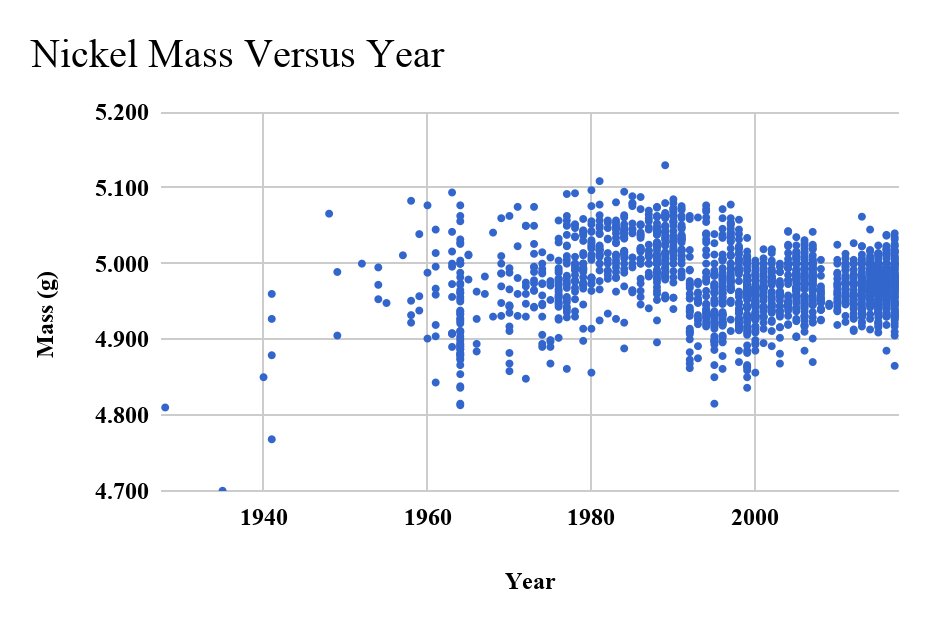 This obviously doesn't incorporate grade, but it still demonstrates my point. Even the brand-new 2017 coins can be anywhere from 4.90 to 5.04 g. They also get noticeably lighter after 1992 for reasons unknown to me. |
|
Pillar of the Community
 United States
2015 Posts |
I am not calling this method an exact science, just another tool to assist if something is a potential problem or unusual. After all, the Sheldon scale isn't a science either. All grading is subjective. My observations have been a steady decrease in weight as the condition worsens mainly on Morgan and Peace dollars, Walking halves, Barber Series coins and Mercury dimes. Nickels and Bronze Cents rarely show any considerable deviation from original mint specs even on low grade examples. Also The silver Roosevelt dimes rarely show any significant reduction. Without using this method as a comparison, I surely would have condemned my 21 walker as being fake because of its weight rather than genuine as the specific gravity test results had confirmed. I don't have any specimens in the G or AG grade for a weight comparison so I would appreciate your weight observations on lowball coins like those above. Also looking for weights on Capped Bust halves in different grades |
|
Bedrock of the Community
United States
17884 Posts |
What these results are showing is that it can be a tool for potentially checking authenticity due to underweight counterfeits, something we already knew. One of the first questions we ask when trying to determine authenticity is "What does it weigh?". It doesn't begin to be a good tool for helping to verify grading. Weimar White tried using that a couple decades ago for determining grade and he also concluded there was too much variation and you can easily have a higher grade coin that weighs less than a lower grade one since the original starting weight is unknown.
|
| |
Replies: 8 / Views: 1,917 |
|








 Posted 03/24/2021 08:03 am


