| Author |
 Replies: 13 / Views: 1,576 Replies: 13 / Views: 1,576 |
|
|
Valued Member
United States
440 Posts |
Edited by IsThisAnything
05/29/2021 6:27 pm
|
|
|
|
Bedrock of the Community
United States
94367 Posts |
Guessing wear and apparent corrosion could account for this difference.
|
|
Valued Member
 United States
440 Posts |
That makes sense. I've never collected any thin planchets so I wouldn't know my weights well and how much a coin could lose during circulation.
|
|
Bedrock of the Community
United States
10982 Posts |
The tolerance for these 2 cent pieces was 6.22 grams +/- 0.26 grams.
If your coin actually weighs 4.7 grams it would be an extraordinary amount of weight loss but certainly possible given its condition and remaining thickness. It is also possible it had a thin planchet from the get-go.
|
|
Valued Member
United States
440 Posts |
Thanks, BH and Coinfrog.
I do believe it's 4.7 grams. I tested some other coins in the scale and it seems to be in calibration. I thought that seemed like a lot even with the wear, but crazier things happen to coins.
|
|
Pillar of the Community
United States
4963 Posts |
Quote:
If your coin actually weighs 4.7 grams it would be an extraordinary amount of weight loss but certainly possible given its condition and remaining thickness. It is also possible it had a thin planchet from the get-go. My thinking as well. Had it started at the lightest possible weight within tolerance (5.96 g), this would still mean it lost over 21% from circulation. I've recorded weights for much of my own collection and found that even G-VG coins rarely weigh less than 5-6% less than the official standards, while PO-FR coins might just break 10%. 20+% seems absurd. |
|
Pillar of the Community
United States
6449 Posts |
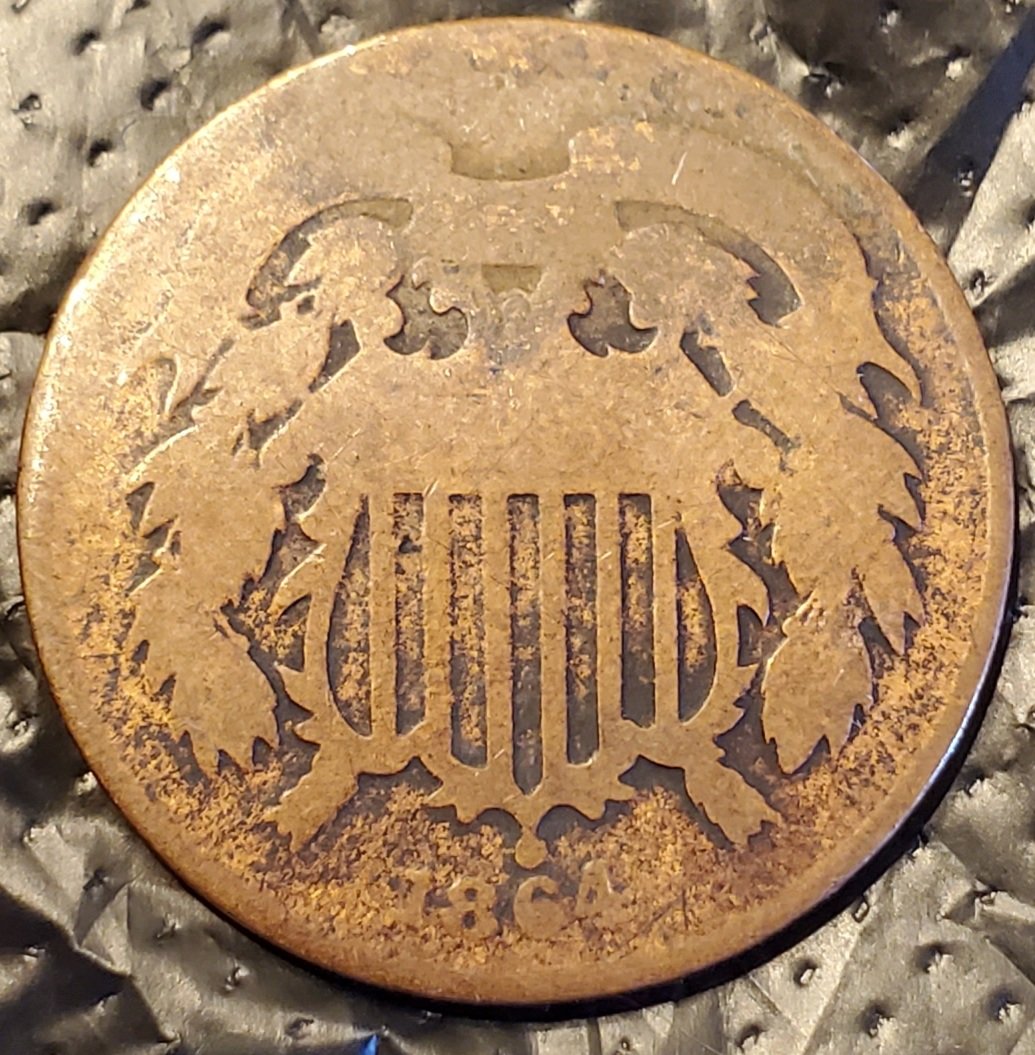
 Any US coin with this much weight loss from wear would be completely detail-free on both sides. No way this coin started out as a normal, full-weight mint product. Throwing out two random, unlikely explanations: 1) contemporary counterfeit. 2) off-metal strike on a less-dense alloy. |
|
Valued Member
United States
440 Posts |
That's interesting, Jaobler. I didn't think of counterfeit, maybe I'll have to take a closer look at it later. It's not a very valuable coin, so it would be good one to counterfeit. No one gonna look too closely for that. That's far more likely than the off metal strike, even though the latter would be very cool.
Edited by IsThisAnything
05/31/2021 2:25 pm
|
|
Valued Member
United States
440 Posts |
I realized coming back to this post today that I never uploaded the scale photo:  |
|
Pillar of the Community
 United States
4623 Posts |
-----Burton 50+ year / Life / Emeritus ANA member (joined 12/1/1973) Life member: Numismatics International, CONECA Member: TNA, FtWCC, NETCC, EveryCountry (online) coin club Owned by three cats and a wife of 40+ years (joined 1983) Author: 3rd Edition of the Sample Slabs book, https://www.sampleslabs.info/ |
|
Pillar of the Community
United States
9811 Posts |
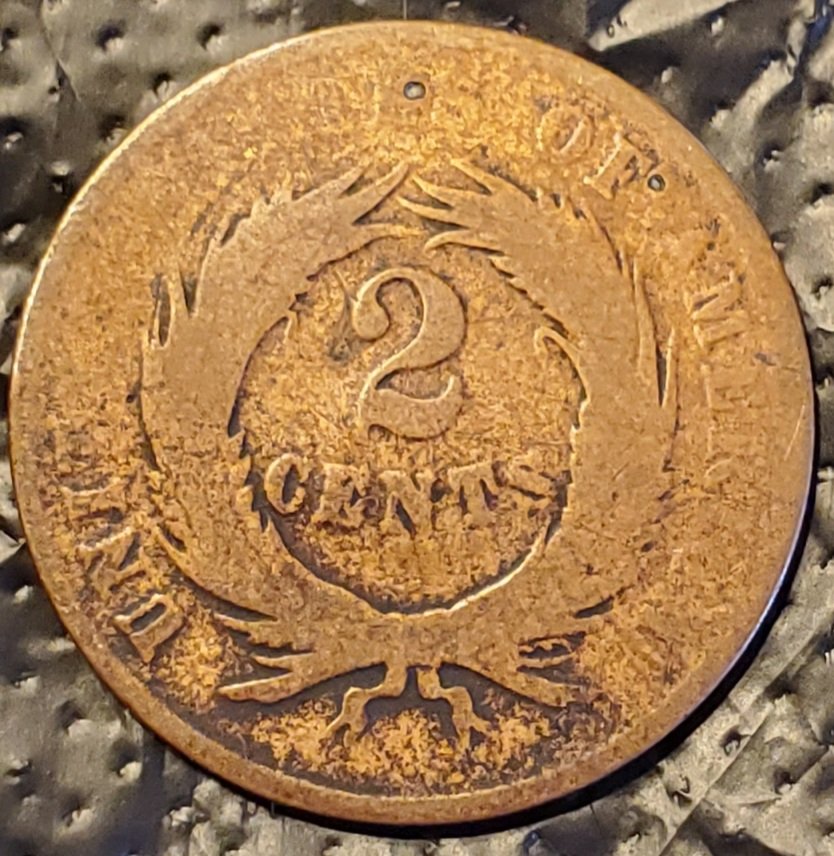
This coin isn't a counterfeit, it's just worn. It is most likely die pairing FL-13CA fairly obvious as the 6 is so close to the ball of the shield bottom and the 4 even higher than the 6. Possibly FL-79BH also a very similar date placement. The amount of wear this coin has makes it virtually impossible to tell 100%, I might be able to in hand but not from photographs, there a few subtle die cracks that may still show up faintly that could designate one die pairing from another, but it doesn't really matter as neither are super rare. Is there any rotation of the obverse to reverse? The FL-13CA is fairly well known to have varying degrees of rotation on it. Also known to have a mushy reverse and incomplete rim especially around the TE of states, Areas this coins is exhibiting weakness and wear already. There are next to no known off metal strikes (excepting patterns) in Two Cent series, and major errors are extremely rare, for the amount struck (especially in 1864 & 1865) there just aren't many errors found to this day. I can count only a handful of off center, double struck examples, (way less than 30 found) and even less capped, brokage, and flip over strike examples, however, there are quite a few known thin planchet examples which this is much more likely. I have also not seen counterfeits from the era. Only modern fakes out of China, surprising again as you see 3 Cent Silver counterfeits often, though that is likely due to the silver base metal versus copper/bronze alloy. Here is a little blurb from noted Two Cent author and expert Frank Leone from his short lived "2-Cent Times" newsletter. (I have almost 2 complete sets of this really rare newsletter), and I have spent time at the ANA researching this unlike Frank, and still have not uncovered much more than he has from the article. 2 Cent errors are really, really rare (at least the major ones are). Lots of Cuds, interesting die cracks, RPDs, a few DDOs, 1-DDR, and many other minor die varieties.  "Buy the Book Before You Buy the Coin" - Aaron R. Feldman - "And read it" - Me 2013! ANA Life Member #3288 in good standing since 1981, ANS, Early American Coppers Member (EAC), Colonial Coin Collectors Club member (C4), Conder Token Collector Club member (CTCC), Civil War Token Society (CWTS) member, Liberty Seated Collectors Club (LSCC) & Numismatic Bibliomania Society member (NBS), USMex, Member in good standing, 2¢ variety collector. See my want page: http://goccf.com/t/140440Edited by westcoin
06/03/2021 12:17 pm
|
|
Valued Member
United States
440 Posts |
West coin, thank you! That's some great information! I actually haven't known a lot about them and have just been picking up a few here and there lately, as I am a "one of everything" collector. That coin just stood out and felt off immediately when I picked it up. I don't collect for value, I collect for fun, so this is very interesting to me and informs my future 2 cent collecting.
I'll have to look to see if there is any rotation, but if there is, it would be VERY minor. I love rotated dies at any degree and I always look for them.
|
|
Valued Member
United States
440 Posts |
I also didn't know counterfeits would be rare/non existant. I was just applying my retail knowledge about modern counterfeit patterns. That's why I get for assuming!
|
|
Bedrock of the Community
United States
17884 Posts |
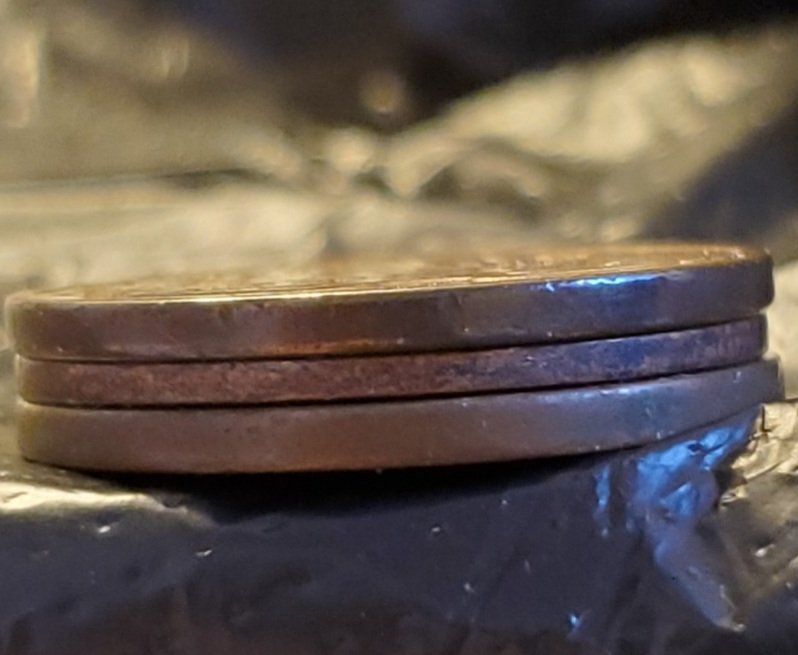
I would also wonder if it may have spent part of it's life in a corrosive solution and then returned to circulation. In his edge picture they appear to be fairly well lined up on the left edge of the image, but on the right side the coin in question seems to be inset from the other two. That would make me suspect a reduced diameter from a corrosive soaking.
|
| |
Replies: 13 / Views: 1,576 |
|






 Posted 05/29/2021 8:02 pm





