hjian You ask:
Quote:
One question I have is the technique to part gold from silver was not ready until late 1800. Why would US mint buy Zs silver from royalists at early 1800 to make profit from removing gold from silver?
A significant clarification is needed regarding the gold trace in Mexican coins of 1820s to answer that inquiry. Bear with the description because it holds the key to what you look for as an authenticator. All of this information is public knowledge and I know that counterfeiters are aware of that fact, but they face a monumental task attempting to recreate the alloy because they really need to match the alloy date exactly to fool XRF. Their only resort would be to melt genuine coins of the same date as the targeted copy and that process creates other issues I will not address here. Needless to say the resultant effort would be costly in todays market for all but the rarest pieces.
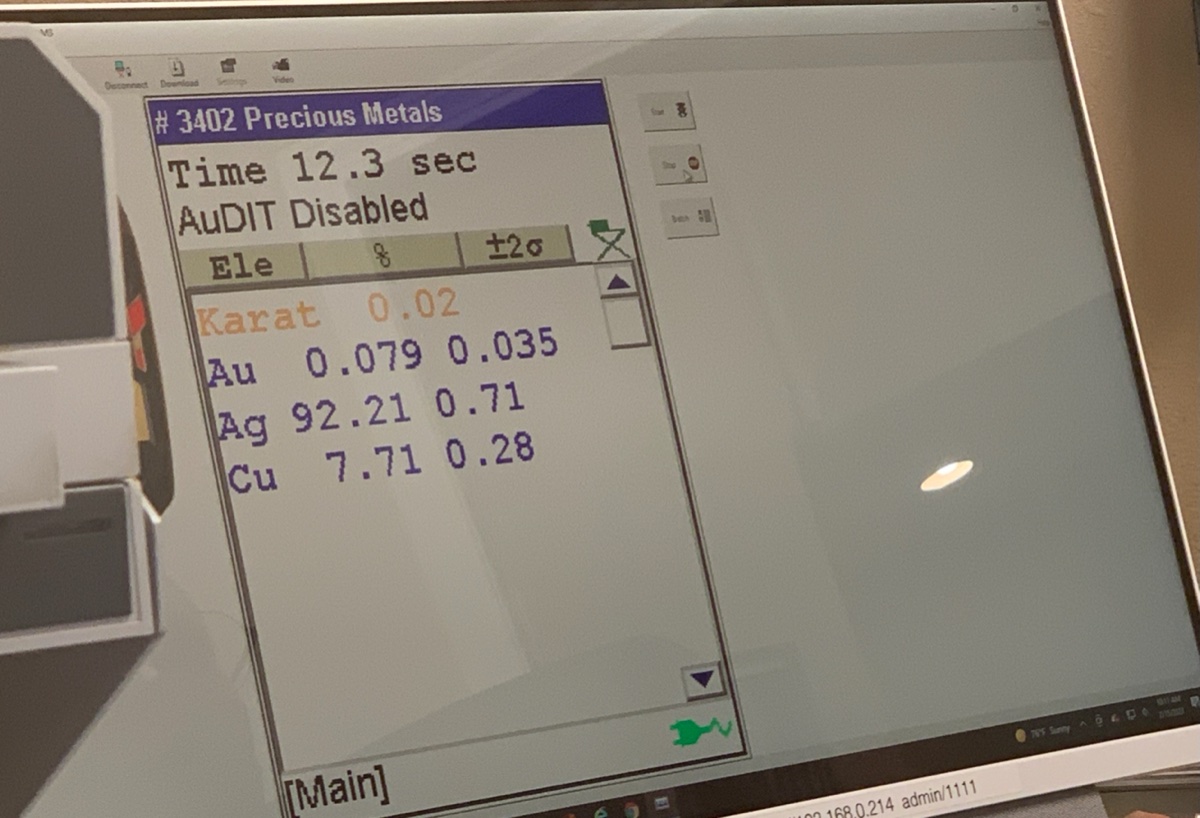
The test that I rely on mostly is done with a hand held XRF unit. This is completely adequate for average value 8Rs but can be successful used in screening out coins of higher values because no damage is done to the coin at all. This unit can detect gold as being present in an 8R because the return signal can be detected at a depth that is thicker than the tarnish and fire scale layers on a typical screw press strike. The heavier the element being detected the higher the energy of the photon release and the deeper the handheld unit sees into the coin. That is why a handheld unit is unreliable in creating the copper silver ratio of an 8R accurately. Copper is too light an element so that the presence of copper is only seen in a much thinner layer at the surface of the coin which is effected by tarnish and fire scale layers. Therefore for copper and silver ratio accuracy and for other minor trace contaminants a lab XRF accurate to 10 ppm is needed at a much higher cost. Right now although costs have fallen precipitously since I began authentication this test can cost well over $100 per coin.
If the reading of gold using a Handheld XRF does not exceed 200 ppm there is absolutely NO chance the coin was made with silver refined in Mexico prior to the 1880-90 time frame. If the test falls in the range from 200 to 400 ppm the coin is still unlikely to have been made in Mexico, but a follow-up lab test is required for certainty. This is based on over 200 XRF tests conducted to date on a range of 8Rs using handheld units. The problem resulted from the fact that of the 200 coins tested 2 which I consider to be genuine beyond all doubt have fallen in the 200-400 range and I consider them suspect until tested more accurately so that trace contaminants in a far lower range can be confirmed. Museum authenticators of Mexican silver artifacts actually employ a higher gold trace standard in their work which my tests do not support. I suspect that the mints refined silver to a higher standard for coins than for use in silver artifacts.
The reason there is a remaining trace of gold is because parting (separation) methods in use in Mexico could not remove all of the gold from the silver produced by the mine Haciendas (refineries at or associated with the mines).
The underlying reasons are two fold. First silver and gold have a physical property unlike most metals. When melted they form a solution because they are mutually soluble in the liquid state. It is like mixing sugar into coffee. The sugar dissolves and spreads evenly in the water. One part of water contains the same amount of sugar as all others. The same thing happens when gold and silver are mixed together as a liquid when they are melted and poured into an ingot. Fortunately the level of solution is much lower than sugar and water or we would all still use electrum for coins.
How to overcome this tendency to mix required a brand new process not invented until the time of the Comstock lode in Colorado ca 1870 and not fully perfected until 1890 for industrial scale usage.
At Zacatecas and Guanajuato the mother load veins consists of a mixture of silver and gold in a quartz intrusion that was forced into cracks in the native rocks by superheated water during a volcanic uplift. The percentages vary but the two metals are always present together in most of Mexico. The uplift happened millions of years ago and involved the North American plate and the Pacific plate which were and still remain in contact (think San Andreas fault). The geologic process is interesting but not needed here. The tectonic plates of Colombia, Bolivia, Peru and Chile need to be considered distinctly when reviewing those uplifts for naturally occurring metals and for authentication of silver from those locals.
The silver ores encountered in the old world were of a different chemical type completely. Old world methods of refining did not apply to these new quartz deposits with their characteristic very low grade ores found in thin quartz veins. After much trial and error a process called the Patio Process was developed in Mexico and South America that was very successful. It used Mercury amalgamation to extract the metal from the quartz. This process was understood as early as 1500 but never employed in Europe because of alternative methods which yielded better results with their ore types.
The Patio Process starts with crushing the ore to a fine powder. Mixing this powder with salts and mercury in the hot sun on the stone surface of the "patio" starts the process. The mixture is stirred by mules walking in circles in the mud. This produced a mercuric mud which contained metals like gold, silver, copper, zinc, lead and iron (with other stuff as well). After the mud was dried and excess mercury was removed, the resulting cake was refined by smelting (oxidation) in a blast furnace it in a process more similar to that used in Europe but starting with a very high grade mix of metals. Mercury was recycled by capturing the vapor and condensing it, so losses of mercury (costly stuff) were controlled. Copper, iron, lead and all other reactive metals were removed leaving the gold and silver mixed together.
The method used to separate the gold from the silver was repeated cupellation which heated the metals to liquid state in a cupel made of powdered bone that oxidized the remaining base metals as slag and gravity resulted in the gold partially separating from the silver. A gold button formed at the point of the cone shaped cupel. The button of gold was removed, the slag was also removed and the process was repeated on all three portions. Every successive cupellation produced finer and finer gold at the base. However, gravity separation can not remove all the gold suspended in solution in the silver.
The Mexican mines operated on a for profit basis often with overseas owners running the show. So with the gold silver ratio fixed at 16 to 1 only so much effort could be employed to remove the gold before removal became unprofitable. The largest cost of cupellation was the fuel. Wood was used because coal could not be transported to the Haciendas before the advent of railroads. So in 1820 in Mexico, mine silver was considered to be "pure" when no more gold could be removed economically. That could require 4, 5, 6 or more successive cupellations. The mines in the mountains above the tree line faced the steepest costs for fuel since the local wood supply was exhausted early on. The number of cupellations could also be influenced by the need to produce output for operational expenses, payroll and of course for taxes being paid. The Royal tax.
Estimates vary but 99% was considered a good level of purity if fuel was abundant and fairly cheap. Acid reduction could be employed in a laboratory setting to purify silver further but in Mexico it was not used on an industrial level for numerous reasons, the largest being cost.
So on average silver from the mines was roughly 99% pure with the remainder being mostly gold. That is one percent of the bar or 10000 ppm gold and 990,000 ppm silver. That is one one hundredth part gold. That is really the upper limit expected to ever be encountered in raw Mexican silver before the Revolution in times of stability. I have actually encountered a Guanajuato 8 Reales from the first Republican era that tested about 8% gold (80,000 ppm gold 920,000 ppm silver). That occurred during the period when Anglo-Mexicana (Manning and Marshal) ran the mint under lease. So you can see the drive for silver sales at times caused very high gold contents coins to be released simply to pay the bills.
During the War things operated under much higher pressures and included which side happened to be running the show at any given time.
Wartime issues that were not parted at all could be much higher - as high as 9 or 10% gold. The reason is simple Mexico still employed Cupellation following the the Patio Process and during the War, time could not be wasted if troops needed to be paid or the government needed cash. Revolutionaries issued Royalist coins using silver debased with copper in hopes the Royalist issues would fall out of favor.
That is why wartime issues (Riddell's so called Hammered coinage) was being melted in very large batches at New Orleans beginning in 1839 - see his 1845 book. The wartime issues of Zacatecas and other mints were found to use raw silver that never was parted using cupellation at all resulting in a far different ratio more like 91% silver and 9% gold. From those coins, the US mint using their normal cupellation process could part a large percentage of the remaining gold and make 8 cents on average per coin. Gold was worth 16 times more than silver by weight, so the math is easy to do. Riddell notes up to 50,000 Mexican hammered coins were melted per year to mint coins at New Orleans.
About 1850 there were improvements made in England in parting gold from native argentiferous lead ores. Some silver was also created in the process but I now suspect that the gold trace may have remained. I am reading a new book that may shed light on that process so I can revise my trace levels for silver refined in the 1850s in England. For now, I consider that English silver could possibly contain less gold than Mexican for a number of reasons I need not discuss here.
The greatest innovations in parting a trace of gold from bulk silver happened rapidly in the US following the discovery of the massive Comstock silver lode in 1869. (Note: The reverse process of refining gold to remove a trace of silver was possible rather early on by the introduction of lead and additional silver into the alloy. That too is not important here.) Refining of silver in a 10-12 year period went from the crude method of the Patio Process (mercury amalgamation) to extraction using mercury, cyanide and gaseous chlorine to extract and part gold from silver. That created the first large scale availability of 99.99% fine silver. The use of electricity and improvements in generators and storage batteries shortly thereafter made modern 99.999% fine silver feasible.
So in a million words or less that is why the US mint could melt Mexican 8Rs at a profit in the 1830's - because it was not at war and fuel and acids were far cheaper to buy.









 Posted 07/10/2021 02:26 am