| Author |
 Replies: 63 / Views: 5,925 Replies: 63 / Views: 5,925 |
|
Press Manager
 United States
1420 Posts |
PCGS - Professional Coin Grading Service announces its official redesignation of the popular early Federal-era copper coin as a regular-issue federal coin.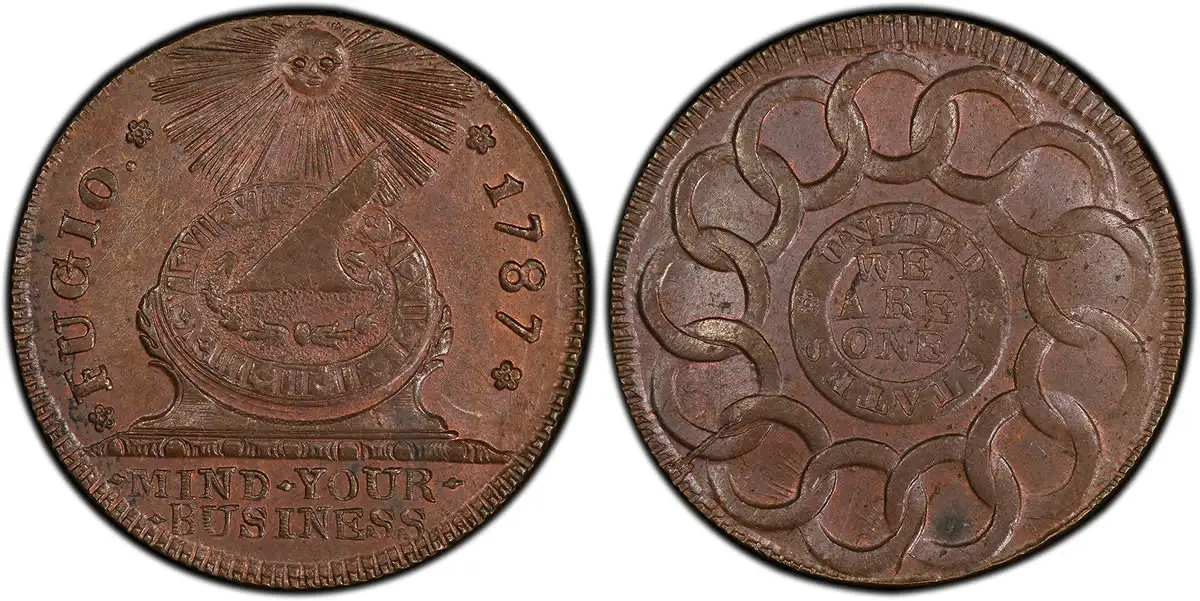 This specimen of the 1787 Fugio Cent, a variety known as United Above, States Below, is highly coveted among collectors and belongs to a popular series PCGS is reclassifying as a regular-issue coin. Click image to enlarge. This specimen of the 1787 Fugio Cent, a variety known as United Above, States Below, is highly coveted among collectors and belongs to a popular series PCGS is reclassifying as a regular-issue coin. Click image to enlarge.The Fugio Cent has long been one of the most enjoyed early American collectibles, and now numismatists can count it as the earliest of all United States Mint regular-issue coins. Professional Coin Grading Service (www.PCGS.com) is announcing the groundbreaking reclassification after an exhaustive study carried out by a team of leading numismatic experts including John Dannreuther, Gordon Wrubel, Craig Sholley, Brian Greer, Chuck Link, Tony Terranova, Chris Victor-McCawley, David McCarthy, and Erik Goldstein. "The Fugio Cent is one of the most popular coins from the early Federal period, so it's a big deal when new research sheds enough light to completely reshape the hobby's understanding of an iconic coin like this," says President of Professional Coin Grading Service Stephanie Sabin. "By officially recognizing the Fugio Cent as a regular-issue circulating coin based on the overwhelming evidence presented by our numismatic experts, we help enhance the hobby's understanding of this important coin and its foundational role in the early United States monetary system." PCGS Director of Numismatic Education and Grading Team Leader Steve Feltner is intrigued at how much information lay beneath the surface of such widely studied and collected coins like the Fugio Cent. "Fugio Cents, long lumped into the same colonial class as New Jersey Coppers, Nova Constellatio Coppers, and Massachusetts Cents, are finally going to get the numismatic credit that they have deserved for nearly two and a half centuries!" Feltner says the decision to reclassify the status of the Fugio Cent wasn't something to be taken lightly. "When I was first approached about the idea of reclassifying Fugio Coppers as Fugio Cents, I will admit I was skeptical. So much has been studied and written about them in the past that I couldn't imagine anything warranting a change." He concludes, "I was wrong." Adds Feltner, "The research and historical backing that was presented to me and my colleagues at PCGS was irrefutable. There were several times during the initial read-through that I caught myself saying, 'that makes sense.' It was an experience that I will never forget." 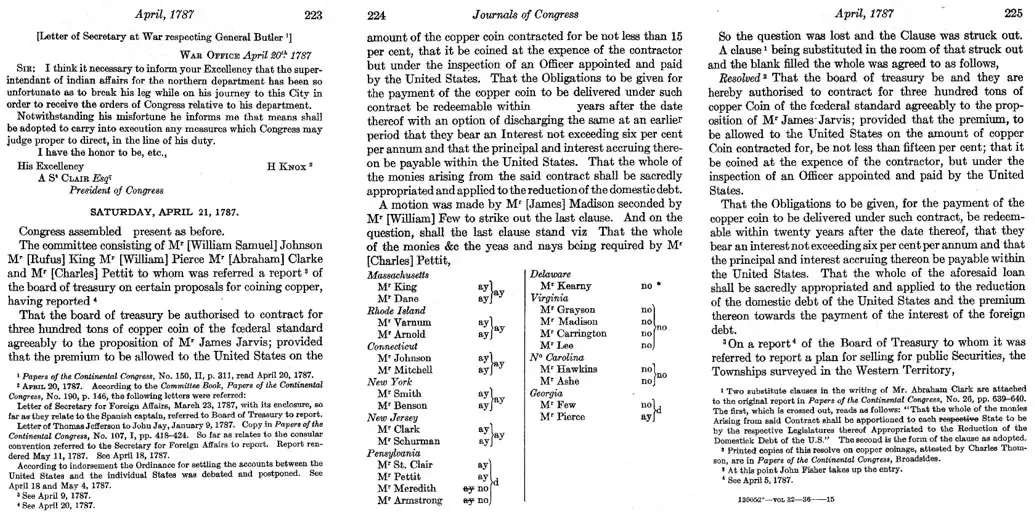 An extract from the Journals of the Continental Congress for April 21, 1787. Click image to enlarge. An extract from the Journals of the Continental Congress for April 21, 1787. Click image to enlarge.Among the evidence warranting the reclassification of the Fugio Cent as a regular-issue coin is a measure passed by the Board of Treasury on April 21, 1787, noting that the Fugio Cents were to be "of the federal standard" per weight standards stipulated in the 1786 report for United States gold, silver, and copper coins. As part of these standards, cents were to contain 157.5 grains of pure copper. So, when Congress authorized the contract for Fugio Cents on this date, the intent was to produce coins that were needed in commerce. The reclassification of the Fugio Cent as a regular-issue coin isn't the first time PCGS has led the way in properly recognizing coins that may have been numismatically miscategorized in the past. Years ago, PCGS was the first grading service to classify 1792 Half Dismes, once listed among pattern coins, as regular issues. A Guide Book of United States coins ("The Red Book") and others soon followed suit. The reclassification of the Fugio Cent means PCGS will list them among regular-issue coinage, under the heading of "Federal Contract Coinage," and they will retain their position among PCGS Colonial Registry Sets. Read the January/February issue of the PCGS Rare Coin Market Report for the full story on why PCGS is reclassifying the Fugio Cent as a regular-issue coin.
|
|
|
|
Valued Member
United States
466 Posts |
This is historically inaccurate. The Constitution was not ratified, and the Federal government was not created until June 21, 1788. Previously the individual state governments were loosely United under the Articles of Confederation and the Continental Congress. Both were abolished by the June 21 Constitutional ratification.
The Constitutional Federal government was necessary for many purposes. The Continental Congress had no power to tax, no means of providing a national defense or of passing meaningful laws. The states were fighting amongst themselves and the Union was on the verge of collapse.
The Continental Congress action approving this coin was a Confederation action under the then existing Articles. It was not an issue of the Federal government, as it did not yet exist.
I have no trouble calling this a Continental issue (Continental Dollar?). I have no problem calling it a USA coin. But it simply isn't a Federal issue.
|
|
Valued Member
United States
466 Posts |
PS
The Continental Congress could not pass laws binding on States or throughout the Union. It had no power and no resources to coin money and declare it legal tender throughout the Nation. One of the reasons for the Constitution, addressed in Article I, was the power to coin money. Previously, the states were the issuers of currency, the value of which had declined to near zero in many instances.
|
|
Moderator
United States
194468 Posts |
This is a very interesting discussion.  |
|
Valued Member
United States
466 Posts |
After reading the Continental Congress Journal excerpt relied on by PCGS, I question whether these coppers were coins or bonds. They bear annual interest of 6% and are redeemable within 20 years. Not characteristics of typical legal tender coinage. Arguably an investment as much as anything else.
|
|
Pillar of the Community
United States
4680 Posts |
Interesting. @ Sharkman, I believe the interest is referring to the purchasing of the 300 tons of materials/coinage. The interest is accruing on the loan for said product. Not interest on a single coin, post mint, as a bond. But I may have misread/misunderstood. Gets more confusing the more times I read it  |
|
Bedrock of the Community
United States
11954 Posts |
I agree with PCGS. We became a nation when we declared independence from the British in 1776, not just a bunch of independent states. We celebrate our independence and becoming a nation on July 4, 1776. The Continental Congress did not have to look exactly like the current Federal government for the United States to be a nation with an official government. The Fugio coins were money commissioned to be created by the official government of our nation.
Also the Fugio cents did not pay interest. The obligation to deliver coins under the contract for the copper coins and the option for early delivery together bore interest at 6%. That and whether the contract obligation was promised to be redeemable in 20 years are irrelevant. The Fugio cents were money.
IN NECESSARIIS UNITAS - IN DUBIIS LIBERTAS - IN OMNIBUS CARITAS THE MAN IN THE ARENA, Theodore Roosevelt at the Sorbonne Paris on April 23, 1910: " It is not the critic who counts; not the man who points out how the strong man stumbles or where the doer of deeds could have done better. The credit belongs to the man who is actually in the arena, whose face is marred by dust and sweat and blood, who strives valiantly, who errs and comes up short again and again, because there is no effort without error or shortcoming, but who knows the great enthusiasms, the great devotions, who spends himself in a worthy cause; who, at the best, knows, in the end, the triumph of high achievement, and who, at the worst, if he fails, at least he fails while daring greatly, so that his place shall never be with those cold and timid souls who knew neither victory nor defeat." My coin website: https://fairfaxcoins.com |
|
Bedrock of the Community
United States
11954 Posts |
The reverse of the coin shows 13 chain links representing the 13 original colonies under the motto of United States (or States United in error). E Pluribus Unum.
The Constitution reflected evolving thinking, which not everyone agreed on, about the form of our government. It did not create our nation or our government. That was done through an act of defiance of King George III in the issuance of our Declaration of Independence, and then defending our conviction to no longer recognize a tyrant across the Atlantic by fighting and winning the Revolutionary War.
IN NECESSARIIS UNITAS - IN DUBIIS LIBERTAS - IN OMNIBUS CARITAS THE MAN IN THE ARENA, Theodore Roosevelt at the Sorbonne Paris on April 23, 1910: " It is not the critic who counts; not the man who points out how the strong man stumbles or where the doer of deeds could have done better. The credit belongs to the man who is actually in the arena, whose face is marred by dust and sweat and blood, who strives valiantly, who errs and comes up short again and again, because there is no effort without error or shortcoming, but who knows the great enthusiasms, the great devotions, who spends himself in a worthy cause; who, at the best, knows, in the end, the triumph of high achievement, and who, at the worst, if he fails, at least he fails while daring greatly, so that his place shall never be with those cold and timid souls who knew neither victory nor defeat." My coin website: https://fairfaxcoins.com |
|
Valued Member
United States
466 Posts |
The United States of America undoubtedly was Declared to exist on July 4th, 1776. I believe it came into existence, practically speaking, when the Second Continental Congress sent George Washington to Boston in 1775 to protect it from the British.The CC prosecuted the Revolutionary War under under the Articles of Confederation, bargained with France for financing and military aid, approved the Treaty of Paris officially ending the war, and promulgated the Northwest Ordinance dealing with expansion into Western lands. These were crucial developments in USA history, but the Continental Congress had no other powers and did, and had the power to do nothing else of note thereafter.
Under the Articles of Confederation, each State functioned and viewed itself as a separate sovereign country. The word state has long been used to denote a separate country. The CC had no power over the states, either to pass laws effective in the states, or to impose taxes. Or even to provide for defense after the War ended.
The states were imposing import duties on each other and fighting amongst themselves. Some states were contemplating alliances with other states and even with foreign governments. England had invaded and was maintaining forts in USA territory in the far West. France threatened from the Caribbean, and Spain from the south. The individual states and Confederation Continental Congress had no way to defend themselves against these much stronger powers. There was no central federal government with power to do anything, and everyone was broke. The states had issued currency that devalued virtually to zero, as did the Continental Congress scrip the Continental Army soldiers were paid with. It cannot be overstated how close the USA was to collapse before the Constitutional Convention.
Historians agree that the Republic began with ratification of the Constitution in 1788, and the 1789 election of Congress and the first president, George Washington, who is universally recognized as the USA's first president. The earlier "presidents" who held the gavel and presided over meetings of the Continental Congress had no executive power and are pretty much forgotten. George Washington, beginning in 1789 was, indeed the first President with executive power over a central Federal government with authority to govern all the states.
As a matter of undisputed historical fact, there was no central federal government with any power over the individual states or the country as a whole until 1789.
Because there was no central federal government having any power prior to 1789, I have to disagree that the Fugio copper was a federal issue. There simply was no "federal" at the time of the CC's resolution relating to copper coinage. I do note the use of the word federal in the resolution as it related to weights and measures. I haven't a clue what the word means in that context, but the Federal Government and centralized Republic we know now was not yet in existence.
My personal belief is that the United States of America as a nation began as a Confederation of thirteen self governing states in or somewhat before July 4, 1776. I believe the United States of America morphed into a centralized Republic with actual governing powers at the federal level with adoption of the Constitution. For what it's worth, the Constitutional Framers even grappled over whether the central government should be a Republic.
So that's why I see it the way I do The United States of America has existed since 1776, but it did not have a Federal government until 1789.
*** Edited by Staff - Added paragraphs. ***
|
|
Pillar of the Community
United States
1347 Posts |
That's a really cool coin, I came real close to pulling the trigger on one, at my last coin show.
|
|
Pillar of the Community
 United States
5276 Posts |
If true as described by Sharkman, then we should call it the "Union of America", formed on July 4th, 1776. Only in 1788 was there any semblance of being "United" (with one federal government).
Perhaps the US simply copied the Dutch who, in 1579, formed the "Union of Utrecht" which was an alliance of seven Dutch independent provinces who promised to help each other in their war/defense against the Spanish. Only in 1588 became the Union a fully fledged Republic with a central authority (The "United Provinces of The Netherlands").
Interesting to note is that America basically followed the Dutch at almost exactly a 200 year interval (1579 - 1776, 1588 - 1788).
|
|
Bedrock of the Community
United States
12057 Posts |
I'm sure this will spark some lively discussion among EAC and C4 members.
The precise definition of which monetary issues are, or are not, "Federal" has been a contentious debate for much longer than I've been alive.
I tend to agree with Sharkman from a purely historical point of view. The notion that a Federal Republic should even exist all was far from settled and hotly debated among the founding fathers; the Articles of Confederation were a weak and mostly meaningless gesture. Jefferson, for instance, favored the concept of the true Republican citizen, his ideal the self-sufficient landowner or the French Revolutionary; Hamilton, Adams, Jay, Marshall and the other Federalists quite the opposite, advocating for a national government with centralized judicial and fiscal (banking) powers, and the restoration of trade and treaties with Great Britain. This was an ongoing concern well into the first decade of the 19th century.
That being said, I don't think it makes much difference how PCGS categorizes Fugio cents apart from semantics, at least to me.
Member ANA - EAC - TNA - SSDC - CCT #890 "Most of the things worth doing in the world had been declared impossible before they were done." -- Louis D. Brandeis |
|
Valued Member
Canada
98 Posts |
Where I am taken aback is the lack of transparency as to the rationale behind the decision. The issue at hand is chiefly of a historical matter, and not really about the physical characteristics of the coin itself (other than being able to affirm its identity when referred to in any documents). Given that this matter dates back a good while--an era of America for which many questions are still open--this is closer to scholarly research than basic hobbyist research.
That's not to say that non-academics can't research these topics--they should--but like anyone producing original findings, their process and rationale should be open for scrutiny. We have very little of that from the press release (again, not the typical format of such a topic) given.
Just as this forum allows the public to openly discuss these matters, I believe the best way to move forward is just to shoot PCGS an email asking for an explanation (I would use specific questions to which the answers should address). If they give an answer to the question, we have more insight into their thought process and can continue to proceed. If they can't, while that's not proof that they are wrong, it comes across as suspect.
Perhaps, some people here would be willing to ask them questions? That's the approach I would take if you feel you have an argument against their decision. Personally, I'm curious to see how this goes from here.
|
|
Valued Member
United States
202 Posts |
There's arguments on both sides, but at the end of the day PCGS is a for profit company with a good deal of bias. While I am sure they have some of the best experts in the field working for them, they ultimately have other motives.
Declaring Fugios federal issue, weather correct or not, will accomplish free publicity for them and increase submissions of all types of coins, not just Fugio Cents. The timing of this decision seems suspect as well, coming right before the FUN show. I'm betting there was more to this than just the 'aha' moment that the article seems to suggest.
|
|
Bedrock of the Community
United States
11954 Posts |
Quote:
The CC prosecuted the Revolutionary War under under the Articles of Confederation, bargained with France for financing and military aid, approved the Treaty of Paris officially ending the war, and promulgated the Northwest Ordinance dealing with expansion into Western lands. These were crucial developments in USA history, but the Continental Congress had no other powers and did, and had the power to do nothing else of note thereafter. I think you gloss over important facts. In 1781, while still fighting the War, the Second Continental Congress created the Department of Finance to manage the national debt, headed by Robert Morris. Although the national debt was apportioned to the states, it was still the national debt and there were many fights, particularly from wealtheir states like Virginia, which Jefferson hailed from, that could better afford the repayment and didn't want to nationalize the debt and Hamilton who fought for the nationalization of the debt. Ultimately Hamilton won. Shortly after the outbreak of the Revolutionary War, the states issued state currency and the Continental Congress issued Continental currency in the form of paper notes. Both shortly became worthless, but the Congress had the power to issue money and did so in large amounts. The failure of the Continental currency was in large part because the Continental Congress did not have the power to tax, generate revenue and therefore stand behind the issuance of its currency.
In 1783, Congress gave itself the power to tax to cover the government's costs which ended up falling short mostly because of the overhang of $43 million in national debt borrowed from France and the Netherlands primarily to fight the Revolutionary War.There was clearly a national government in the Constitutional Congresses with the power to tax, issue money, contract to coin money and ratify a Constitution. Well before 1787 when the Fugios were contracted to be coined and came into existence. The Continental Congresses had all the power necessary to bring about all the changes the States agreed to in our nation. IN NECESSARIIS UNITAS - IN DUBIIS LIBERTAS - IN OMNIBUS CARITAS THE MAN IN THE ARENA, Theodore Roosevelt at the Sorbonne Paris on April 23, 1910: " It is not the critic who counts; not the man who points out how the strong man stumbles or where the doer of deeds could have done better. The credit belongs to the man who is actually in the arena, whose face is marred by dust and sweat and blood, who strives valiantly, who errs and comes up short again and again, because there is no effort without error or shortcoming, but who knows the great enthusiasms, the great devotions, who spends himself in a worthy cause; who, at the best, knows, in the end, the triumph of high achievement, and who, at the worst, if he fails, at least he fails while daring greatly, so that his place shall never be with those cold and timid souls who knew neither victory nor defeat." My coin website: https://fairfaxcoins.comEdited by numismatic student
01/05/2022 10:47 pm
|
|
Valued Member
United States
466 Posts |
NS
Much of what you say is well taken. But the Continental Congress did not ratify the Constitution. It was created by the Constitutional Convention, not the Continental Congress, and it was approved by WE THE PEOPLE in a nationwide series of state elections in which the number of eligible voters was intentionally expanded to be as broad as reasonable.
The Continental Congress issued money that had no substantive value because the Continental Congress could not back it. I am aware of the Continental Congress collecting import duties, and it requested money from the states which was essentially unpaid, but my reading has indicated that the CC failed because it lacked the effective power to tax. Maybe you are correct. The CC could have tried to tax, but been powerless to collect.
The Articles of Confederation the Continental Congress operated under expressly recognized that each State retained its sovereignty,freedom and independence. It describes the Articles as "a firm league of friendship" between the states. The Articles gave Congress the power to represent the United States of America in international affairs, but no domestic law making authority. Congress could request money from the states but not compel payment. The Continental Congress had no power within any State.
I just disagree that the powers you list equate to a central or national government with the power to govern the thirteen states as a single nation. I agree with Paralyze that theArticles of Confederation were "a weak and mostly meaningless gesture." Centralized national government with meaningful power and authority came after the Constitution when the Federal government was formed and the states were bound to it.
Your observations are thought provoking, but we come down on opposite sides of the coin (sorry) on this one.
|
| |
Replies: 63 / Views: 5,925 |
To participate in the forum you must log in or register.
Disclaimer: While a tremendous amount of effort goes into ensuring the accuracy of the information contained in this site, Coin Community assumes no liability for errors. Copyright 2005 - 2026 Coin Community Family- all rights reserved worldwide. Use of any images or content on this website without prior written permission of Coin Community or the original lender is strictly prohibited.
Contact Us | Advertise Here | Privacy Policy / Terms of Use
|
| Coin Community Forum |
© 2005 - 2026 Coin Community Forums |
| It took 0.68 seconds to rattle this change. |
 |
|









 Posted 01/04/2022 10:35 pm


