| Author |
 Replies: 12 / Views: 1,251 Replies: 12 / Views: 1,251 |
|
|
New Member
United States
30 Posts |
Just starting to collect and move my coins into an album when I noticed my 13 S was blank on one side. Does this add to the value? I would say the "heads" side was good to very good. 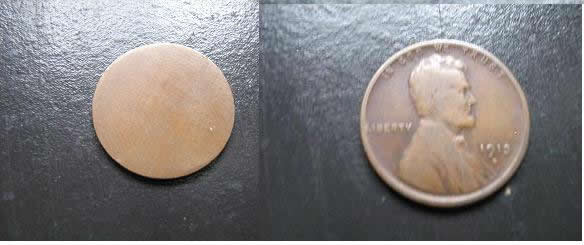 |
|
|
|
Pillar of the Community
United States
5700 Posts |
Theres something you do not see every day, nice find!
|
|
Moderator
 United States
16694 Posts |
 The reverse was intentionally scraped off. Unfortunately, worthless. swcoin.ecrater.com
|
|
Pillar of the Community
United States
5318 Posts |
 There's no other explanation for a rim missing on one side. |
|
New Member
 United States
30 Posts |
Well, it will have to do till I get a replacement. I am green, I admit. Few other funky cents in the lot I will post later.
|
|
Moderator
United States
16694 Posts |
Quote:
Well, it will have to do till I get a replacement. I am green, I admit. Few other funky cents in the lot I will post later That's how you learn! Post the other coins you have. We would like to see them  swcoin.ecrater.com
|
|
Bedrock of the Community
United States
20027 Posts |
to CC! ...and keep the Lincolns coming!  Lincoln Cent Lover!VERDI-CARE™ INVENTOR https://verdi.care/
|
|
Pillar of the Community
United States
1699 Posts |
I've seen many coins like this, and was wondering if a coin could only be struck with one die only have one side with the striking surface on it. Is this possible?
|
|
Bedrock of the Community
United States
10045 Posts |
Even if struck with a blank or defaced die, that side of the coin would retain the rim.
Yet, I cannot think of an instance of a US coin struck with a blank die.
|
|
Pillar of the Community
United States
2589 Posts |
what about two fused planchets that were struck together and then split apart later?
|
|
Pillar of the Community
United States
1807 Posts |
Quote:
XavierOfGreen Posted - 2 Hr 39 Min ago : 6:01:41 PM
--------------------------------------------------------------------------------
what about two fused planchets that were struck together and then split apart later? That would be a Brockage Error,when the previous coin remained stuck to a die, creating an incuse impression in the next struck coin. I don't think it would be as flush on the surface as this coin. Edited by rockdude
03/01/2009 8:44 pm
|
|
Pillar of the Community
United States
7123 Posts |
I agree with those who Identified the coin as post mint damaged , sanded off side .
Its interesting to know that my generation was not the only one who messed up coins for no reason .
|
|
Bedrock of the Community
United States
17884 Posts |
Quote:
That would be a Brockage Error,when the previous coin remained stuck to a die, creating an incuse impression in the next struck coin. He said two planchets, there was no mention of a previously struck coin. So it would not be a Brockage. It is possible for two planchets to enter the coinage chamber at the same time. Now let's think about what the results would look like. The lower coin would show a VERY sharp strike on the side that faced the die, same for the upper coin. This is because of the greatly increased pressure of the strike. Now with two planchets in the coining chamber the upper one would not fit completely down into the collar. So the upper one would also be a partial collar error as well. Inside the coining chamber the tow sides o planchet are against each other. Not the planchets are not flat so we do not have a flat to flat contact here. And since the collar is slightly larger than the planchets they may also not be directly over each other. Now consider what happens when the dies come together. The dies are very slightly convex so the upper planchet gets pushed downward in the center and makes contact with the lower planchet. At about the same time the pressure on the upset rims increases and the meal there starts tring to get out of the way but since there isn't completely even contact some areas get pushed down and some up. The planchets starts spreading out radially until it makes contact with the collar and tries to flow upward if it is the lower planchet or downward if it is the upper. But they don't meet the collar everywhere at the same time so the edges where it meets the collar are uneven. Also since the upper planchet spends a slight bit or time bending downward and pushing on the center of the lower planchet first, the lower planchet gets a bit of a head start flowing outward so you can have aslight "dishing effect as the lower planchet gets to the collar first in most places an flows up. In short the finished coins will be blank on one side, but they won't be completely flat or smooth, especially at the edges where the face meets the rim. |
| |
Replies: 12 / Views: 1,251 |
|







 Posted 01/11/2009 4:03 pm





