| Author |
 Replies: 12 / Views: 1,031 Replies: 12 / Views: 1,031 |
|
|
Pillar of the Community
United States
3552 Posts |
Where is the MM for these 80% Ag coins?
Has it always been in the same location?
|
|
|
|
Bedrock of the Community
United States
10284 Posts |
Edited by TNG
09/05/2021 5:56 pm
|
|
Pillar of the Community
 United States
3552 Posts |
Quote:
...40% silver I was confused since when I saw 'METAL: Outer layers - 80% Silver, 20% Copper; Center - 79% Copper, 21% Silver' on CoinFacts. And when I did not read it closely and since it nowhere mentions 40% Ag, the assumption was not crystal clear. But I now realize correctly that the ones with Ag must weigh 11.5 g: proof or reg. strike. |
|
Pillar of the Community
United States
3552 Posts |
But now comes the conundrum.
Since the silver 76s (proof and reg. strikes) all have an 'S' mintmark in the same place on the obv. per CoinFacts, what does one classify a 40% Ag one without an 'S' on either the front or back?
I know this MMless one still 'should' be silver since it does weigh 11.5 g without the mintmark.
Does anyone have an explanation since ALL 'non' silver 76s apparently weigh 11.3 grams? The weight discrepancy with the lost 'S' was the primary reason for this thread.
|
|
Bedrock of the Community
Australia
21792 Posts |
"40% silver " refers to the overall average purity of the silver in a '40% silver Kennedy'.
Thus, the total weight of a 40% silver Kennedy is 11.5 grams, and as a result, has ASW = 0.1479 troy ounces of silver in the coin.
To make up to one Troy ounce, you will need 6.76 - 40% silver Kennedys.
For this reason, much easier to buy or sell them at ("X") times their face value, where the variable "X" is dependent on the spot pure silver price.
Calculations are all reasonably easy, all based on lower high school level arithmetic.
|
|
Bedrock of the Community
United States
62064 Posts |
So doing the math, If they are 40% silver, the copper core would make up 60% of copper. Quote from Coin facts: Quote:
Bicentennial Half Dollars were produced in 1975 and 1976 in the usual copper-nickel "clad" versions, but also in a resurrected 40% silver "clad" alloy (same as on the 1965-1970 Half Dollars). Both Mint State and Proof version were made. No 1975-dated Quarter Dollars, Half Dollars, and Dollars were made, thus Proof and Mint Sets from 1975 contain Cents, Nickels, and Dimes dated 1975 along with the three Bicentennial Coins. Special, three-piece sets of the silver Bicentennial coins were sold at a premium to collectors. |
|
Pillar of the Community
United States
3552 Posts |
obv & rev 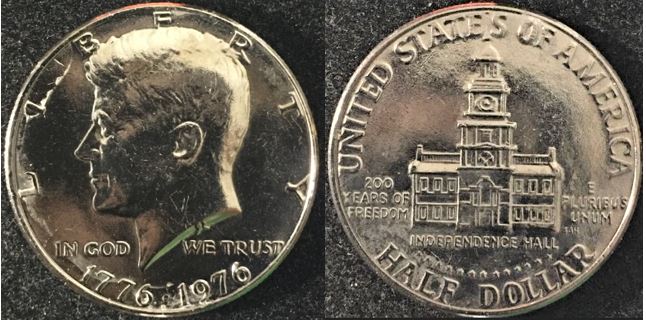 |
|
Bedrock of the Community
United States
62064 Posts |
|
|
Pillar of the Community
United States
3552 Posts |
proof proof @ five in. 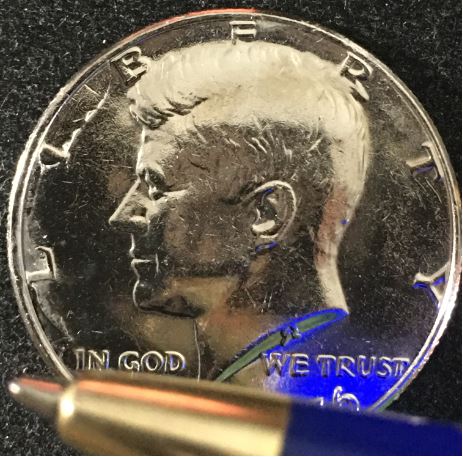 |
|
Pillar of the Community
United States
3552 Posts |
somebody ate the oreo  |
|
Pillar of the Community
United States
3552 Posts |
Quote:
...looks plated Initially I was thinking that it could be an unlisted variety or even an error. If we go with the assumption that it is plated, is it reasonable to calculate that the plating weighs 11.5 - 11.3 = 0.2 g and that the plating has covered up the copper x-sectional view? 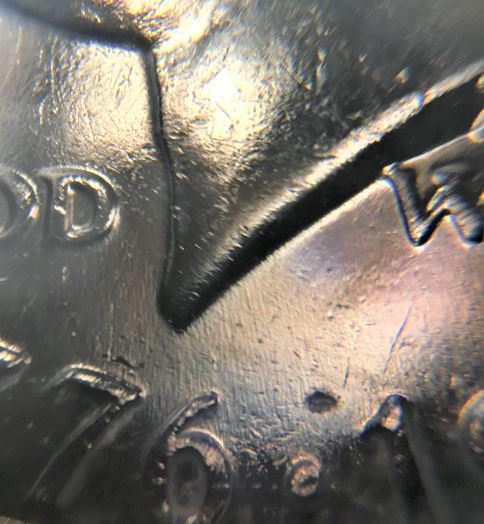 |
|
Bedrock of the Community
Australia
21792 Posts |
As mpdmedia has reported, there is a silver/copper alloy in the outer clad layer, and a copper/silver alloy in the core of all 40% silver Kennedys. Percentages as of different purity of alloys as reported.
Refer to his post.
On inspection of the milled edge, appearance of the poorer alloy core is not obvious.
|
|
Moderator
 United States
195559 Posts |
I agree with coop, this coin is plated.
|
| |
Replies: 12 / Views: 1,031 |
|










 Posted 09/05/2021 6:39 pm