| Author |
 Replies: 12 / Views: 3,543 Replies: 12 / Views: 3,543 |
|
|
Pillar of the Community
Australia
1985 Posts |
Found this 1980 fifty cent coin a while ago and thought it looked a lot thinner than a usual 50 cent coin. Finally got around to weighing it and it comes in at 13.6g compared to the normal 15.55g - that's almost 13% lighter. 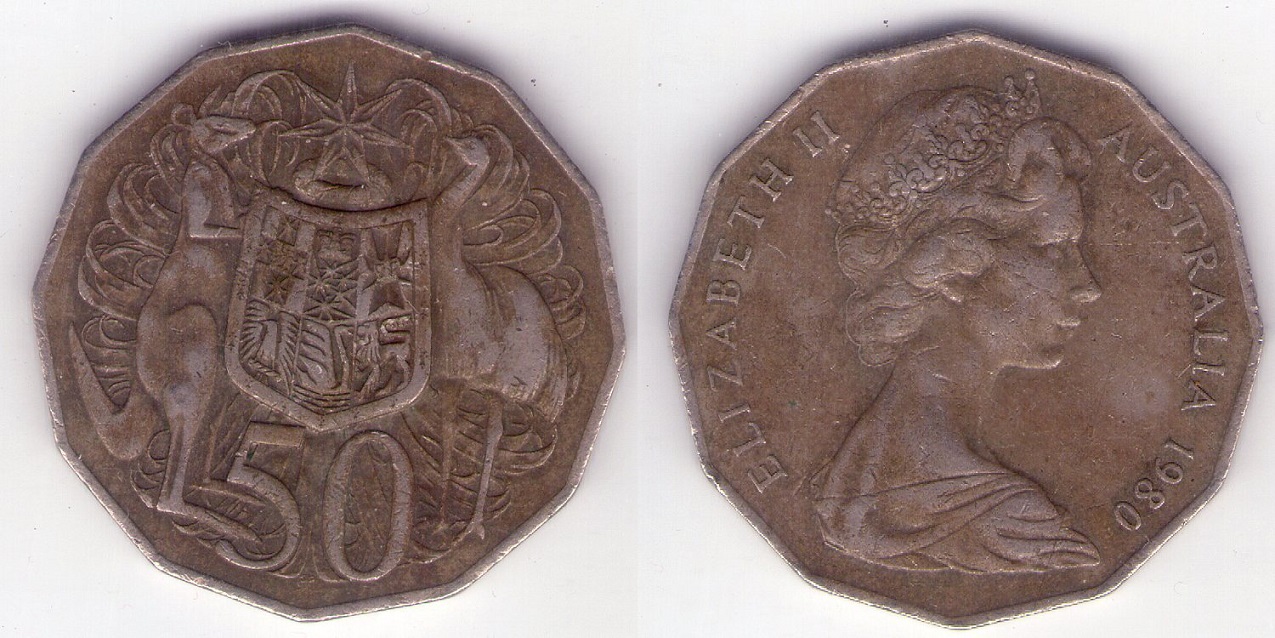 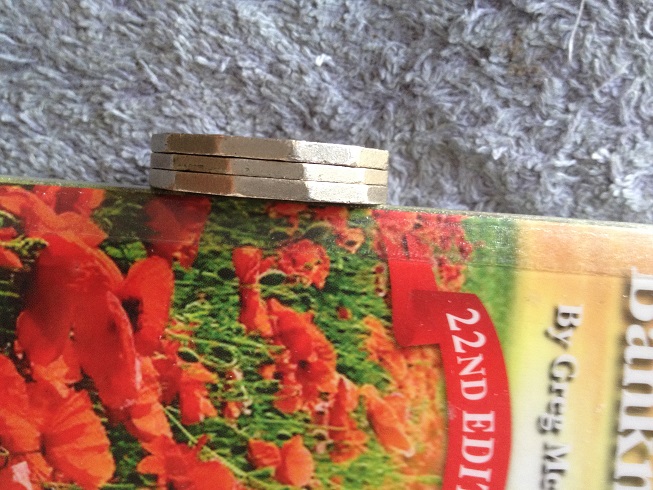 Played around with photo software and it shows the coin in the middle is about 20% thinner. 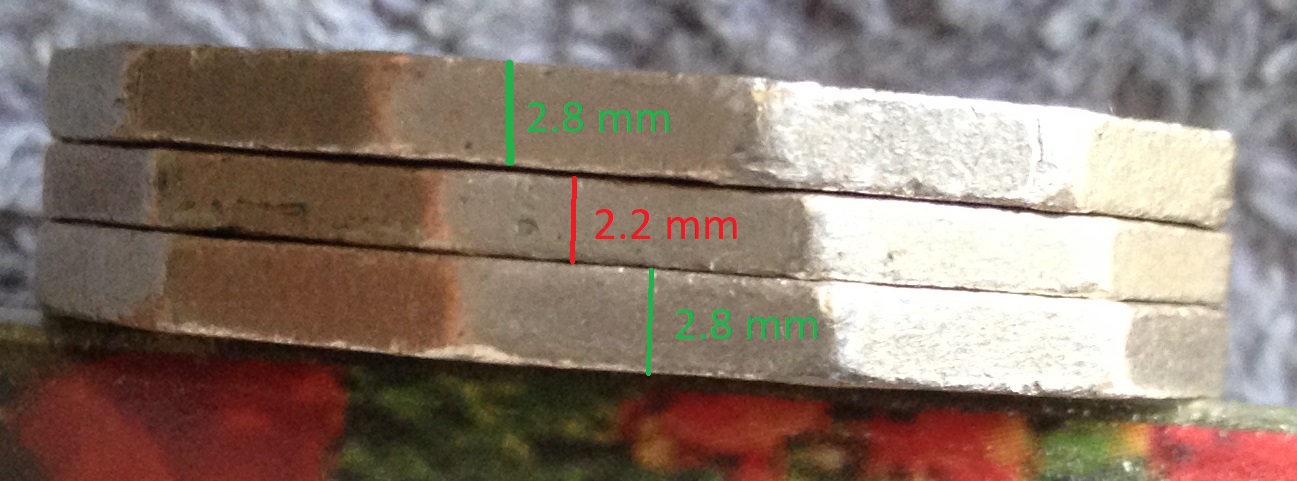 Anybody seen anything like this before? |
|
|
|
Pillar of the Community
Australia
2180 Posts |
I've never payed much attention to the thickness but it doesn't look like the weight or thickness was removed after striking - could be a genuine underweight planchet.
|
|
Pillar of the Community
Australia
1366 Posts |
From what I can see I'd say that it would have to be a Mint error. Maybe the sheet that the blanks were cut from was accidentally rolled to an incorrect thickness or maybe the blanks were accidentally cut from a sheet that was meant for a different denomination?  |
|
Pillar of the Community
 Australia
1985 Posts |
Quote:
maybe the blanks were accidentally cut from a sheet that was meant for a different denomination Interesting theory. Australian 20 cent is 2.5 mm thick and 10 cent is 2.0 mm thick, so would have to be a sheet used for a foreign coin. |
|
Pillar of the Community
Australia
852 Posts |
If it was cut from a sheet meant for another coin then there will be many more 1980 fifty cents with the same defect.
Now roughly how long and wide are these sheets? In modern mass production they might not even be sheets but very long rolls and if so there could be tens of thousands of them unless either the batch of blanks or batch of struck coins was identified as defective and scrapped (leaving this coin as the one that escaped the scrapping).
Did Canberra still make their own blanks in 1980 or had they outsourced production to Korea by then? That might indicate what the original denomination 9and country) the sheet was rolled for. Also is it the standard CuNi metal alloy or a different mix as that might provide a clue.
I guess the noodlers of fifty cent coins need to weigh every 1980 that comes their way.
|
|
Pillar of the Community
Australia
2180 Posts |
I thought in 1980 planchet production would still have been local.
No idea about the sheet dimensions either but I saw a video of 1957 sovereign production recently and the sheets looked pretty narrow (maybe 3-4cm wide) and short enough to handle manually.
|
|
Bedrock of the Community
Australia
21792 Posts |
Not hard to do the maths to prove the blank was cut from a strip intended for 20 Cent coins. I will have a go at it, and report back later. Simple arithmetic needed.
Input information needed
- area of 50 Cents
- area of 20 Cents
- weight of both standard coins
- given: weight of thin 50 Cents in question: 13.6 grams
Need to calculate the exact area of a dodecagram (12 sided)
I am into the sunset years of my life, but I need the mental exercise. Should be simple task for any high school kid.
-----------------------------------------------------------------------------------------------------------------------------------------------------
Done my calcs, have come to a conclusion. Any other takers?
Edited by sel_69l
10/22/2021 10:58 pm
|
|
Pillar of the Community
Australia
9841 Posts |
If my maths is correct.
736 mm2 for the 50c @ 13.60g = 0.01848g/mm2
639 mm2 for the 50c @ 11.31g = 0.01770g/mm2
Conclusion: @ a difference of only 0.00078/mm2, might to do hard to call. Could be a calculation error from rounding.
What did you come up with Sel.
|
|
Bedrock of the Community
Australia
21792 Posts |
My calcs:
given:
50 Cent coin 31.65mm across the flats (RAM spec), 32.7665mm between opposite points (calculated).
20 Cent coin 11.31 grams, 28.52mm diameter, (RAM spec).
Thin 50 Cents 13.6 grams (+- 0.5mm sensitivity measurement error).
0.01943 g/mm2 for the standard thickness 50 Cents,
0.01689 g/mm2 for OP's thin 50 Cents,
0.01770 g/mm2 for a standard 20 Cents.
4.6% g/mm2 difference between assumed and calculated weight for a 20 Cents, and the thin 50 Cents.
15.0% g/mm2 difference between the standard 50 Cents and the thin 50 Cents
14.3% total weight difference between the standard 50 Cents and the thin 50 Cents.(direct from given info)
Edited by sel_69l
10/23/2021 06:47 am
|
|
Pillar of the Community
Australia
1985 Posts |
sel_69l, I agree with your calculations, given that the side of a 50 cent coin is 8.48mm and the area is 805.1mm^2. [A = 3 × ( 2 + square root of 3 ) × s^2]
Best bet is that it was made from a sheet intended for 20 cent production given that Australia didn't get their blanks from Korea until 1997.
Bottom line - if one thin planchet coin exists there must be more of them out there, right?
Edited by MachinMachinMan
10/23/2021 07:56 am
|
|
Pillar of the Community
Australia
3841 Posts |
Im surprised that it circulated with such weight variation!
Reason is because most vending machines would be calibrated to not accept any coins of different weight threshold. That's how I found some counterfeit $2 coins.
For one second, I thought of the possibility of acid dipping but the details look too good. Dipping in acid does reduce weight however it doesn't look like the case here.
My partial coin collection http://www.omnicoin.com/collection/gxseriesMy numismatics articles and collection: http://www.gxseries.com/numis/numis_index.htmRegularly updated at least once a month. |
|
Valued Member
Australia
370 Posts |
Quote:
Bottom line - if one thin planchet coin exists there must be more of them out there, right? There probably is but maybe noone has bothered to check. I know I haven't. |
|
Bedrock of the Community
Australia
21792 Posts |
MMM: I agree with your best bet, but I did enjoy the mathematical calisthenics.  Edited by sel_69l
10/23/2021 7:55 pm
|
| |
Replies: 12 / Views: 3,543 |
|










 Posted 10/10/2021 08:29 am


