| Author |
 Replies: 18 / Views: 2,076 Replies: 18 / Views: 2,076 |
|
Bedrock of the Community
United States
11963 Posts |
Recently I acquired three Doble Excelentes from the reign of Fernando II of Aragon and Isabel I of Castilla. The three coins are different as they appear to have been struck during the long 40 year period of this particular issue. I was wondering if you can recommend a reference book for these coins and would appreciate any thoughts on these coins. In particular, are there sub-types that allow me to determine a sequence of design/type production that would allow me to determine which of these coins are earlier or later in the 40 year window. I think one of the slabs references a Cayon number and an FR reference number. I don't know which references those are and where to go to acquire them if they are available. In addition, I think the first NGC slab has an error as it references FERDINAND V but it should be FERDINAND II. Coin #1 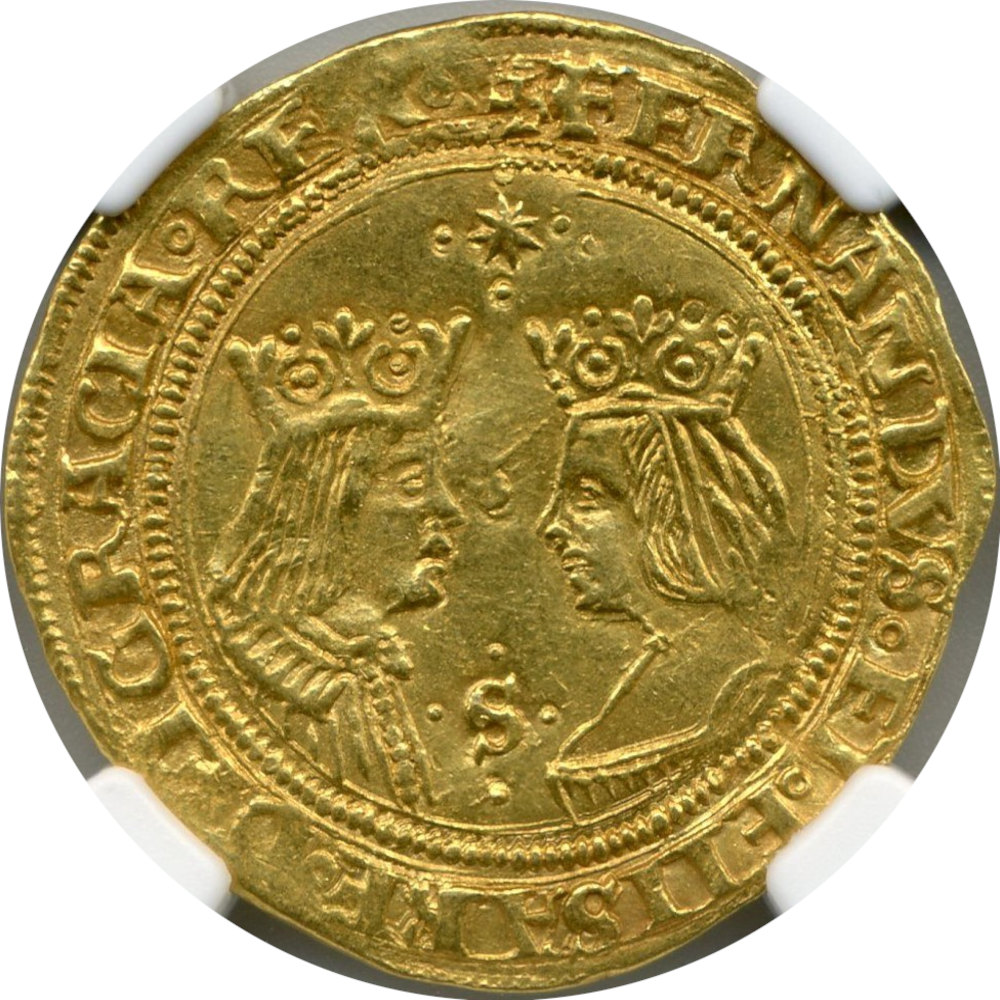 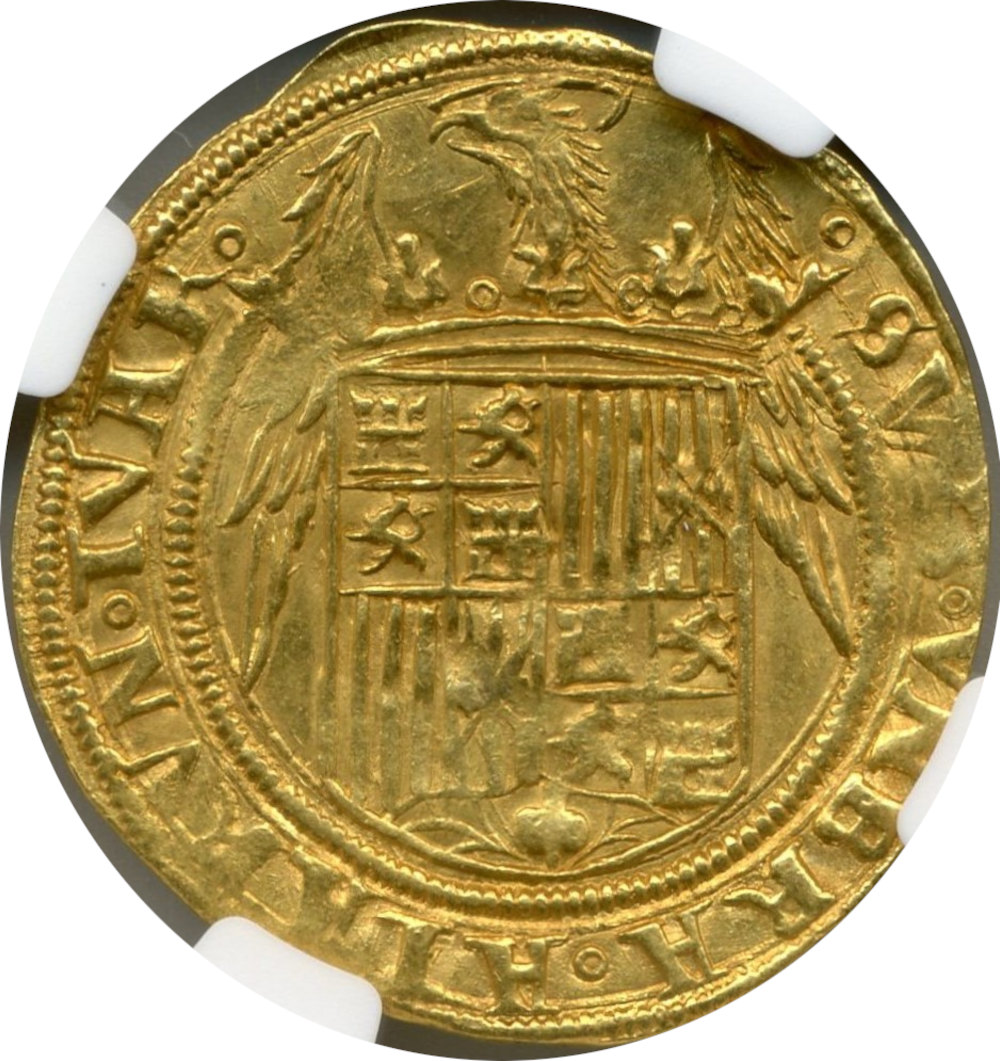 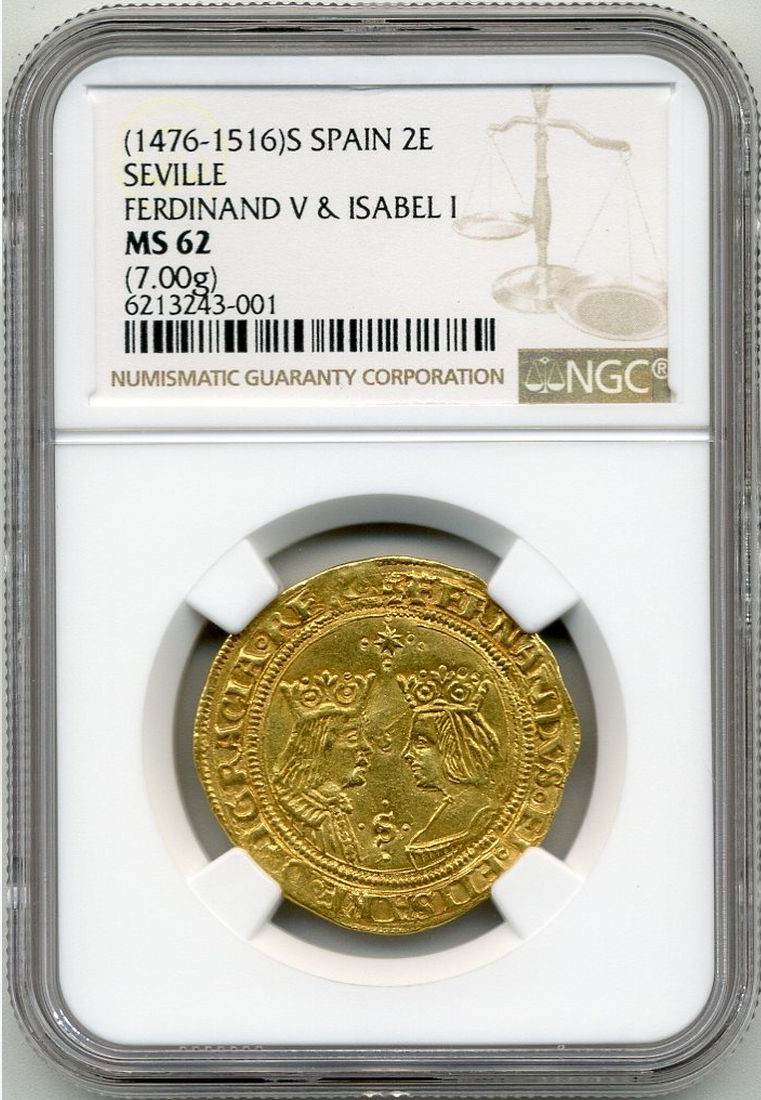 Coin #2 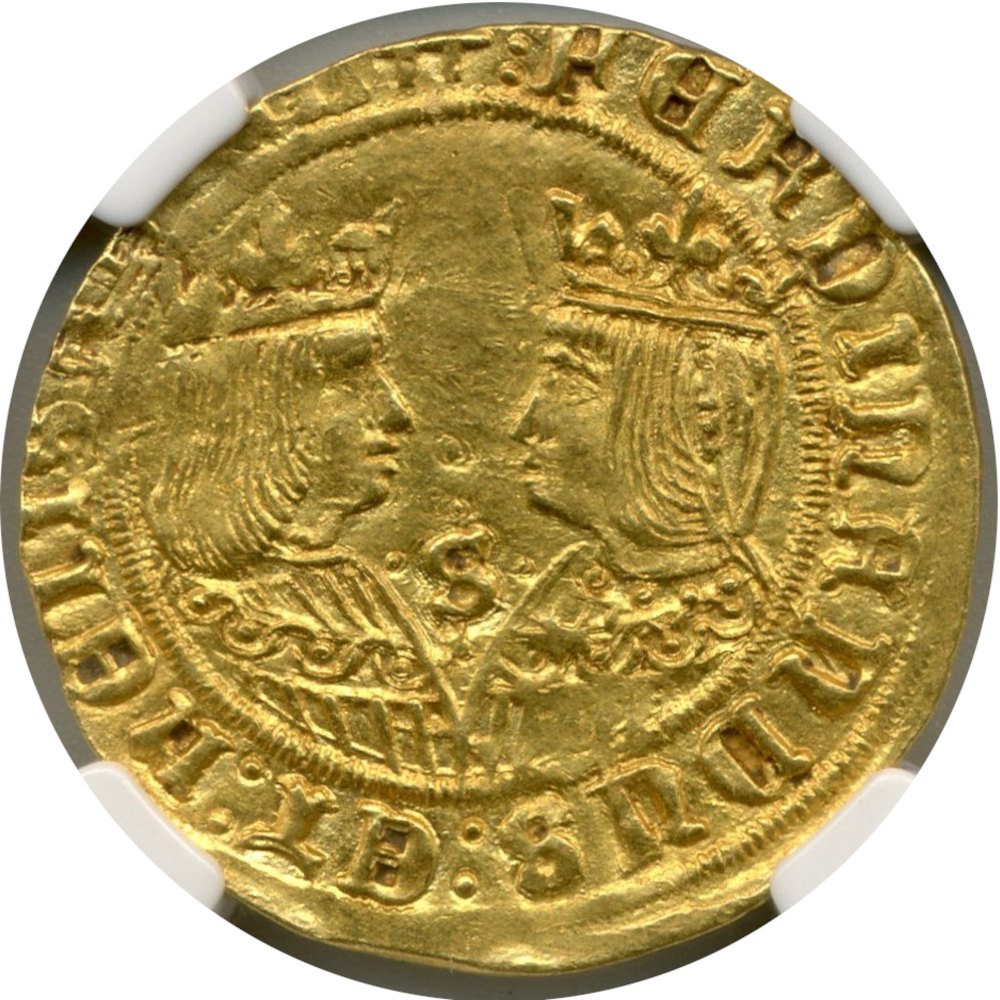 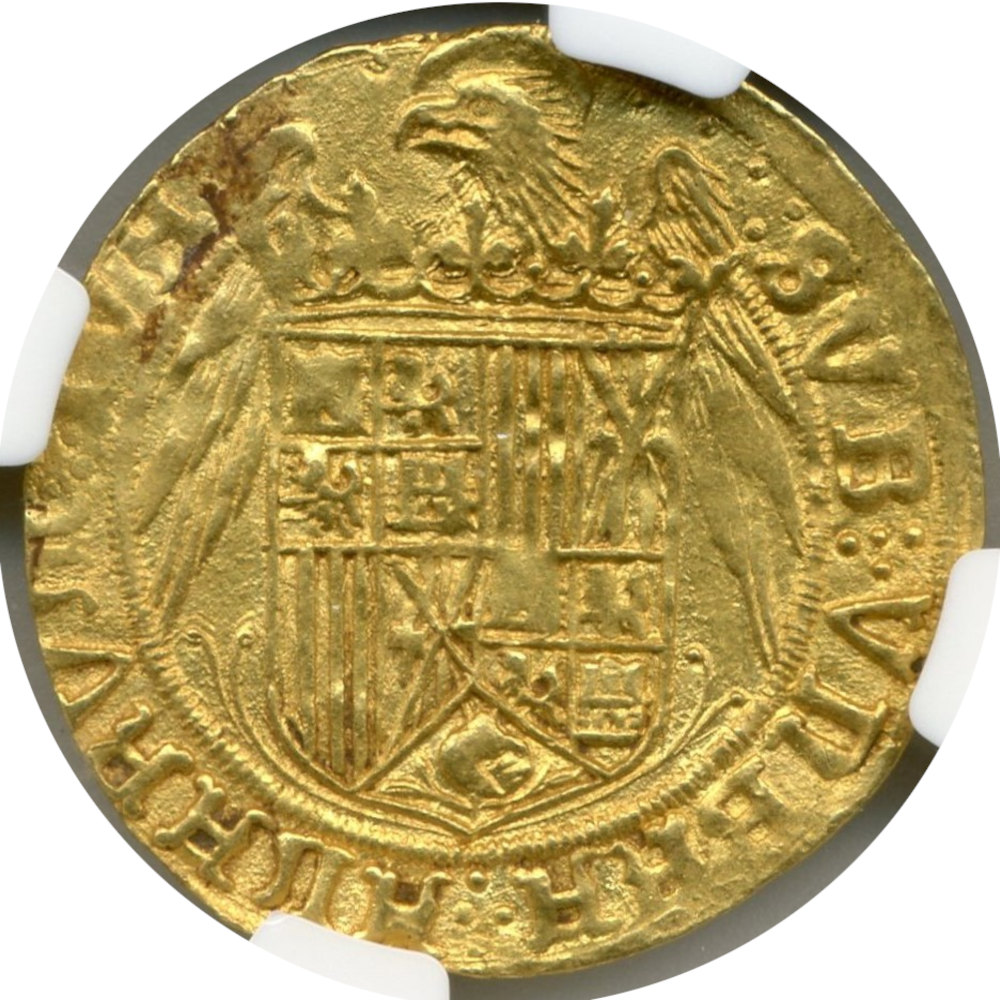 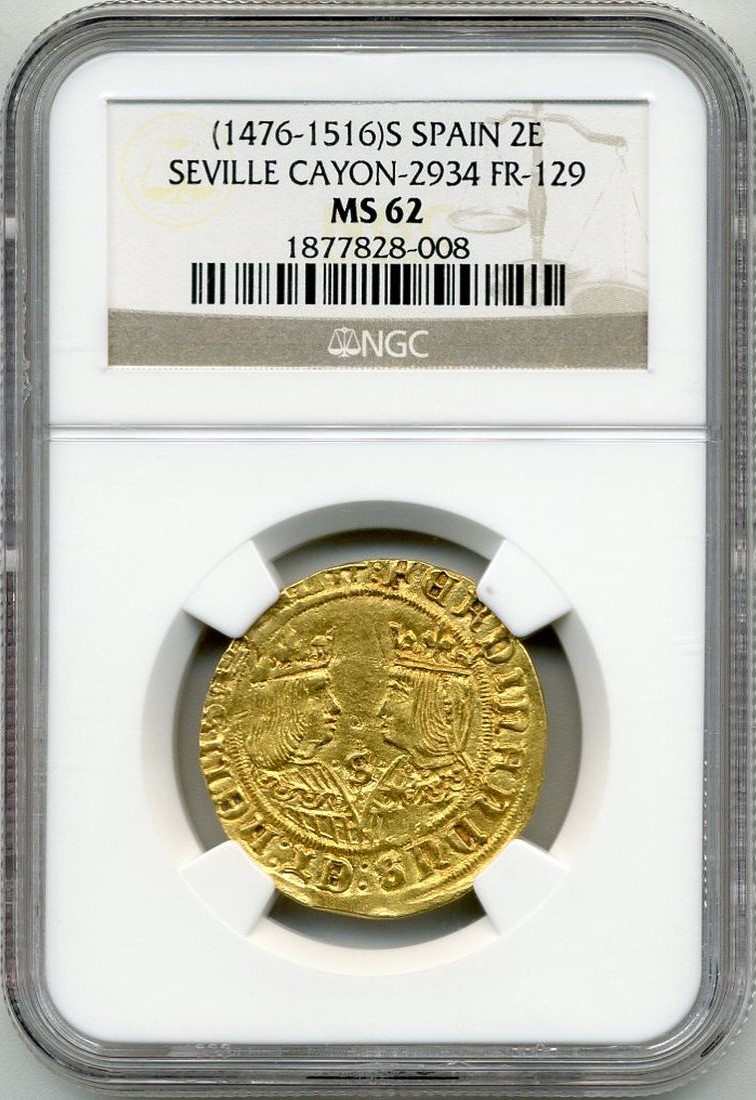 Coin #3 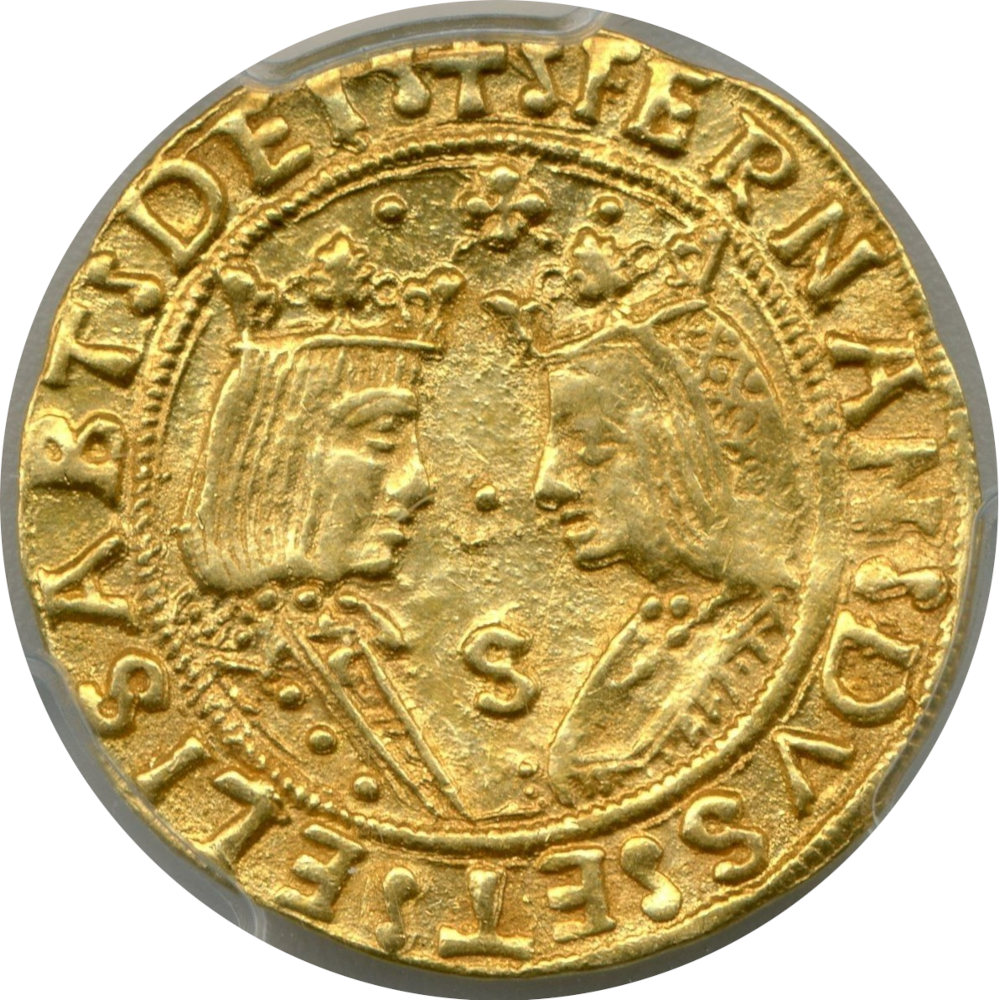 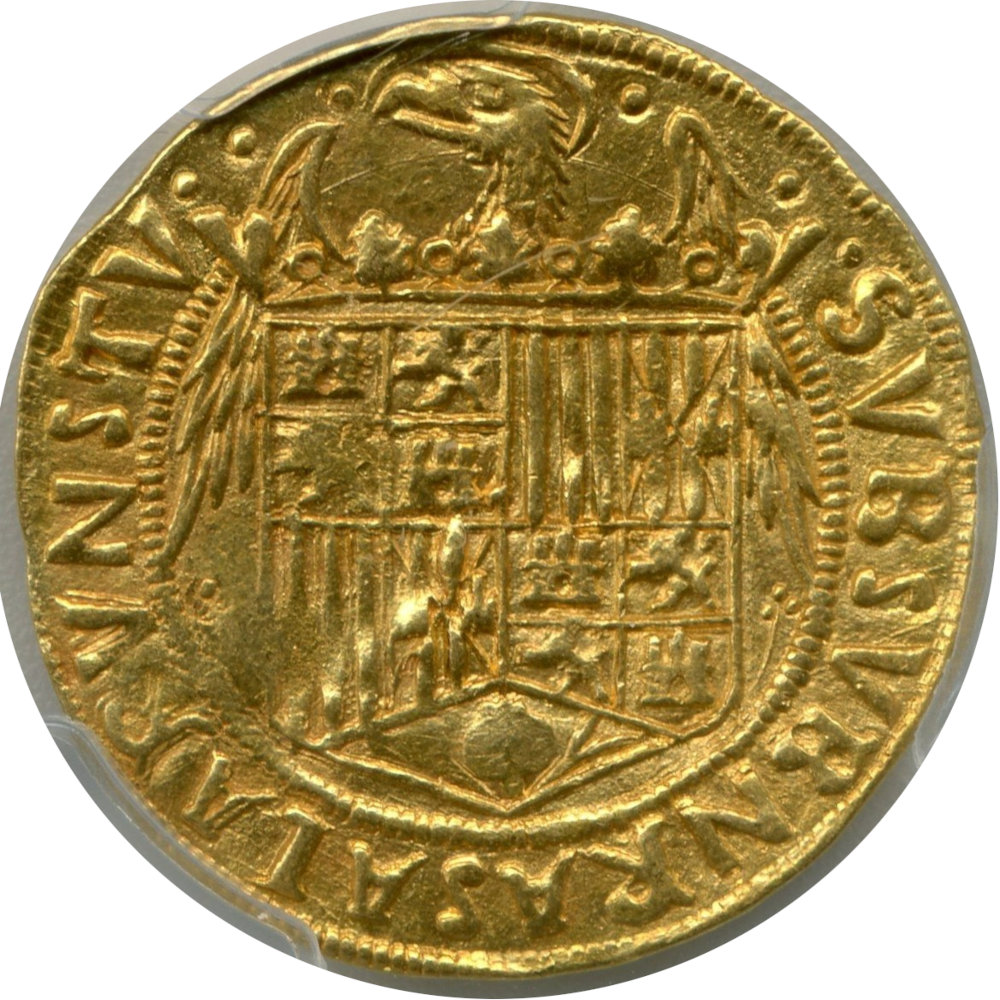 |
|
|
|
Bedrock of the Community
 United States
11963 Posts |
Apparently a little digging reveals that he was Fernando II of Aragon but he was Fernando V of Castilla when he ascended to that throne in 1475. So I guess NGC was not wrong.
|
|
Bedrock of the Community
United States
11963 Posts |
These seem to be applicable references with the Calicó y Trigo tomes perhaps the most relevant. Fr-129 seems to refer to the issues from the Sevilla Mint with Fr-130 the Toledo Mint and Fr. 131 the Segovia Mint.
Is Fr. referring to the Friedbergs' reference? Are these volumes expensive and difficult to find? Is there perhaps online access?
Is there a reference specific to the issues of the Reyes Católicos (Catholic Kings)?
Catalog reference: Fr-129, Cayón no. 2928 (cross above the monarchs).
Source:
Calicó, Ferrán, Xavier Calicó and Joaquin Trigo, Monedas Españolas desde Felipe II a Isabel II, Años: 1556 a 1868, 5ª edicion, Barcelona: Gráficas Reclam, 1982.
Cayón, Adolfo, Clemente Cayón and Juan Cayón, Las Monedas Españolas, del Tremis al Euro: del 411 a Nuestros Dias, vol. 1, Madrid: Cayón-Jano S.L., 2005.
Friedberg, Arthur L. and Ira S. Friedberg, Gold Coins of the World, From Ancient Times to the Present, 9th ed., Clifton, NJ: Coin and Currency Institute, 2017.
Edited by numismatic student
11/02/2021 2:13 pm
|
|
Pillar of the Community
 United States
6514 Posts |
Beautiful coins. Good luck with your research.
|
|
Bedrock of the Community
United States
11963 Posts |
Thanks chafemasterj. I was able to order all three books used online. Internet is awesome. Looking forward to the information from the references but if anyone with expertise wants to add information it would be most welcome.
|
|
Moderator
 United States
34538 Posts |
@ns, glad to see you picking up a little light reading. I have the middle one by the Cayons and it is a good two or three inches thick. I've been able to get by with that one only, so I'm hoping that you'll add your comments as to whether either of the two proves to be useful. Thx!
"If you climb a good tree, you get a push."
-----Ghanaian proverb
"The danger we all now face is distinguishing between what is authentic and what is performed."
-----King Adz
|
|
Pillar of the Community
United States
1554 Posts |
Since the coins were struck at Seville, they are technically coins of the Kingdom of Castile where Ferdinand was Ferdinand V. Though joined in personal union, the kingdoms of Castile and Aragon were administered separately. The two kingdoms were not formally united until later. Others might might use "Spain, the Catholic Monarchs" or "Spain, Ferdinand and Isabella" for simplicity.
|
|
Bedrock of the Community
United States
11963 Posts |
Thank you for the additional information Spence and Kush!  |
|
Bedrock of the Community
United States
11963 Posts |
I received my used Friedberg reference. Mine is the 6th edition from 1992. I think the most recent is the 9th edition published in 2017.
Friedberg, Arthur L. and Ira S. Friedberg, Gold Coins of the World, From Ancient Times to the Present, 6th ed., Clifton, NJ: Coin and Currency Institute, 1992.
The information here is sparse, but the 2 Excelentes coin was minted in 6 Spanish mints: Fr. 127 - Burgos, Fr. 128 - Granada, Fr. 129 - Sevilla, Fr. 130 - Toledo, Fr. 131 - Segovia, Fr. 132 - Cuenca.
The are no mintage figures nor any breakdown of varieties at the mints over the 40 year 1476-1516 period. There were several denominations minted, including the 50 (Very Rare - See thread on Huntington coin), 20 (sold for 6000,000 Euros), 10, 4, 2, 1 and 1/2 Excelente denominations. There were also the 1 and 1/2 Castellanos denominations and the 4 and 1 Ducat denominations listed during the reign of Fernando y Isabel.
Judging by the pricing of the 2 Excellentes coins from 1992, it appears that the coins from the Sevilla Mint are the most common at $1,500 for a EF example. This is unsurprising given that Sevilla became the main hub of the trade with the New World after Colombus' discovery and gold from the New World flowed in through the city. Sevilla is the only Spanish port not on the Sea as it sits on the banks of the Guadalquivir River. Sánlucar, Cádiz and the Canary Islands were other large points of departure to the New World.
Looking forward to the information in the Calicó and Cayón references.
|
|
Bedrock of the Community
United States
11963 Posts |
The U.S. National Park Service writes:
"In 1493, during his second voyage, Columbus founded Isabela, the first permanent Spanish settlement in the New World, on Hispaniola. After finding gold in recoverable quantities nearby, the Spanish quickly overran the island and spread to Puerto Rico in 1508, to Jamaica in 1509, and to Cuba in 1511. The natives fared badly. Many died in one-sided armed conflict with soldiers and settlers, or in forced servitude in mines and on plantations. Others died of diseases to which they had no immunity. By mid-century, the native Ciboney of Hispaniola and western Cuba were extinct, and other tribes, including the Arawak of Puerto Rico, were nearly so.
Beginning in 1508, Spanish settlements sprang up on the mainland of Central and South America. In 1519, just six years after Balboa had crossed the Isthmus of Panama and claimed the entire Pacific Ocean for Spain, Pedro Arias de Avila, Balboa's father-in-law and executioner, founded the city of Panama on the Pacific coast. The same year, Hernan Cortes led a small force from Cuba to the Gulf coast of Mexico, founded Veracruz , and set about destroying the Aztec empire. Most of Mexico fell within two years. Subsequent conquistadors followed the example set by Cortes. By 1532, Francisco Pizarro, had effected the early stages of his conquest of the Inca empire of Peru. By 1550 Spain had dominion over the West Indies and Central America and its large surviving native population.
New World mines yielded gold and silver for Spain in far greater amounts than France and Portugal had ever been able to extract from West Africa. One-fifth of the total production, the quinto real, went to the Spanish Crown. The average value of silver shipped to Spain rose to a million pesos a year before the conquest of Peru, and to more than 35 million a year by the end of the century. Cacao, cochineal, hides, spices, sugar, timber, and tobacco yielded additional income. Seville, through which all legal trade with the colonies passed, became a great financial center and nearly quadrupled in size between 1517 and 1594."
|
|
Bedrock of the Community
United States
11963 Posts |
"Gold is a metal most excellent above all others and of gold treasures are formed, and he who has it makes and accomplishes whatever he wishes in the world and finally uses it to send souls into Paradise."Found this quote attributed to Christopher Columbus in a paper by J.R. Fisher titled: "Gold in the search of the Americas" and it explains both Columbus' motivations and his brutality in achieving his goals. Fisher further writes: "For the next two decades the Spanish conquistadors rampaged through the Antilles in their search for gold. The crown made half-hearted attempts to protect the native population by encouraging the emigration of peasant families who might devote themselves to agriculture, but without notable success. The reason was aptly summed up by Hernan Cortes' reply to an official who offered him land when he reached Hispaniola in 1504: "But I came to get gold", declared the future conqueror of Mexico, "not to tilt the soil like a peasant"." Fisher further writes that gold and converting the heathen were the primary motivations of Spanish colonization. Although the Spanish colonists never found success in agriculture, the British colonists were able to find profitable cash crops like tobacco, introduced to North America from Trinidad and Fisher provides the following quote from Roger Williams, the founder of Rhode Island: "That God Land wilt be as great a God with us English as God Gold was with the Spaniard."Both the Spanish and British collapsed indigenous populations in the lands they colonized and the economic development in the New World was only possible through the import of African slaves for labor. Not the kind of stuff that instills pride in the way humankind has treated one another. Fisher paper: https://core.ac.uk/download/pdf/81787862.pdf
Edited by numismatic student
11/06/2021 10:53 pm
|
|
Pillar of the Community
United States
8038 Posts |
Gorgeous coins, and interesting commentary thus far.
Shooting from the hip, as I have no references, I would guess that the second coin pre-dates the other two.
As @spence can also tell you since he is a more serious student of this area than I, the end of the 15th century was a time when the letterforms were undergoing major changes from older gothic fonts to more modern ones, with theh changes happening at somewhet different times in different places. Your second coin uses older letterforms for the most part. Compare the very gothic FE in FERNANDUS to the lettering on the other two coins. The only confusing thing for me is that this coin uses what we would call a U, rather than a V. Which tends to be a later development I think. But there is more that looks old than modern on the lettering.
|
|
Pillar of the Community
United States
8038 Posts |
After some digging on acsearch ... It looks like there are some subtypes that are commonly assigned date/range "after 1497" or 1497-1504. These include Cayon 2934, 2938, 2777 and 2783. So some cataloger must have found a criterion for narrowing the date range. I also found this single date attribution to an earlier slice: https://www.acsearch.info/search.html?id=567935That makes my earlier "shot from the hip" wrong. Must have just been and old fogey like me engraving that die and clinging to the old ways. |
|
Bedrock of the Community
United States
11963 Posts |
Thank you for the observation and research tdziemia.
I did notice that the second coin was different but not because of the font but because it refers to Fernando as FERDINANDUS. The first coin has his name as FERNANDVS and the third coin refers to FERNAN/DVS with a scroll separator within the name. The scroll separator usually divides words and usually does not appear within a word and was thinking that it may be an engraving error.
The font is clearly different in the stacks example and there is a compass mark between the busts that I have not seen before in the Stacks coin you linked. Two of my coins, the first and third also show different markings between the busts other than the mintmark but I have not yet determined what they mean. It would be interesting to see how Stacks narrowed the date range entirely within the 15th century.
|
|
Pillar of the Community
United States
8038 Posts |
I wonder if there is something in the coins that differentiates the pre-1497 subtypes from post-1497  . Also, it is clear from what I am about to write that breaking up and punctuating the name is a common variant, rather than an engraving error. I spent a few minutes poking around on acsearch, and quickly got amazed by all the variety in this coin. Each of the first 7 coins that popped up in my search (using Spain Doble Sev) was a different subtype. There seems to be enormous variation in the combinations of sigla at the top and bottom of the field between the portraits, and obverse legend. It also doesn;t help that each auction house uses different catalogs (I at least hope that "Calico" and CCT are the same). Here is what I saw (starting with the catalog Ref, then siglae and legend): Cal.69 - 8 pt. star(top)/S(bottom). +FERNANDVS ETELISABET DEIGRAT (punctuation by single annelet where I have left spaces) Cal.73 - cross/S with 3 dots. X FER.NANDVS ET ELISA.BET (punctuation by scroll) CCT54a/Cay.2932 - small ring/S over 6 pt star. FeRnAnDVS----eLISABeT:D:G:ReX:eT:ReGI (punctuation by colon), Where I have written "e" it is the gothic e that looks like epsilon CCT53/Cay.2925 - 4 pt. star/S. FER:NANDVS ELISA:BET DIGRAT (punctuation by two large dots) CCT56/Cay.2933 - 8 pt. star/S +FERNANDVS ET ELISABE DEIGRATI (punctuation by single annelet) CCT58/Cay.2938 - 4 pt star with 4 dots/S with 4 dots. X FE RNANDVS ET ELISA:BET DIGR (punctuation by scrolls) And it just keeps going like that... Hopefully all will be explained in the next book you receive.  Edited by tdziemia
11/07/2021 1:06 pm
|
|
Bedrock of the Community
United States
11963 Posts |
Thank you tdziemia. I also look forward to gleaning more from the references. I think it is likely that there is more scholarship on these issues on top on the reference material.
|
| |
Replies: 18 / Views: 2,076 |









 Posted 11/02/2021 2:12 pm


