Coin Community Family of Web Sites
Coin, Banknote and Medal Collectors's Online Mall 300,000 items to help build your collection! Shop for APMEX Bullion on eBay!Shop CCF Members on eBay! Vancouvers #1 Coin and Paper Money Dealer Royal Canadian Mint products, Canadian, Polish, American, and world coins and banknotes. Specializing in Modern Numismatics


Username:
Password:
Save Password
Forgot your Password?


This page may contain links that result in small commissions to keep this free site up and running.

Welcome Guest! Registering and/or logging in will remove the anchor (bottom) ads. It's Free!

Beginner's Guide To Attributing Capped Bust Half Dollars

To participate in the forum you must log in or register.
Author Previous TopicReplies: 17 / Views: 5,542Next Topic
Page: of 2
Pillar of the Community
jacrispies's Avatar
United States
3848 Posts
 Posted 11/14/2022  12:15 pm Show Profile   Bookmark this topic Add jacrispies to your friends list Get a Link to this Message Number of Subscribers
The Capped Bust half dollar series is a super neat series. One of the most appealing factors of this series is easily being able to identify the die variety of a particular coin. Why attribute Capped Bust half dollars? There are a handful of answers to that question. Perhaps you are trying to complete a full Capped Bust Half variety set, or maybe you just purchased your first one and would like to know how many examples exist for that particular variety. Being able to identify the varieties allows you to cherrypick from dealer's trays, with the potential to find valuable and extremely rare coins.

Attributing Capped Bust half dollars starts off with finding the right resources. Whether you have a copy of Overton and Parsley's United States Early Half Dollar Die Varieties 1794-1836, or you can access Dave's Bust Half Dollar Site at maibockaddict.com, you are more than ready to get started attributing your bust halves. The Ultimate Guide to Attributing Bust Half Dollars by Dr. Glenn R. Peterson is another great reference to own. But first, we have to start with the basics. What is an Overton Number? What exactly am I looking for? How do each of these diagnostics come to be? These questions will be answered as we go along.

In the yeardates of 1794-1836, half dollars are attributed by die variety using Overton numbers. Overton, the original writer of United States Early Half Dollar Die Varieties 1794-1836, used a system of numbers to classify each die marriage. The first letter is an O, representing Overton, and the following number is the specific marriage reference number. Each yeardate starts off at 101, and adds one number until all the marriages are represented. Sometimes you will see an "a" or "b" following the Overton number, like the O-111b or O-108a, which signifies a later die state. For example, the 1811 O-103 is an earlier die state of the 1811 O-103a, because the "a" die state has developed a recognizable crack that splits through the date.

The dies to make Capped Bust half dollars were created using a master hub. The master hub would impress an image of Miss Liberty, the eagle, and the scroll on the face of the working die. Following that procedure, each star, numeral, letter, and dentil was individually punched or engraved on the face of each working die. Even the lines of the eagle's shield were engraved by a steady, skillful hand! Because all of this work was done by hand, every working die was unique. Stars are crooked, letters are crowded, and the lines of the shield often overlap each other. Some unique features were intentional like an overdate, and some were unintentional like a graver slip. All of these differences in design come together to create the diagnostics to be able to identify the die variety.

With so many things to look at, creating a system of consistency is ideal for attributing these half dollars. The following list are things to observe when attributing these coins:
1. Popular Varieties
2. T-I Alignment
3. Relative Star Positioning
4. Date Position
5. Die Defects and Unique Features

Each type of observation has its benefits and downsides, and one type is not going to be enough alone to get you the attribution every time. They are best used in conjunction with each other.

Popular Varieties: Recognizing popular varieties is a great place to start. Is your coin the 1814 E/A? That would make it the 1814 O-108. Do you see the reminisce of a 7 underneath the 8 on an 1808? That would make it the 1808/7 O-101 overdate. If you are able to check your half dollars for major varieties, then you can skip the tedious examination and quickly identify your halves. Keep in mind that very few halves are able to be identified in this way, so this step is not applicable in every circumstance.

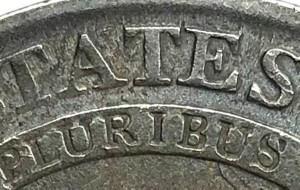
T-I Alignment: The T-I alignment is referencing the I in PLURIBUS in relationship to the second T in STATES. This position often varies among varieties, so it is an easy reference to glance at. United States Early Half Dollar Die Varieties 1794-1836 by Overton and Parsley and The Ultimate Guide to Attributing Bust Half Dollars by Dr. Glenn R. Peterson both use T-I alignments in their attribution techniques. Here are a few examples of the terminology to describe the T-I alignments.

I completely left of T:
Beginner's-Guide-To-Attributing-Capped-Bust-Half-Dollars
Right sides T-I in line:
Beginner's-Guide-To-Attributing-Capped-Bust-Half-Dollars
I centered under right side of T:
Beginner's-Guide-To-Attributing-Capped-Bust-Half-Dollars

Dave's Bust Half Dollar Site even lists the varieties in order by left to right T-I alignment, so it is simple to take note of the T-I alignment, and match it up with the example on the screen.

Relative Star Positioning: Both Overton and Peterson use this technique which involves the star position relative to Miss Liberty, or the segments that the outer point of a star lines up with. A simple starting point can be lining up the inner point of star 7 to a specific location on Miss Liberty's forehead. The star may line up with the curl, the junction of the curl and the headband, the junction of the headband and the cap, or farther up the cap. The stars can also vary in positioning with each other. Two stars next to each other should have their points lined up, so if an imaginary line would extend those points, they would symmetrically meet exactly between both stars. If they are not lined up, then the star point lines would be overlapping each other asymmetrically. Recognizing the star positions relative to the segments does not always work, as LDS (Late Die State) half dollars tend to have little to no segments remaining.

Beginner's-Guide-To-Attributing-Capped-Bust-Half-Dollars
Take this 1824 half for example. Some things can be noted, such as star 7 is at the junction of the headband and the cap. The outer point of the same star is lined up with the center of a segment. Star 8 overlaps star 9, and star 10 overlaps star 11.

Sometimes searching for small characteristics can be very tedious and exhausting. Don't give up! Once the unique features of the obverse die are recognized, then it can be easily matched up with your physical or online attribution source.

Date Position: With each digit punched by hand, sometimes the numbers don't come out symmetrical. In 1818, there were drastic differences in numeral positions. A numeral can be much further than the others, making it appear unusual. There are only a couple of obverse dies in 1818 in which the numerals are even and symmetrical. The minute differences between numeral positions can be very small, but memorizing them can allow you to recognize a variety like a familiar face.

Die Defects and Unique Features: Some of these defects have received specific names. The 1822 "Button Cap" variety features a small button-like feature on the fold of the cap. The 1810 "Morse Code" variety has two very small dots and a dash below the eagle's left talon. The 1817 "Comet" variety has a large defect line stretching from Miss Liberty's cap to the segments. Most of these small features seen on many halves do not have commonly known names.

If a bust half was purchased and attribution is needed, it is not the most efficient to search the entire coin for small defects that can be compared with images often not sharp enough. This technique is ideal for verifying a variety. If you are 80% sure your coin is a specific variety, The Ultimate Guide to Attributing Bust Half Dollars will describe a defect or unique feature that will allow you to confirm the attribution. Whether it is a punctuated date, defect lines, die rust, touching letters, or single leafs, many varieties can be verified using this technique.


This may feel overwhelming at first, but don't give up! Once a handful of coins are attributed, it starts to become second nature. There is no right way to attribute these early Capped Bust half dollars, so practice is key to making a system that can be relied on. If you have the desire to attribute these coins but lack the coins themselves, you can always scan online auctions and attribute the bust halves through images. You will be surprised how many rare varieties are out there, waiting to be cherrypicked!

Suffering from bust half fever.
Want to learn how to attribute early half dollars by die variety? Click Here: http://goccf.com/t/434955
Shoot me a PM if you are looking to sell bust halves.
Moderator
Learn More...
jbuck's Avatar
United States
187446 Posts
Pillar of the Community
United States
1227 Posts
 Posted 11/14/2022  6:19 pm  Show Profile   Bookmark this reply Add I6609 to your friends list Get a Link to this Reply
I don't collect the cap half but if I did this post would be most helpful to someone starting out thanks for sharing jacrispies
Pillar of the Community
United States
2280 Posts
 Posted 11/15/2022  11:01 am  Show Profile   Bookmark this reply Add NumismaticsFTW to your friends list Get a Link to this Reply
I have not started diving into this series yet!

I plan on starting soon, and this helps and motivates me to get into these sooner.

For the short amount of time you've been in our hobby, your knowledge is impressive in a multitude of series, especially this one.

Great thread, thanks!
You realize when you know how to think, it empowers you far beyond those who know only what to think.

-Neil deGrasse Tyson
Pillar of the Community
CarrsCoins's Avatar
United States
756 Posts
 Posted 11/15/2022  11:30 am  Show Profile   Bookmark this reply Add CarrsCoins to your friends list Get a Link to this Reply
well written and informative. thanks!

are there reference books that you prefer or have had bad experiences with?
Pillar of the Community
ericgreen's Avatar
United States
1509 Posts
 Posted 11/15/2022  9:57 pm  Show Profile   Bookmark this reply Add ericgreen to your friends list Get a Link to this Reply
Very interesting and informative!
Pillar of the Community
robbudo's Avatar
United States
2757 Posts
 Posted 11/15/2022  10:44 pm  Show Profile   Check robbudo's eBay Listings Bookmark this reply Add robbudo to your friends list Get a Link to this Reply
Nice writeup- thanks!
Moderator
Learn More...
nickelsearcher's Avatar
United States
15381 Posts
 Posted 11/16/2022  05:24 am  Show Profile   Bookmark this reply Add nickelsearcher to your friends list Get a Link to this Reply
Very informative, thank you for sharing.
Take a look at my other hobby ... http://www.jk-dk.art
Pillar of the Community
jacrispies's Avatar
United States
3848 Posts
 Posted 11/16/2022  10:09 am  Show Profile   Bookmark this reply Add jacrispies to your friends list Get a Link to this Reply
Thanks everyone for the encouraging comments!

@CarrsCoins - As mentioned, Overton's book and Dave's Bust Half Dollar Site online are excellent resources for attribution. I read that the third edition of Overton's book is the best, but I have not purchased a copy yet. I own the fifth edition, and while there are errors, it is perfectly good enough to use. I personally don't use my copy of Dr. Peterson's book often. There are no resources that I had bad experiences with, all each have their place.
Suffering from bust half fever.
Want to learn how to attribute early half dollars by die variety? Click Here: http://goccf.com/t/434955
Shoot me a PM if you are looking to sell bust halves.
Pillar of the Community
CarrsCoins's Avatar
United States
756 Posts
 Posted 11/16/2022  10:25 am  Show Profile   Bookmark this reply Add CarrsCoins to your friends list Get a Link to this Reply
thanks for the follow up!

i have a copy of Steve Tompkins' book as my reference for the early part of the bust half series (flowing hair and draped bust). its a good reference with some really nice condition census info. I havent heard about a release date for volume 2 but if/when he gets around to it I would imagine it will be a really great book to add to the list!
Pillar of the Community
jacrispies's Avatar
United States
3848 Posts
 Posted 11/16/2022  11:58 am  Show Profile   Bookmark this reply Add jacrispies to your friends list Get a Link to this Reply
Certainly! I am excited to read Volume 2. I saw that it should be out by late 2021, but I am not sure if that is accurate.
Suffering from bust half fever.
Want to learn how to attribute early half dollars by die variety? Click Here: http://goccf.com/t/434955
Shoot me a PM if you are looking to sell bust halves.
New Member
AlexDC's Avatar
United States
45 Posts
 Posted 11/17/2022  3:20 pm  Show Profile   Bookmark this reply Add AlexDC to your friends list Get a Link to this Reply
@jacrispies Great post! Definitely book marking this as a quick reference :)
Pillar of the Community
MisterT's Avatar
United States
2001 Posts
 Posted 04/10/2025  02:02 am  Show Profile   Bookmark this reply Add MisterT to your friends list Get a Link to this Reply
I only have about 7 bust halves in my collection, mostly from building type sets. I never really paid attention to the attribution numbers but you have given some detailed information on where to begin with the attribution. I never knew that much of the details were hand punched or engraved on the working dies. Thank you for an awesome read. I never stop learning from the members on this site!
Valued Member
United States
240 Posts
 Posted 04/11/2025  12:30 pm  Show Profile   Bookmark this reply Add kennedy759 to your friends list Get a Link to this Reply
how do you store your capped busts? folder, album or air tites? I have one,1817, and bidding on 3 others. Since they are 2mm larger then modern half dollars they don`t fit in modern half dollar air tites or folders
Moderator
Learn More...
jbuck's Avatar
United States
187446 Posts
 Posted 04/11/2025  2:38 pm  Show Profile   Bookmark this reply Add jbuck to your friends list Get a Link to this Reply
I only have one (not counting the reeded edge type) and it is in my 7070, so the hole was already bigger to allow it.
Pillar of the Community
Learn More...
cipster's Avatar
United States
2362 Posts
 Posted 04/11/2025  7:28 pm  Show Profile   Bookmark this reply Add cipster to your friends list Get a Link to this Reply
@jacrispies Thanks for an informative, and concise description of the Bust Half Dollar varieties. A large part of my collection is Large Cents and Bust Half Dollars. I find Bust Half Dollars easy to attribute given good resources. I have a copy of Donald Parsley's Book. I also have a copy of Bust Half Fever by Souders.

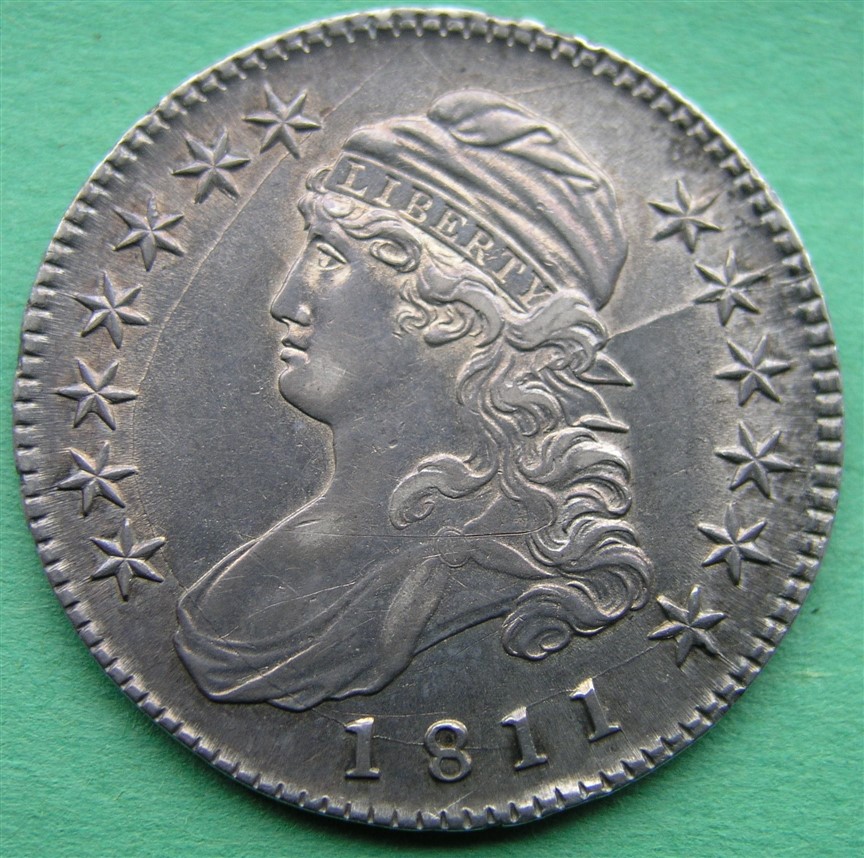
I love die cracks and Bust Half Dollars have so many of these. Here's one of my favorites - not valuable, but awesome. In the past I broke out slabbed coins but now I've reversed that because of my age. I don't have anyone in my family who appreciates coins so in the past few years I've had all of them graded. At some point I may have to sell these ladies.


Beginner's-Guide-To-Attributing-Capped-Bust-Half-Dollars
Member ANA and EAC

"You got to lose to know how to win".
Dream On by Aerosmith
  Previous TopicReplies: 17 / Views: 5,542Next Topic
Page: of 2

To participate in the forum you must log in or register.


Disclaimer: While a tremendous amount of effort goes into ensuring the accuracy of the information contained in this site, Coin Community assumes no liability for errors. Copyright 2005 - 2026 Coin Community Family- all rights reserved worldwide. Use of any images or content on this website without prior written permission of Coin Community or the original lender is strictly prohibited.
Contact Us  |  Advertise Here  |  Privacy Policy / Terms of Use

Coin Community Forum © 2005 - 2026 Coin Community Forums
It took 0.44 seconds to rattle this change. Forums