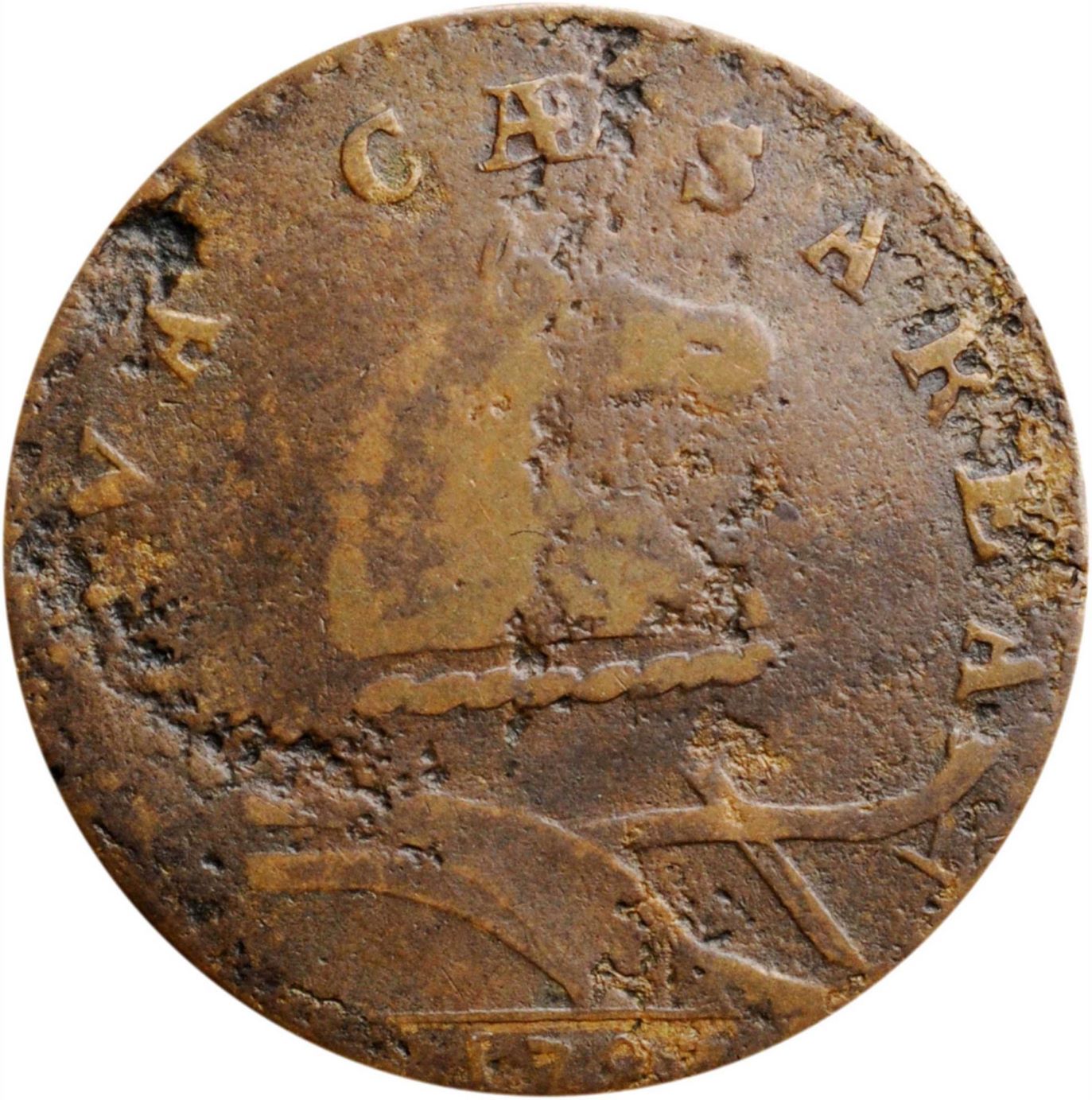
Its true an XRF surface scan would help here but let's first crank this up a numismatic notch or two for your sake <BG>: 1- NJ Maris 68-w always comes irregularly struck and notoriously made not very well and this example being of no obvious exception. Some may consider it the most notoriously ILL-MADE made NJ variety that is not a R7+ or higher if you get my meaning. 2. Of all the coins Michael Hodder cataloged for John Ford it was lot 211 that SHOCKED him the most the Cheaney-Hines-Sheldon-Clarke-Boyd 68-w based on a private conversation Bill Anton had with Hodder and then passing this information down to me - the question - Mike - which NJ was most memorable in Ford? Even in UNC condition it was still imperfect with the noted die buckling from K-8 to K-3. Furthermore - although now a lost fact in NJ's the mint designations to all the varieties no longer are posted with the previously seen Hodder mint attributions. NJ's which were odd, not family linked or peculiar were at times given Hodder's Uncertain Mint designations. Maris 68-w of an Uncertain Mint designation due to its striking peculiarities, planchet quality and of course its lack of a die marriage to another variety. Speaking of strike similarities or dis-similarities since in my 1995 paper given at the ANS titled "The So-Called Atlee Broken "A" letter punch which debunked Breen's attributions of using letter punches solely by themselves as a QUICK MINT Designation provenance tool - if we look here at NOVA we see an example of the Atlee broken A letter punch as it appears on most (if not all?) NJ Maris 68-w's. This sharp broken A letter punch was the result of a casting process? Unlikely. The horrible surface and multiple die breaks? could also be the result on an improperly annealed planchet and/or an improper alloy mix this being Maris 68-w the most notorious ill made NJ in my opinion under a R7+ designation. Now if we were talking Rahway Mint 14-J only a fool would debate this with these types of diagnostics - your turn. JPL
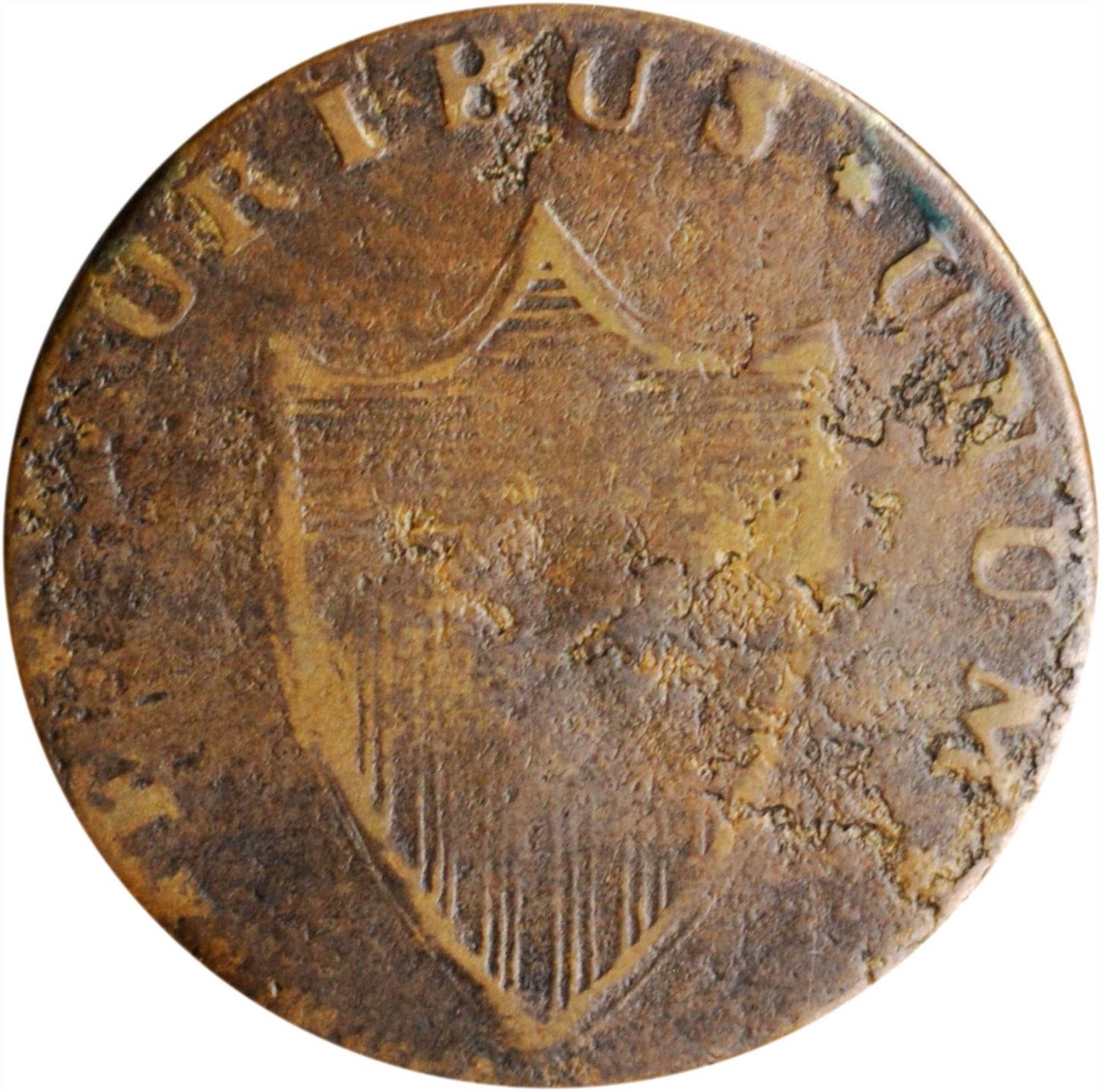
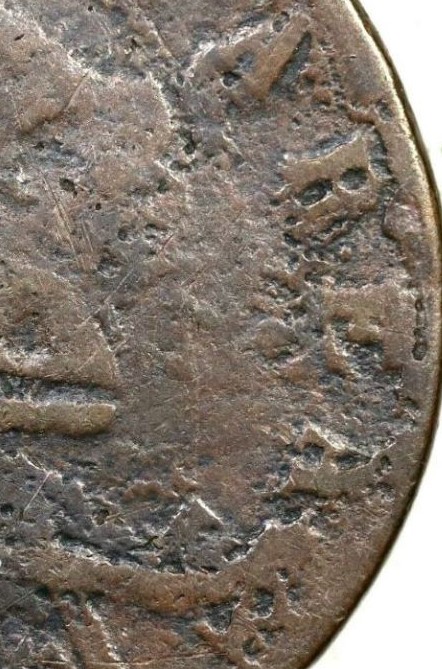
Thing is, this wasn't the only one in the offerings at the time that looked like it was a cast, down to the sand (or whatever served as the mold) coming apart. They pretty much looked the same which, obviously, is impossible. I often respond viscerally to a coin; and maybe like an old Trout looking askance at a "fly" that wasn't just right, I don't like it. It doesn't "add up". Here's the obv. & rev. from one in a Stack's auction. A crappy but a VERY different planchet. This is Struck; how do you reconcile what purports to be the right field-see third picture, it's complete irregularity (it's stepped) that is supposedly "struck", to the surface of the Stack's example? The die would have had to have been irrevocably scarred for that to happen.
I seen the late Mike Ringo's cast NJ's and most appear like a GII CCC cast 1/2d's in their appearance. If a cast most would have filed edges to remove the rim burrs. These are all very rare (to answer realeswatcher inquiry in this thread) as with GIII CCC1/2d's since casting was replaced with striking prior to this period (i.e., c.1770's - beyond). Its a $200 coin - the sellers are legitimate dealers as already mentioned. If someone buys this I can do a free XRF scan for you within 1-2 months thru a bullion melter friend of mine who owns an XRF gun. We do see some grayish material unless its just the photo. Its struck IMO with these two diagnostics of being improperly annealed as the Stack struck coin and possibly with improper mix alloy. Cast coins particularly cast NJ's like GII CCC casts are lumpy in planchet diagnostics (narrow & thick) have filed edges most of the time and do not generally have say half the letters sharp as in this inquiry coin. As Mossman alluded to with his ANS paper on CCCs with Dr. Smith most are of a bronze (Cu/Sn) composition with ~4-6% tin which can be seen in a XRF surface scan if this coin (M.68-w) goes that far into a metallurgical analysis. JPL
Ok... I'll point-out something. Please let me know how this is possible: if you see the field at A-R, then that field goes south to a steppe, then a bar is on top of the steppe, and there is a long diebreak on top of that? Trace it, that is a break-you can see it going over the plow. Impossible die state, any way you look at it. The stepping alone would preclude this coin as being diestruck, unless it was horriblly acid-treated, etc-and I don't see that there.
Its possible if along with die breaks you add into this example die bulging and surface planchet occlusions due to an improper alloy mix and/or poor planchet annealing. JPL
Yes, but that doesn't explain a die break where there isn't supposed to be one. When a die breaks, every coin struck after that will show the break. This would have to be The Last One Struck (or very close to it, as it's unrecorded), but we know that's impossible. Also, would this be an "orphan" planchet in the strip? Do any others of the variety look like this? I can't find one. Burfle23: a couple of things: yes, a longtime Early US collector friend thinks that S-161 is a cast-one other longtime Colonial specialist-friend won't say. That EAC meeting that I remember Jack Robinson (and maybe Bill Noyes) passing around dental cast certified Late Date Large Cents was at the yearly breakfast meeting with all the Regional chairs, etc. I was with JY, Jr. at that one, so it was a ton of years ago... There will always be Questions, and I think the Answers to them about this coin will run out before the Questions do. With that, I hope everyone has a Happy New Year! I learned a few things; I hope others did as well
Love the discussion of XRF and early coppers colonialjohn! I have a friend at a PA testing facility and he coordinated testing at 2 levels as well as specific gravity/ density on my known struck counterfeit early coppers versus many known genuine ones of the same date range, as well as a couple of recent Chinese counterfeits and a couple of old electros.
The results were very interesting within groupings of fake 1805 and 1806 Half Cents and my early large cent fakes, documented in a couple of articles in EAC's Penny-Wise.
The large cents tested as genuine, with my 1796 S-85 proven to be struck over a later date petite head large cent...
I think it's all been said. People see what they want to see. As far as an XRF test on this: it wouldn't really be useful information, as the metal source for the "coin" could be anything. You'd have to try to test it against others of the variety, and even that is no guarantee... And John: cast NJ colonials aren't that rare; I sold several contemporary casts to Clem back-in-the-day
Wow, you really are good Peter! I would think one would need to see an example in hand to be totally sure; I actually have all 3 in hand I was told you stated as cast fakes and will take my time going through them. I was just giving anyone here the opportunity to ask for anything specific about them from this discussion.
Clem became good friends with my wife and I through coin conventions, especially the Dayton EAC she and I chaired; really miss him and would have loved to see the ones you sold him as contemporaries.
I worked in a coin, etc. store in Beverly MA when Clem worked for Parker Bros., waaaaay back when. Two coins that stand out sold to Clem (he did buy from me MM's with strange, nubbed edges) were a bright yellow 53-j NJ (for $125.00!!), and a holed 56-n NJ o/s on a double-struck CT. Those should be recognizable.
As far as the "68-w" et al are concerned, I didn't see any obvious signs of circulation on them. Their 'sameness' seems apparent. The 68 stands out, because it is an impossibly-struck coin for the variety. It was not struck by dies. The variety just doesn't look like that, and the dies' states don't exist. That little bell rings signifying Possible Counterfeit Alert...
Perhaps this can help add a little bit to the discussion here.
Here's an old half penny token from the Quebec Bank minted in 1852. Although this was minted much later than 1787, the porous surface of the coin looks similar to the surface on the original NJ piece on the first page. The reason why I put this here is because this token isn't exactly rare or highly valued. Of all the coins to counterfeit, I doubt a criminal would dedicate their resources to counterfeiting this particular token. Maybe something else is up?
I watched this video here a while back that talks about patina and toning on ancient bronze coins:
IEWacCLJFx0
Towards the end of the video, the guy mentions that the surface of many bronze/copper coins can mineralize after being exposed for some time to the environment. I don't quite understand the chemistry behind it, but essentially the chemical content of the coins outer surface changes. This might be related to bronze disease (that nasty blue color that we see engulfing some copper coins that once it starts, it doesn't go away but spreads). If the coin is cleaned and the outer mineralized layer is removed, the details on the coin are also removed, leaving behind a "pitted" surface (sort of like a person's face after surviving small pox). Maybe this is what happened to the colonial piece? 1787 is a long time ago, and the coin itself may have contracted a serious case of bronze disease, or developed the condition many times, and therefore it was cleaned many until its present state? Each time it was cleaned, it lost details on its surface, which is why it looks so "pitted." New Jersey can also have a humid climate during certain parts of the year, which can maybe cause bronze to corrode or tarnish over time? Factor in the fact that that piece has been exposed to such a climate for 100-150 years, and thus you have a bronze coin that has been damaged by the environment?
The "thing" about the 68-w in question is that it is in a die state that doesn't exist, and wasn't struck. I don't think that it circulated. One thing to remember about contemporary counterfeits, is that those coins familiar to the public (1775 British. 1/2d's come to mind, and many were produced with that date in the 1790's) were targets. That said, I'd say that the 1852 Quebec Half Penny looks brassy on the rubbed high point, and the denticles are poorly defined (they weren't struck like that-crisp separation is the norm). I'd pass as a Genuine example, but would like it as a Cast
I'll leave this: Years ago, at the advent of Encapsulated Certification, a firm which I worked for had a Birch Cent in a **** slab, graded VF25. It was kind of white and porous I thought, but **** said it was OK, so... except for that a hugely-considered expert (going back to Lester Merkin days) of Colonial/Early US coinage said it was NG. I had the opportunity to see him at a show, and asked him. What he said then still resonates with me today: "I don't give a (darn) what anyone says. The coin is No Good. Look at it." and with that the discussion ended. He knew, and if he said something, you could take that to the bank. Obviously, I am not in that category, but I look.
Disclaimer: While a tremendous amount of effort goes into ensuring the accuracy of the information contained in this site, Coin Community assumes no liability for errors. Copyright 2005 - 2026 Coin Community Family- all rights reserved worldwide. Use of any images or content on this website without prior written permission of Coin Community or the original lender is strictly prohibited. Contact Us | Advertise Here | Privacy Policy / Terms of Use





 First Page
 Previous Page


 Posted 12/31/2022 6:22 pm