The Lewis and Clark Exposition was held in Portland, Oregon from June 1 through October 15, 1905. In addition to celebrating the centennial of the 1804-1806 expedition of Captains Meriwether Lewis and William Clark, the Exposition was also intended to promote Portland's economic potential (with an eye toward attracting investors) and to foster trade and economic cooperation among nations on both sides of the Pacific Ocean. The full name of the Exposition was the Lewis and Clark Centennial and American Pacific Exposition and Oriental Fair ("Exposition").
The Exposition included participation by 17 US states (plus the Territories of Alaska, Oklahoma and the Philippines) and 21 nations. Overall, the exhibits presented a story of scientific progress and development and advancements in technology. Over the course of its four and one-half months, the Exposition enjoyed a paid attendance of ~1.6 million plus ~900,000 free admissions - a total of ~2.5 million. (OK figures, but they pale in comparison to those for the Louisiana Purchase Exposition of the year before which attracted approximately 20 million attendees.)
The Lewis and Clark Centennial and American Pacific Exposition and Oriental Fair Company ("Company") was the organizer and manager of the Exposition, along with Oregon's appointed Centennial Commission. The Company decided upon "Westward The Course of Empire Takes Its Way" as the Exposition's motto/slogan; it alluded to the unlimited potential of the US' westward expansion. The theme was expressed in the Exposition's logo/emblem.
Logo/Emblem of the Lewis and Clark Exposition (from Postcard)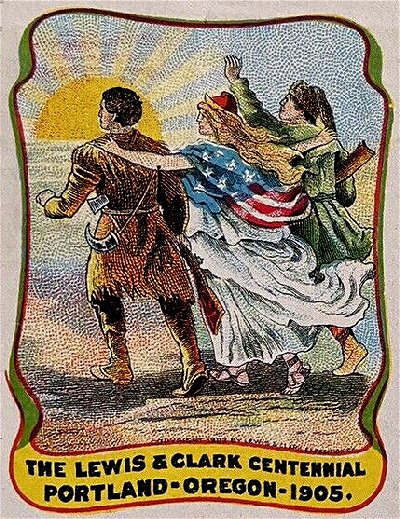
A pair of commemorative Gold Dollars was authorized by the US Congress to support the Exposition, and a souvenir medal program was also executed. The Mint struck medals in silver, bronze and gold-plated bronze in the Mint Exhibit that was located in the US Government Building. (The US Congress appropriated a minimum of $600,000 for the Federal Government's participation (e.g., construction costs, exhibit expenses, travel expeses, etc.) in the Exposition.)
US Government Building with Hot-Air Balloon in Foreground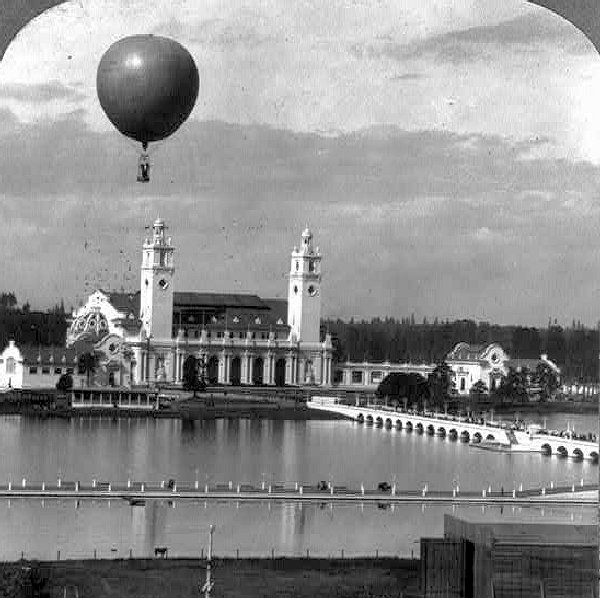 (Image Credit: Library of Congress, Prints and Photographs Division. Public Domain.)
The medal's obverse design presents
Lady Columbia, symbolic of Progress, leading Lewis and Clark toward the sun setting over the Pacific Ocean. It is based on the official logo/emblem of the Exposition (above) which was titled "Into the Setting Sun."
The reverse of the medal features a map of the Pacific Northwest (Oregon, Washington and Idaho) plus parts of Montana, Nevada, Utah and California (northern). The map includes the depiction of various trade routes from Portland to points west (marked by lines). The Exposition was definitely considered a vehicle for promoting increased trade with Japan and China.
Lewis and Clark Exposition "Official" Souvenir Medal - Silver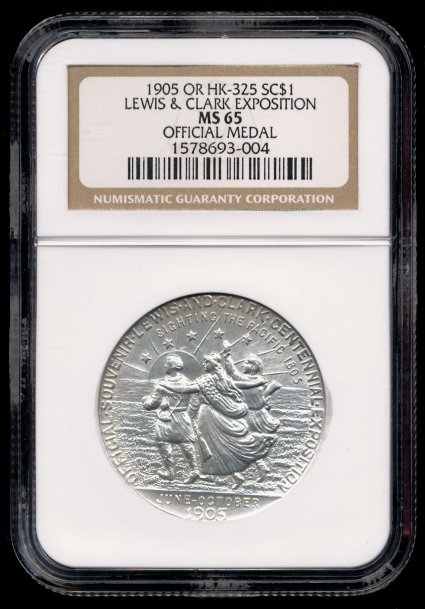
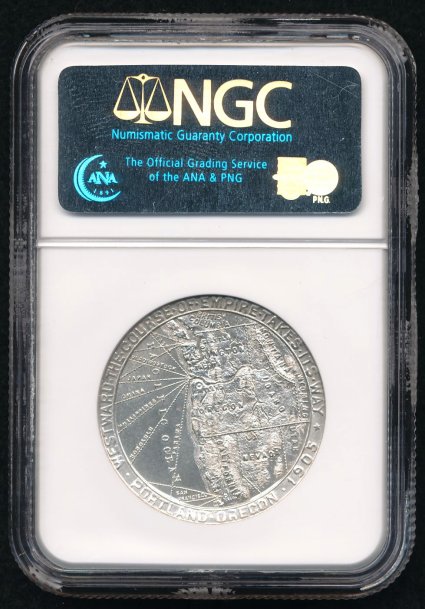 Lewis and Clark Exposition "Official" Souvenir Medal - Gold-Plated Bronze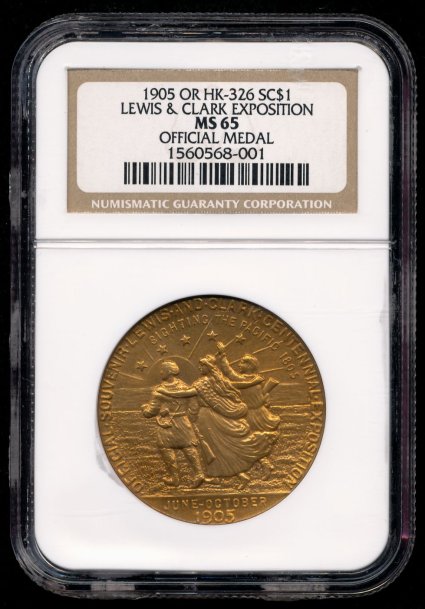

For other of my topics on commemorative coins and medals, including more on the Lewis and Clark Exposition, see:
Commems Collection.







 Posted 05/20/2023 09:16 am


