| Author |
 Replies: 19 / Views: 2,373 Replies: 19 / Views: 2,373 |
|
Pillar of the Community
United States
6976 Posts |
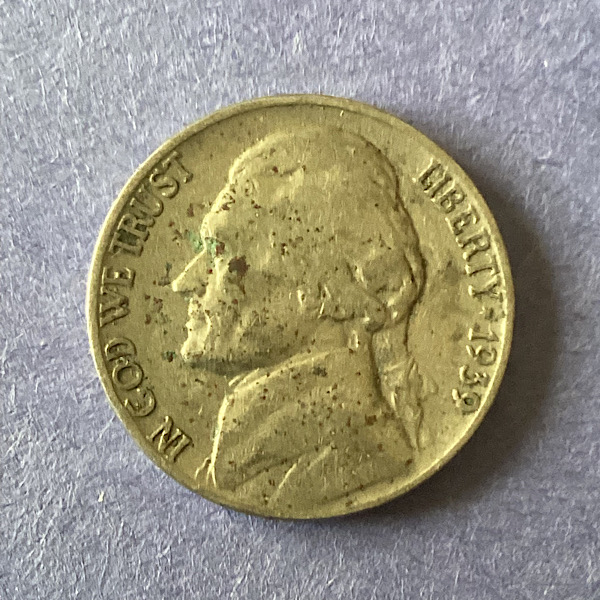 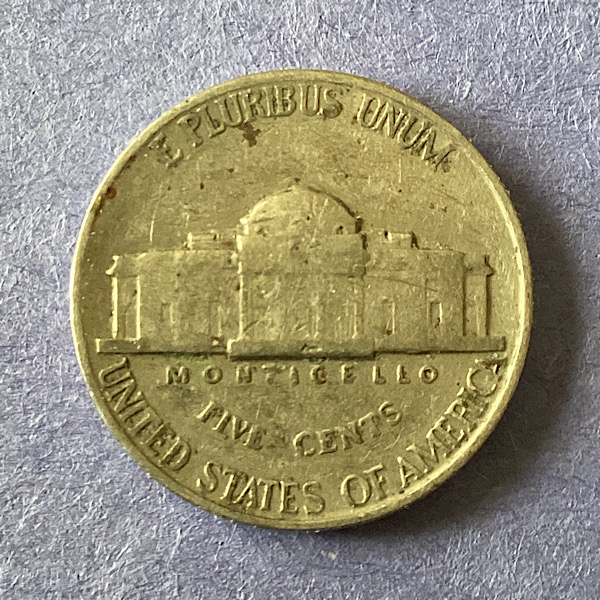 This Jeff has quite a bit of surface crud. Some of it might be corrosion, but a lot of the gunk in the letters can be scraped with a fingernail or wooden toothpick. Plop it in a capful of acetone? WD40? Baking soda? Vinegar? Dish soap? Something else? Apparently scrubbing it with a soft bristle toothbrush is heresy. I figure as it sits, this nickel is worth a nickel. So it's a pretty low stakes cleaning. Er, conservation attempt? *** Moved by Staff to a more appropriate forum. ***
|
|
|
|
Moderator
 United States
56855 Posts |
Acetone,it won't hurt it any.Skip the rest. Make sure it is 100% pure not standard nail polish remover.Post an after photo. John1  |
|
Pillar of the Community
United States
3848 Posts |
Acetone, nothing else. I do not think any of your listed materials will do much besides vinegar (not good).
Suffering from bust half fever. Want to learn how to attribute early half dollars by die variety? Click Here: http://goccf.com/t/434955Shoot me a PM if you are looking to sell bust halves. |
|
Pillar of the Community
 United States
6976 Posts |
So what's the procedure? Soak it in acetone for (duration), and then: rinse with water, dab dry with a soft cloth? Rub with a cloth? Scrub violently counterclockwise with a Toothbrush of Value Devastation +2? |
|
Moderator
United States
198174 Posts |
Do not rinse with water. Rinse with fresh acetone (use a flowing rinse). Let it air dry (acetone evaporates fast). Do not use water (its impurities may leave spots), do not rub or dab with cloth (it may scratch).
|
|
Pillar of the Community
 United States
5727 Posts |
 It won't hurt, but it's highly unlikely it will help the appearance either. Not much you can do for a mild case of road rash. |
|
Bedrock of the Community
United States
94367 Posts |
Good luck, but guessing this is a lost cause.  Edited by Coinfrog
05/22/2023 6:25 pm
|
|
Moderator
United States
110474 Posts |
give it a try, maybe most of that black gunk will come off it.
|
|
Pillar of the Community
United States
6976 Posts |
To be fair, this is a test case. I've got coins like circulated bicentennial quarters that have literal wads of black gunk adhered to them. Others have paint, crud, and quite possibly asphalt or driveway sealer. I don't even like putting them into new, clean rolls with similar denominations because I don't want the other coins to be stained or discolored by contact.
|
|
Bedrock of the Community
Australia
21794 Posts |
Acetone is excellent for removing organic substances from coins
provided that any organic sulfur of chlorine chemistry is not in those substances.
If there is, they will react with the metal of the coin, to form inorganic residues, which can an often do, leave permanent inorganic stains on the coin.
Permanent fingerprinting is an example, where the fatty acid oils in the skin leave behind their characteristic markings.
Inorganic staining, be from skin oils or any other fatty acids, such as from foodstuffs, cannot be removed with acetone.
In the case of the pictured coin in question, it looks as if those small black spots may be of an inorganic nature, unfortunately.
Try acetone anyway; it certainly won't do any further damage.
|
|
Pillar of the Community
United States
6976 Posts |
The spots are on the metal. The ones by the eye even have greenish metal discoloration, probably due to the copper.
However, the black gunk in IGWT is not corrosion, it's something sticky that can be scraped with a toothpick.
That's an interesting tip about fingerprints and organic material. Sounds like the coin needs to be wiped thoroughly with hot water prior to acetone.
Is there any harm to plunking a coin into boiling water for a while?
|
|
Moderator
United States
198174 Posts |
Quote:
To be fair, this is a test case. Those are important to the learning process.  |
|
Pillar of the Community
United States
6976 Posts |
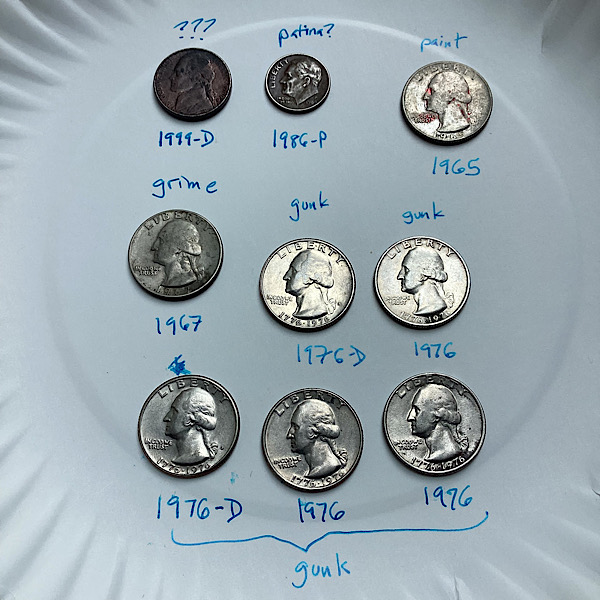 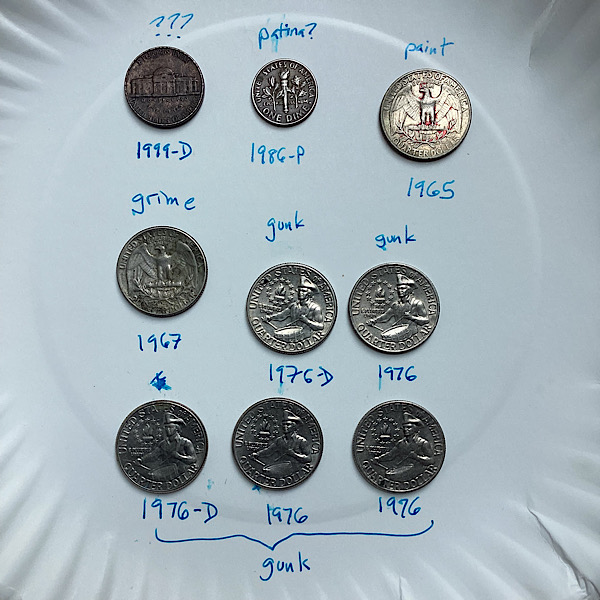 Ok, my first test batch. I decided against the 1939 Jeff because it might have some minor value, so I plunked that back into the 1940s Jeff jar. The 1999-D nickel, 1986-P Roosevelt, 1965 Washington have gone into a little jar of pure acetone from the car parts store. The 99 nickel has some sort of coffee colored "patina" on it. Seems like tremendous EVD, although the scratches have a very bright copper color. Maybe something selectively stripped nickel from the surface alloy, or maybe it's just thinner deposits in the scratches. I have a 95 with the exact same substance and appearance, and I've been curious what it is. The 86 Roosevelt has a much harder "patina" in the low spots. Not sticky or scratch-able with a toothpick. The 65 Washington has red ink or paint on it, and is also somewhat sticky. |
|
Pillar of the Community
United States
6976 Posts |
Oh, and I let them soak for an hour, no real change. Will let them in overnight and check again tomorrow at lunch.
|
|
Pillar of the Community
United States
6976 Posts |
After 3 hours, the nickel is clearing up considerably. No change to the dime, and surprisingly, no ink removed from the quarter. I haven't rubbed them though, just turned them over and returned to a cool, dark, isolated place.
|
|
Moderator
United States
198174 Posts |
Very interesting!  |
| |
Replies: 19 / Views: 2,373 |







 Posted 05/22/2023 4:23 pm


