| Author |
 Replies: 13 / Views: 1,217 Replies: 13 / Views: 1,217 |
|
|
New Member
United States
3 Posts |
I was (finally) doing some sorting through lower-denomination US coins and came across a "V" nickel that is not 21 mm diameter, but is approximately 22.8 mm. The thickness appears correct and it weighs approximately 10% more than a standard-size nickel of the same year. In all other ways it looks like a typical well-worn "V" nickel. And no, it's not magnetic. My old coin book and a web search turned up nothing on this. Well, I guess it could be counterfeit, but who would counterfeit a 1906 nickel? Any ideas? Thank you very much in advance. 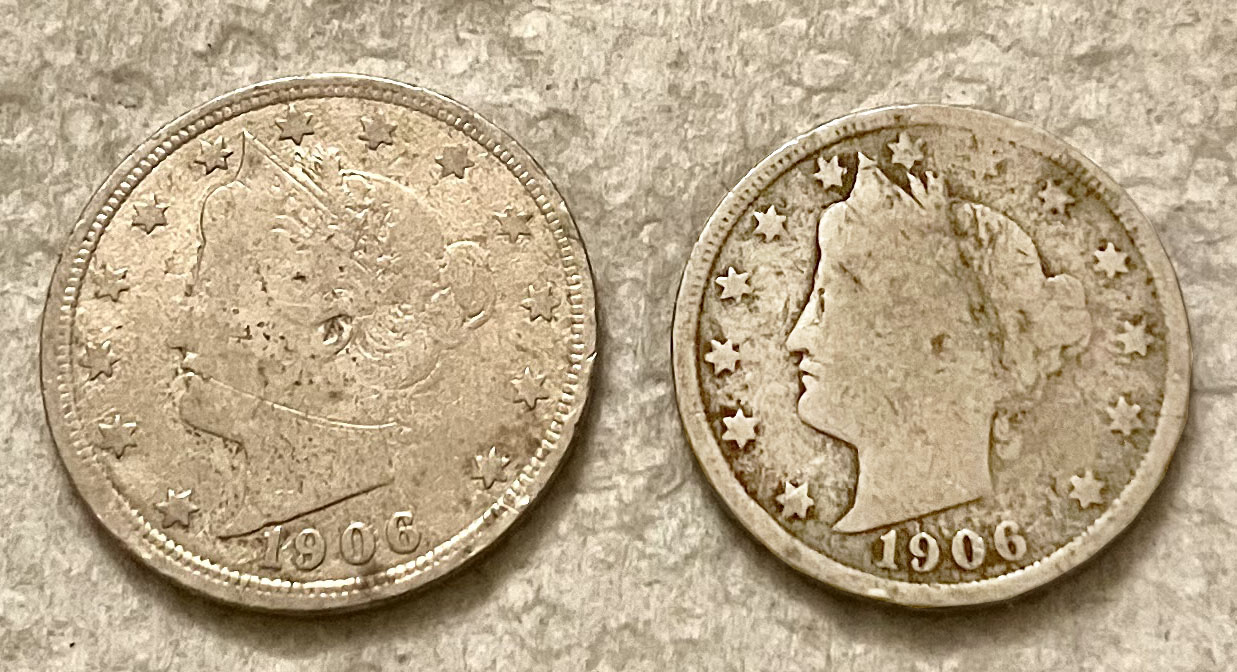 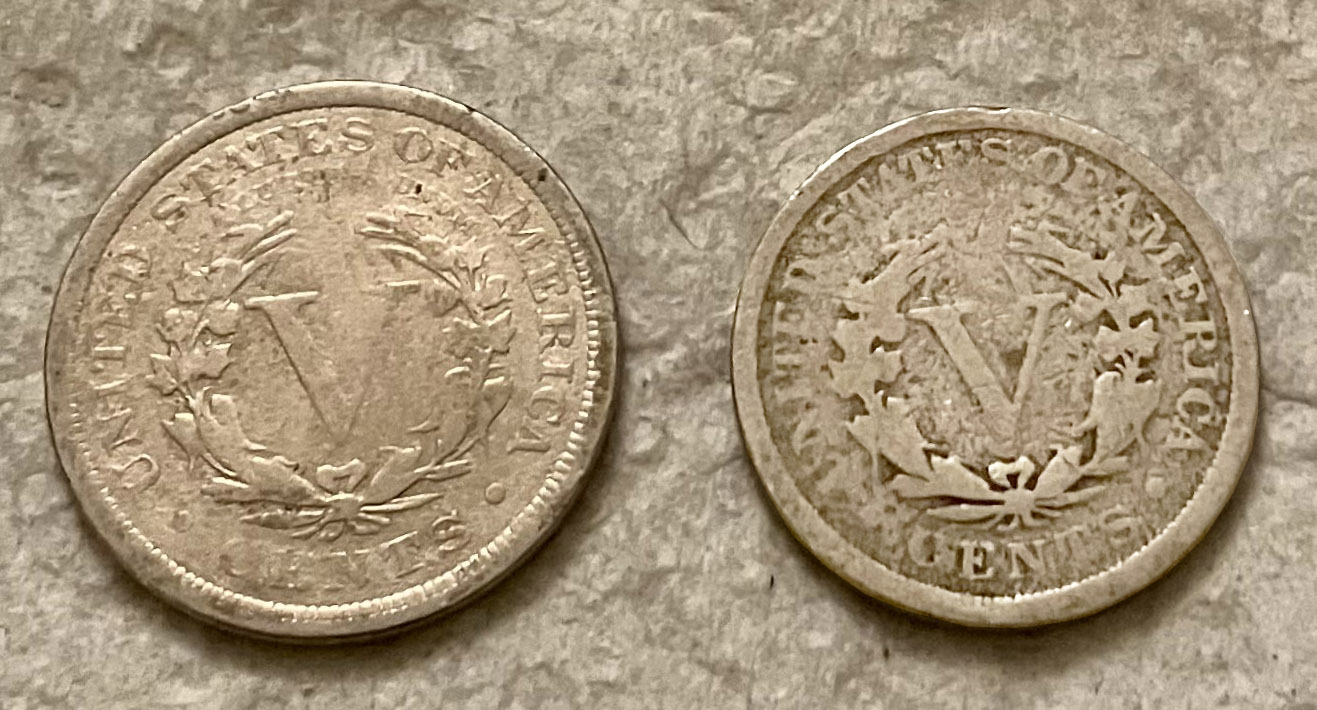 |
|
|
|
Bedrock of the Community
United States
94367 Posts |
Looks pounded out, a "Texas nickel"?   to the CCF! Edited by Coinfrog
06/16/2023 10:02 pm
|
|
Moderator
 United States
34567 Posts |
First, welcome to CCF. Second, I agree that your coin has been flattened slightly, which has correspondingly increased the diameter.
"If you climb a good tree, you get a push."
-----Ghanaian proverb
"The danger we all now face is distinguishing between what is authentic and what is performed."
-----King Adz
|
|
New Member
 United States
3 Posts |
Thanks for the inputs. Yes, that it has been flattened does certainly appear to be a possibility, and the most likely, especially since it is a bit (but only a bit) below standard thickness. My original thinking was that the thickness reduction (0.10 to 0.15mm) maybe was just wear. I was also unsure whether the coin details were showing signs of being flattened or just are heavily worn, as I have other V nickels that are worn to the same appearance. What I still find curious is that the larger coin is roughly 10% higher in both weight and volume than my other V nickels, and that the coin details (and diameter) are still so symmetrical. Other coins & objects I have seen flattened and increased the diameter this much are significantly distorted. If this was flattened I really do wonder how it was done. And why. Edited by dw01
06/17/2023 10:35 pm
|
|
Moderator
United States
108675 Posts |
Well this would be the first 'Texas' nickel I have seen..
Can you provide an edge on image with the normal bickel?
|
|
Pillar of the Community
United States
4233 Posts |
Quote:
and that the coin details (and diameter) are still so symmetrical It looks rather oblong to me. Maybe it's partly the camera angle but it's stretched SW-NE. |
|
Moderator
United States
15974 Posts |
to the CCF Take a look at my other hobby ... http://www.jk-dk.art |
|
Moderator
United States
56855 Posts |
dw01, I agree with it being flattened after it left the mint. PMD. John1  |
|
Pillar of the Community
United States
579 Posts |
 First for me too |
|
Moderator
United States
34567 Posts |
@dw, can you please tell us the exact weight of the seemingly oversized nickel? Thx. Flattening should increase diameter and decrease thickness, but leave alone the volume and weight.
"If you climb a good tree, you get a push."
-----Ghanaian proverb
"The danger we all now face is distinguishing between what is authentic and what is performed."
-----King Adz
|
|
Pillar of the Community
United States
1538 Posts |
Maybe someone needed a quarter and only had a nickel? May have been pounded between two pieces of leather to soften the blows.
|
|
Pillar of the Community
United States
669 Posts |
@kbbpll is correct. It is certainly an oval stretched SW-NE.
|
|
New Member
United States
3 Posts |
Sorry about the photo. Because of the lighting, the photo was taken from a slight angle and then parallax corrected. Good eye on the "stretching". I measured 5 other V nickels and the maximum individual coin diameter deviation was 0.02 mm. The large nickel has a diameter deviation of 0.13 mm. I have a hypothesis on the weight (and volume) difference: Because of the "flattening" it is much closer to original weight than my other V nickels because the normally raised features were not raised and thus not subject to as much wear. Based on the information provided in this thread - for which I thank you all very much - I did some profilometer-type measurements and found that the liberty head edge height was equal to or less than my worst condition V nickel. This is notable because this "worst condition" coin is so worn that the date is not visible. If the large coin had this level of wear, I suspect the date and stars would not be so visible. And since it was asked, the thickness of the large coin is 1.47 - 1.52 mm, my other V nickles are in the 1.67 - 1.52 range. I weighed more of my V nickels and they varied from 4.4 to 4.8 gm, with the large coin measuring 4.9 gm. (Note that the scale used for this was a general-purpose Ohaus beam balance, so accuracy to better than ±0.2gm, especially in the low range, is questionable) Again, thanks for the input! Edited by dw01
06/17/2023 6:04 pm
|
|
Pillar of the Community
United States
4233 Posts |
Not sure what you did with the image, but you could put the normal one on top of the pounded one and see if it's is really oblong or not.
All I can conclude is that it certainly wasn't struck like that at the mint - they didn't make the dies and collar bigger in order to produce this.
|
| |
Replies: 13 / Views: 1,217 |
|







 Posted 06/16/2023 10:20 pm


