Hi all. I did a science experiment and I wanted to share the results. So background:
I have a total of 24 1967 10 cent mackerel dimes. 6 of those were in their original uncirculated proof-like state wrapped. The other ones were varying degrees of wear/tarnish. I wanted to know which were 80% and which were 50%. There is conflicting information about how to tell, some people disavow the idea that any of them were ever 50% until 1968.
Of course I don't have an XRF analyzer, nor have access to one. I don't know if the drop-test would be a good choice for me since I am new to collecting silver coins and don't have the experience.. plus it may be a subjective test. Weight isn't a good way to test too as they're all over the place 2.163g to 3.389g.
So here's the catch. I am an x-ray tech in the hospital and have been educated on the attenuative differences between elements based on their atomic number (# of protons in the nucleus of an atom) I figured I could experiment using difference x-ray photon levels to get a good
visual analysis. I've done this before years ago comparing a lab-diamond to a real diamond. To no surprise the real diamond (being essentially pure carbon with an atomic number of 6) did not visually appear, while the lab-diamond, having impurities such as Sulphur (among others) showed up as bright as a piece of metal basically.
My theory was that the other metal in .80 and .50 silver alloy is copper. Which shares a 1 atomic number difference between it and nickel. Ni = 28. Cu = 29. So, pretty close. Radiographically they should have similar attenuative properties (at least visually, I'm sure you could measure it if the coin thicknesses were identical and you had the ability to measure Hounsfield units like in CT software... maybe).
However silver has an atomic number of 47. Which is quite different. So with 30% more silver content I made the hypothesis that visually the .80 coins should be "brighter" having attenuated more of the x-ray photons than the .50 which, having 50% copper (similar to nickel), would have the properties to absorb less of the x-ray photons.
Here is a photo of my first x-ray I took. Each vertical row are different coins. My controls are on the far left a 100% nickel '95 dime. 2nd row (from the left) are .925 early-1900's. 3rd row are '65 .80 dimes. Are 4th are mackerels that I suspected were .80 based on being uncirculated. My first picture was lower penetration (55 kvp.. penetration is not the right description but easiest to explain it as it). Second picture is of a much higher 125 kvp with more beam intensity (over-all higher and stronger beam). I adjusted the contrast/brightness in the 2nd picture to visualize it better. Here are my results:
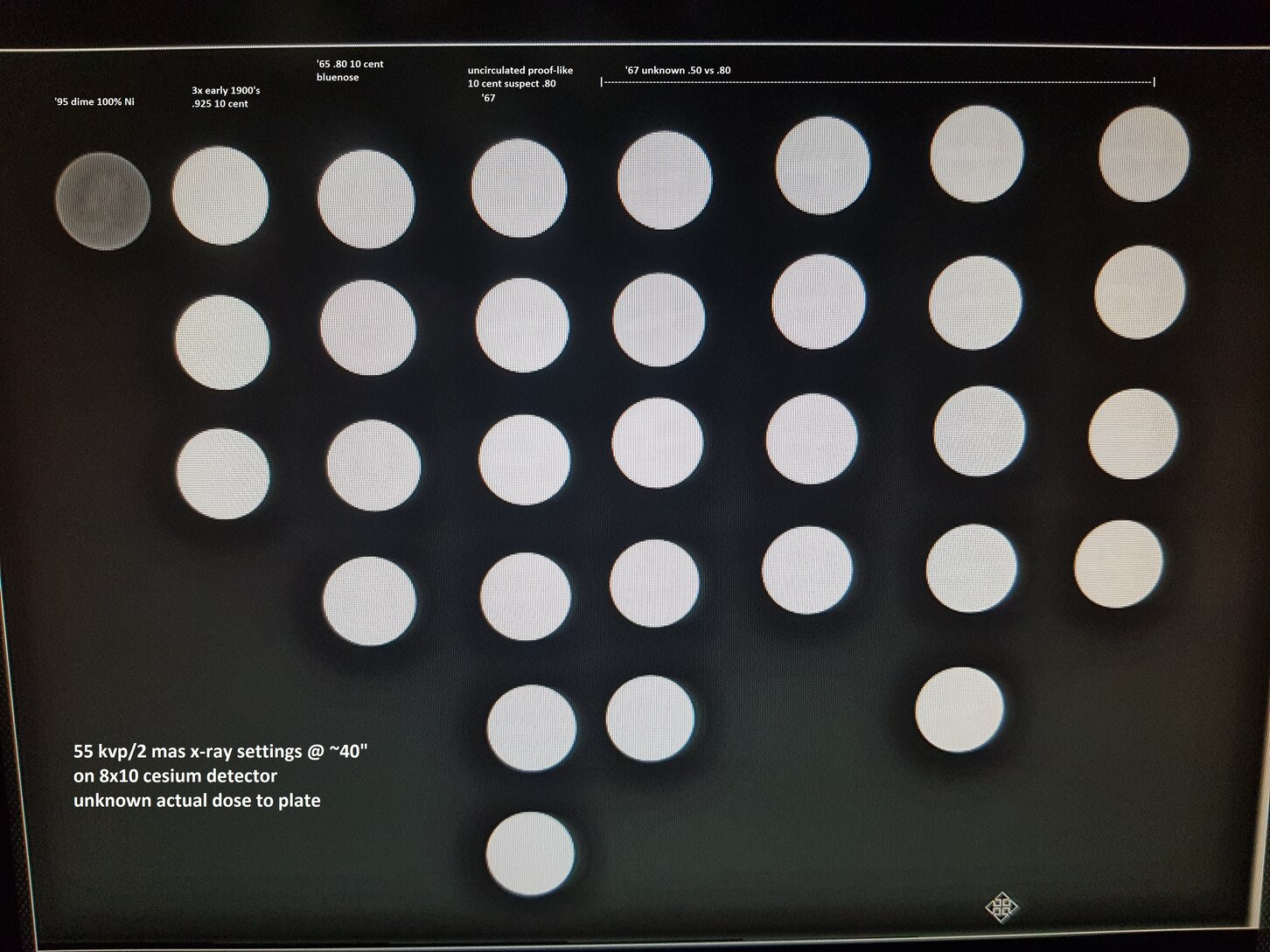
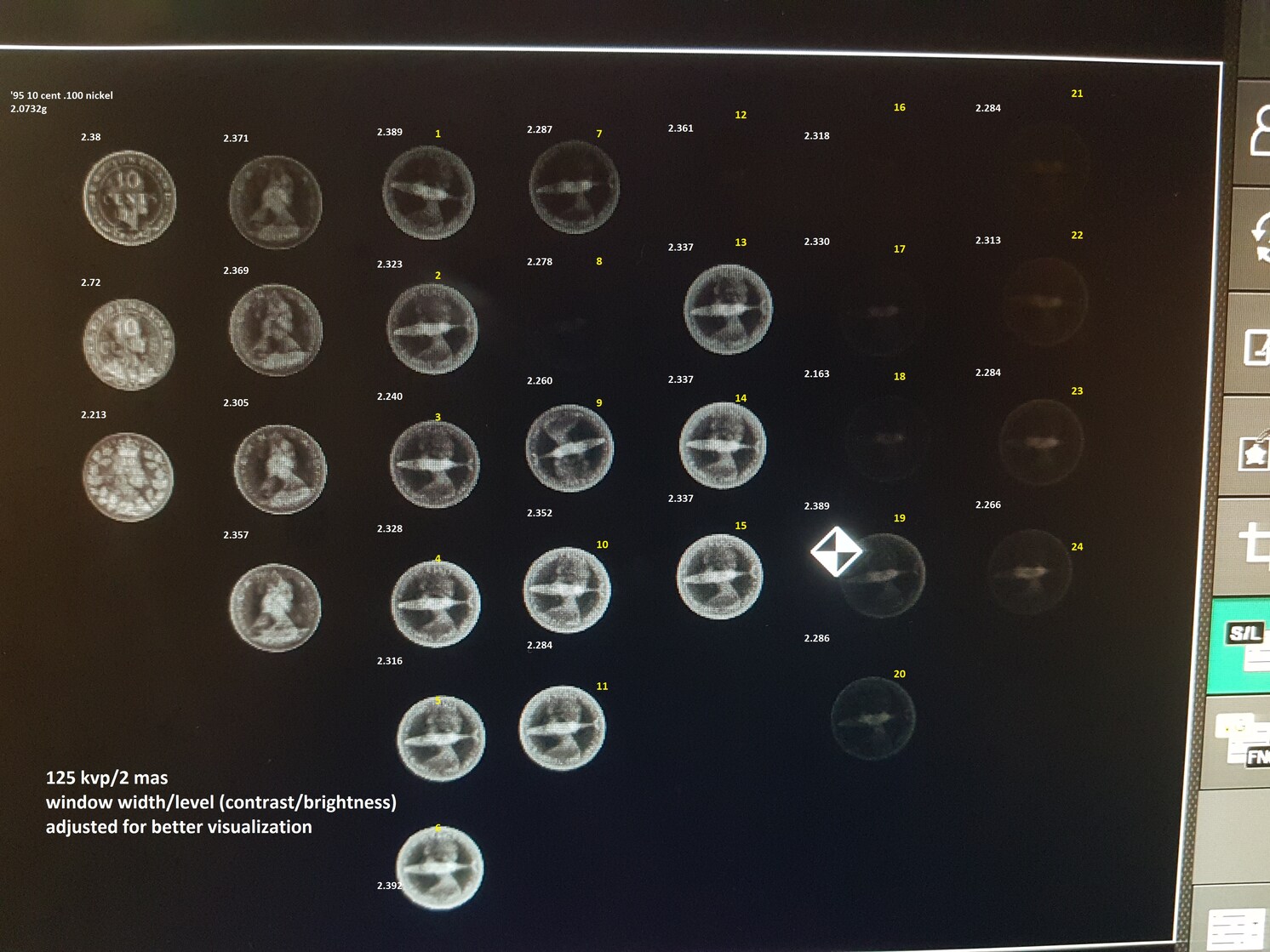
So in the 2nd picture I would draw the obvious conclusion that coins 8, 12, and 16-24 are all 50%. 19 was a heavy coin so it's possible it either has less wear and more "edge" which caused it to attenuate more than the other 50% coins. You can certainly see the mackerel and effigy are less visible. #7 is a bit "brighter" than #19 but doesn't weigh as much. So I suspect that that one is indeed 80% being lighter (therefore not as thick).
In the first picture you see the nickel's effigy is barely visible while all others are markedly radiopaque.
The .925's in row 2 are full of detail in the 2nd picture.
The 3rd row's 80% 1965's are comparable to the 4th row's mackerels. Therefore I confidently draw the conclusion that the 4th row's uncirculated were indeed 80% are these 2 rows allow me to visually-accurately assess the relative silver content the remaining rows (#19 is a bit of a mystery to me but I still conclude it is a 50% piece based on it's weigh and radiolucent properties)
So knowing this as long as I have a coin of known wanted silver content with similar thickness, I can use my x-ray machine to assess coins in the future (at least for the next '20 years :P). It's probably cheaper to get a used portable x-ray machine, plate, and reader than an XRF analyzer haha.
If you have a friend who works in diagnostic imaging in x-ray, take advantage of them on their nightshift and have them x-ray your coins for you if you're in doubt :P
- Jake







 Posted 08/24/2023 4:35 pm


 to the Community!



