| Author |
 Replies: 15 / Views: 2,991 Replies: 15 / Views: 2,991 |
|
|
Valued Member
United States
326 Posts |
Could someone confirm for me that this is a clipped planchet? I pulled this coin directly from a $1000 federal reserve box out of a bu roll. Marks on the face of the coin are toning. Value?     Edited by meckl9
04/16/2009 01:24 am
|
|
|
|
Pillar of the Community
United States
3507 Posts |
Hi,
There is no such thing as a die clip. This is a coin that was struck on an incomplete planchet. They are known as "clipped" planchets although the first term I used is more precise.
The planchet is improperly cut from the coinage strip and then subsequently works its way through the process and gets into a coining press.
It looks to be a legitimate error.
Nice Find!
Bill
|
|
Pillar of the Community
United States
7629 Posts |
I will digress to Bill's more experienced handling of errors, but it is my opinion that this coin is suspect of having been cut outside the mint. I do not see the typical weakness in the devices around the clip, nor do I see any weakness on the opposite edge, which is not always present, but usually is.
I would also question the edge lettering on this piece. If it is complete on the opposite side, I would want to know how it got there. The edge lettering, to my understanding, depends on pressure from the opposite side, which there is none...so opposite the clip there should be no edge lettering.
|
|
Valued Member
 United States
326 Posts |
Here is my only insight. I know the timeline of this coin personally. I watched it be delivered by Brinks to the bank and then watched it come from the vault to the teller and saw her cracking the fed wrapper. So someone would have had to have cut this coin at the place these coins are fed wrapped which I would believe is highly unlikely.
|
|
Pillar of the Community
United States
5700 Posts |
I am not an expert in this matter, I know bill is exceptional at this area, however after reading all the posts, Chuck has some very valid points he so factually states, 1-the "incomplete Planchet" once upset should show at 180 degrees from the missing piece more evidence of the pressure applied to this coin upon being upset, I do see some obvious rim appearance of damage or uncommon rim marks,just not what I would think would appear with this type of problem  also I too would like to know if there is any edge lettering at 180 degrees across from the missing piece, as there should not be any,there or across from this also, according to my understanding of this process, when a incomplete Planchet is involved, the force applied to the "coin" to incuse the lettering, would not "reach in to print such lettering"this is of course only my opinion, Mike |
|
Valued Member
United States
326 Posts |
Planchet clip side view and 180 degree view have been added.
Edited by meckl9
04/16/2009 01:24 am
|
|
Moderator
 United States
56855 Posts |
I have to agree with Chuck on this one,no offence Bill. John1  |
|
Pillar of the Community
United States
7629 Posts |
With the additional photos I'm at least a bit more convinced than I was before. I got to thinking last night about the weakness that would show on the opposite side of the coin (Blakesley effect) on a real clipped planchet, and made myself aware that I am used to looking at coins that do not have edge lettering. I imagine that the edge lettering changes a lot in what I am looking at.
|
|
Valued Member
United States
198 Posts |
Blakesley Effect is indeed a determining factor, however not 100% reliable and there are exceptions to the rule. Very good call on the edge lettering Chuck, this is something new we'll all need to remember since the return of edge lettering to our coinage. ~ Jim
|
|
Valued Member
United States
326 Posts |
So have we come to any consensus that this is a true clipped planchet? I find it very hard to believe that someone would manually cut this coin at the distribution center.
|
|
Valued Member
United States
146 Posts |
meck19 Whats up with the rim on obverse from 7 oclock to 11 oclock. Reverse rim from two to four.Also what is that covering up "U"and "I"of UNITED on reverse,extra metal?If genuine clip the"H" in John and 2nd "A"in "ADAMS,I should think would show some weakness because of the void right next to it.Metal would flow into the void instead of the letters.I would think the same would apply to the reverse gown lines. There are several things thast would lead me to believe this is not a real clip.That said,some photos out of focus and some with to much light it is hard to say 100% without coin in hand. hope this helps RW |
|
Bedrock of the Community
United States
12437 Posts |
I believe that the edge lettered coins do not go through an upsetting mill so the Blakesley Effect is not valid for those coins.* The edge lettering process would create an analog of the Blakesley Effect manifested as weakness/lack of edge lettering as opposed to a weak rim. One this coin, the opposing weakness/lack of edge lettering confirms it  BTW, any size errors are quite valuable on the Prez dolls at least according to what Fred Weinberg has listed and size errors for all coins since 2001 or so have been quite rare since the Mint introduced riddling machines to separate them out. *Nope, they do go through the upsetting process, from a 2007 article- Blanks intended for Sacagawea dollars are annealed (softened) after they are run through the upset mill while those blanks intended for Presidential dollars are annealed before the upset so that the work hardening of the rim created by the process remains intact. The Mint found that this allows the planchet to withstand the rigors of the edge-lettering process better. The edge lettering is applied to the coins after they are struck.
http://www.numismaster.com/ta/numis...ticleId=2728Edited by biokemist6
04/17/2009 8:25 pm
|
|
Pillar of the Community
United States
4541 Posts |
very interesting thanks for the info
|
|
Bedrock of the Community
United States
62064 Posts |
The problem I have with this coin is that the incomplete planchet should be weaker near the clipped area. It should gently flow into the fields. This coin looks cut as the rim doesn't disappear gradually. 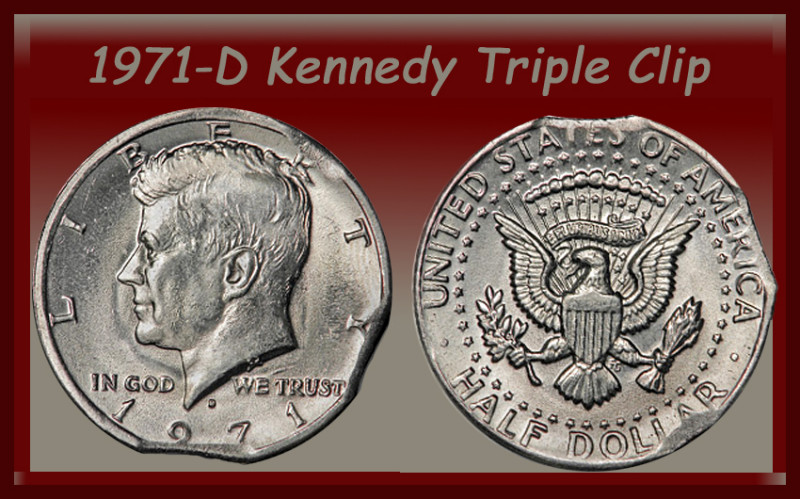 |
|
Pillar of the Community
United States
3507 Posts |
This is why I think it is legit.
1) When a blank is cut, it is cut most of the way through with just a hair left to go before it releases from the strip. When you look at the first picture, you can see the depth to which the blank was cut. There is a very thin portion visible in the picture at the bottom of the clipped portion.
2) There is a small bit of metal struck into the coin where the word UNITED is. That small fragment of metal was a small piece that was left dangling, so to speak as the blank broke away from the strip.
3)The Blakesley effect is visible as a slightly wider border right around the word "President" on the obverse. It is minutely effected but visible.
4) The metal flow of the letters above the President's head is not as effected as we might expect because of the higher rim that is created on these planchets before the coin is struck.
6) there is weakness on the edge lettering opposite the portion that is missing. That would happen as the coin rolled through the edge lettering machine.
7) I could be out in left field or even slightly nuts:-) but I think I have this one right.
Thanks,
Bill
Edited by foundinrolls
04/17/2009 7:06 pm
|
|
Pillar of the Community
United States
5700 Posts |
Is there any way you could post another picture, of the reverse with the word united, and to the rim, in one picture, I can not see the area well enough to be clear, thanks, Mike...
|
| |
Replies: 15 / Views: 2,991 |
|










 Posted 04/16/2009 12:15 am


