|
This page may contain links that result in small commissions to keep this free site up and running.

Welcome Guest! Registering and/or logging in will remove the anchor (bottom) ads and the security checks. It's Free!
To participate in the forum you must log in or register. | Author |
 Replies: 11 / Views: 920 Replies: 11 / Views: 920 |
|
|
Moderator
 United States
34572 Posts |
In a recent OFEY thread focused on pre-1600 coins http://goccf.com/t/467708), I wondered why there seemed to be so many European coins with 1475 dates. I've done a little more digging into Robert Levinson's, "The Early Dated Coins of Europe 1234-1500"and wanted to report out here my results. Levinson assigns a rarity scale with the most common group estimated at 251 or more pieces collectable. He does note that for a few of these common types, the numbers extant likely exceed 1000 pieces and specifically calls out 1475, 1477, 1482, 1492, and 1500 as being dates where specific coinages were super-high. I went through each date in this book for each of the five geographic regions (Germany, Southern Low Countries, Northern Low Countries, Habsburgs, Switzerland, Scandinavia, Italy, and France) looking for types that were listed as Common. Germany and the Southern Low Countries had the most types, with 18 and 17, respectively. Both the Northern Low Countries and Habsburg Territories had four types, while none of the remaining geographic regions had any. I tallied these 39 types by year and produced the below frequency plot.  Frequency plot of issues considered "Common" by Levinson between the dates 1444 and 1500. The date of interest for this thread (1475) is shown in red. Frequency plot of issues considered "Common" by Levinson between the dates 1444 and 1500. The date of interest for this thread (1475) is shown in red.A few things to note: 1499 was actually the year with the most dated types that are listed as Common; however, only three mints are represented: Schneeberg (x1), Antwerp (x2), and Dordrecht (x4). 1475 has five types that are common, but interestingly they all come from different mints (Cleve, Freiberg, Leipzig, Antwerp, and Bruges). Two dates (1477 and 1478) both have four Common types. Additionally, seventeen different years have either one or two Common type. It seems quite reasonable to conclude that there *are* more coins dated 1475 compared with most other years in the 15th Century, but why is this case? It was typical for mints of this time to produce coins periodically as presumably this effort was only undertaken when there was both demand for the coinage and supply of metal stock since some of the mints were semi-autonomous, for-profit endeavors. Perhaps the mints in the first year after a period of quiescence were extra busy? This theory seems to work well for Cleve (34 years since previous dated issuance), but less so for Freiberg (6 years) and Leipzig (6 years). On the other hand, the mints of Antwerp and Bruges had both produced dated issues the previous year. For both of these last two mints, 1474 was the first year that dated coins had been produced in those mints. Levinson speculates that the simultaneous minting of dated coins starting in 1474 for Flanders, Brabant, and Gelderland was not likely at the direction of the Archduke looking to standardize the weight and design of the coins of his realm due to Flanders continuing to produce undated coins plus plentiful use of non-standard dies. Perhaps it was more of a suggestion from the Archduke? I'm not sure that I'm offering much in the way of answers with this post, but hopefully the thread gains some traction among folks who are more knowledgeable about these things. Also, feel free to post your 1475-dated coins on this thread that are listed as Common. Here are three of the five from my collection: Cleve Groschen (Levinson I-137): 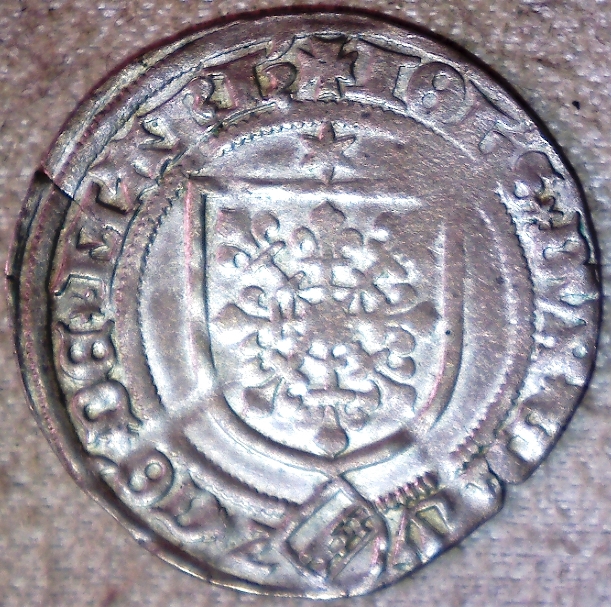  Leipzig in Saxony Spitzgroschen (Levinson I-148): 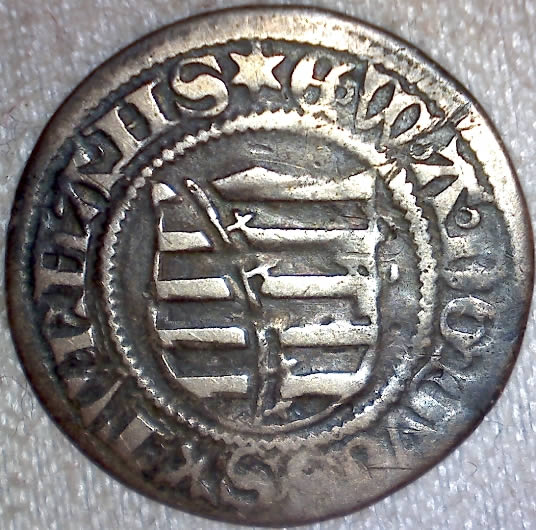 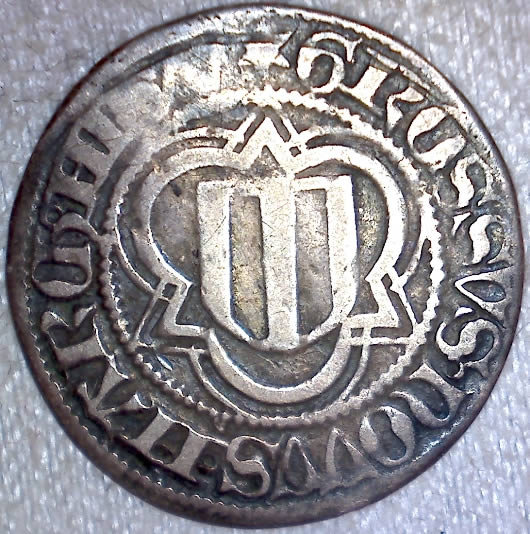 Brabant Double Briquet (Levinson II-17): 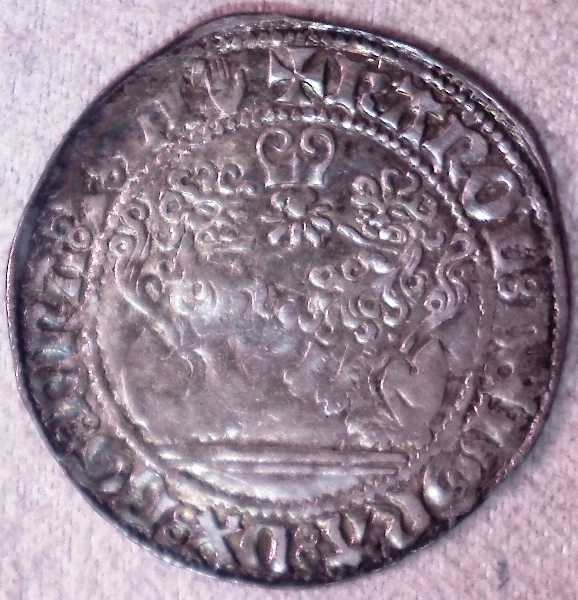  "If you climb a good tree, you get a push."
-----Ghanaian proverb
"The danger we all now face is distinguishing between what is authentic and what is performed."
-----King Adz
|
|
|
|
Pillar of the Community
United States
6969 Posts |
A fine piece of research, and a well written article. =)
I personally know very little about any coins except 20th century American, but these are the questions that I would ask. Was there some historic event like a war that necessitated the fabrication of more coinage for pay or trade? Is it possible that one of those places melted down a large amount of prior coins for some reason, and struck new coins—a new (and vain) leader, loot from a war, loot from Asia or the new world, intentional debasement, that sort of thing. Is there an event that produces a survivor bias for those years—a preserved hoard, a recovered shipwreck, a payment to another kingdom that was later released into circulation, and so forth?
|
|
Moderator
 United States
34572 Posts |
Thx @brand. My thinking is against survivorship bias though since this year has so many common types from different mints and rulers. I'm hoping that one of our other medievalists can weigh in on your interesting thoughts!
"If you climb a good tree, you get a push."
-----Ghanaian proverb
"The danger we all now face is distinguishing between what is authentic and what is performed."
-----King Adz
|
|
Moderator
United States
198004 Posts |
Fascinating. Thank you for sharing you analysis and examples.  |
|
Pillar of the Community
 United States
5315 Posts |
There were a series of wars in the Northern Netherlands between 1350 and 1490, called the "Hook and Cod Wars" between local noblemen and city folk. Several cities were sieged and then relieved.
The interbellum of one of those wars was 1475-1480, after which the Utrecht War broke out (1481-1484).
In can imagine Mint personnel not wanting to strike coins when an army is parked outside.
|
|
Pillar of the Community
United States
5315 Posts |
Note that the date 1482 is also important as at that moment Mary of Burgundy died. Subsequently, the Low Countries were annexed by the Habsburg Empire.
Edited by NumisEd
11/08/2024 10:40 am
|
|
Pillar of the Community
United States
8076 Posts |
Indeed a great piece of analysis! WIth a background in the physical sciences I love a nice graph, and my brain is forcing me to see a bell curve with a tail to the right, the curve centered in the mid-1470s.
First, on 1499 ...
I think Levinson's data has these "puts and takes."
Two of the Dordrecht coins dated 1499 were struck at least 7 years later under Charles V (III-270b and 271b), apparently using the old dies from his prdecessor. That would drop the figure for coins actually struck in 1499 (or close) down to 5.
On the other hand, I was surprised to NOT see the 1499 Bremen 4 grote coin called common. In acsearch there are 15 sales in the last 5 years (I did not look for the split between the two mints), which is more than shows up for the 1499 Dordrecht coins that were actually struck in that year.
Will follow wih my thoughts/comments on Low Countries.
|
|
Bedrock of the Community
United States
94367 Posts |
Interesting presentation, thank you.
|
|
Moderator
United States
34572 Posts |
Really helpful insights @num and @tdz. I really appreciate you both weighing in with your knowledge of this time period.
"If you climb a good tree, you get a push."
-----Ghanaian proverb
"The danger we all now face is distinguishing between what is authentic and what is performed."
-----King Adz
|
|
Pillar of the Community
United States
8076 Posts |
Continuing on the Low Countries coins ... I don't have a good hypothesis for why Charles the Bold began dating his Low Countries coins with the new emissions of 1474. According to de Witte, there were problems of foreign coins circulating in the Low Countries, and Charles had been working with the English to fix rates of exchange between English and Flemish coins earlier in his reign. Maybe as he embarked this new coinage he was just looking for another way to differentiate them from the earlier issues and liked what he saw in the dated issues at the northern boundary of his domains (Utrecht, Groningen, etc). Interestingy, he never put dates on his Burgundy issues (i.e. his "home town" coins). Hapsburg influence in the region was still a decade-and-a-half away. Anyhow, as a result, According to my "simple" count (only denominations, not varieties/subtypes, and not using the extra filter of which ones are "common" based on 21st century survival), the Burgundian Netherlands went from 0 dated coin types in the 1460s-1470s to: 8 in 1474 8 in 1475 4 in 1476 5 in 1477 (Charles and Marie combined) 7 in 1478 7 in 1479 11 in 1480 10 in 1481 Additionally, whatever was struck in the Low Countries in this era was struck in large quantity. When Charles' father, Philip the Good, struck his first emission of new coins 1434-1437, he struck 3.5 million silver 2 groat coins at the Leuven mint for Brabant. When he struck his last emission in 1466-1467, he struck another 1.5 million silver coins (1/2 to 4 groat pieces). In Charles first (undated) emission (1468-1474) the Leuven mint cranked out over 3 million EACH of stuivers/patards and groats. So the new DATED coins ordered in October 1474 began production in December of that year, and were struck in comparable quantities for the next 2+ years until Charles' death in battle in January 1477. In Babant, the Antwerp mint made 4 million double briquets in Charles name dated 1474-1477, 1.5 million briquets, and 3 million half-briquets. No wonder a bunch of them survived! I haven't looked for the mintages of the analagous Flanders types, but some of them are also rated common by Levinson, so probably comparable mintages, as Flanders was more populous than Brabant. Lastly, and not surprisingly, Charles had a war to fight and soldiers to pay: https://en.wikipedia.org/wiki/Burgundian_Wars Just some thoughts on the Low Countries component of the trend ... Edited by tdziemia
11/08/2024 9:05 pm
|
|
Pillar of the Community
United Kingdom
1168 Posts |
I can't add anything to the thread, but I did find the post and the research very interesting. Thought provoking indeed. Thanks for sharing. |
|
Moderator
United States
34572 Posts |
Great to have this additional historical perspective @tdz. Thx!
"If you climb a good tree, you get a push."
-----Ghanaian proverb
"The danger we all now face is distinguishing between what is authentic and what is performed."
-----King Adz
|
| |
Replies: 11 / Views: 920 |
|
To participate in the forum you must log in or register.
Disclaimer: While a tremendous amount of effort goes into ensuring the accuracy of the information contained in this site, Coin Community assumes no liability for errors. Copyright 2005 - 2026 Coin Community Family- all rights reserved worldwide. Use of any images or content on this website without prior written permission of Coin Community or the original lender is strictly prohibited.
Contact Us | Advertise Here | Privacy Policy / Terms of Use
|
| Coin Community Forum |
© 2005 - 2026 Coin Community Forums |
| It took 0.59 seconds to rattle this change. |
 |
|
| |
| |




 Posted 11/08/2024 09:45 am


