One of the 4 existing CSA Originals in PCGS SP40 CAC
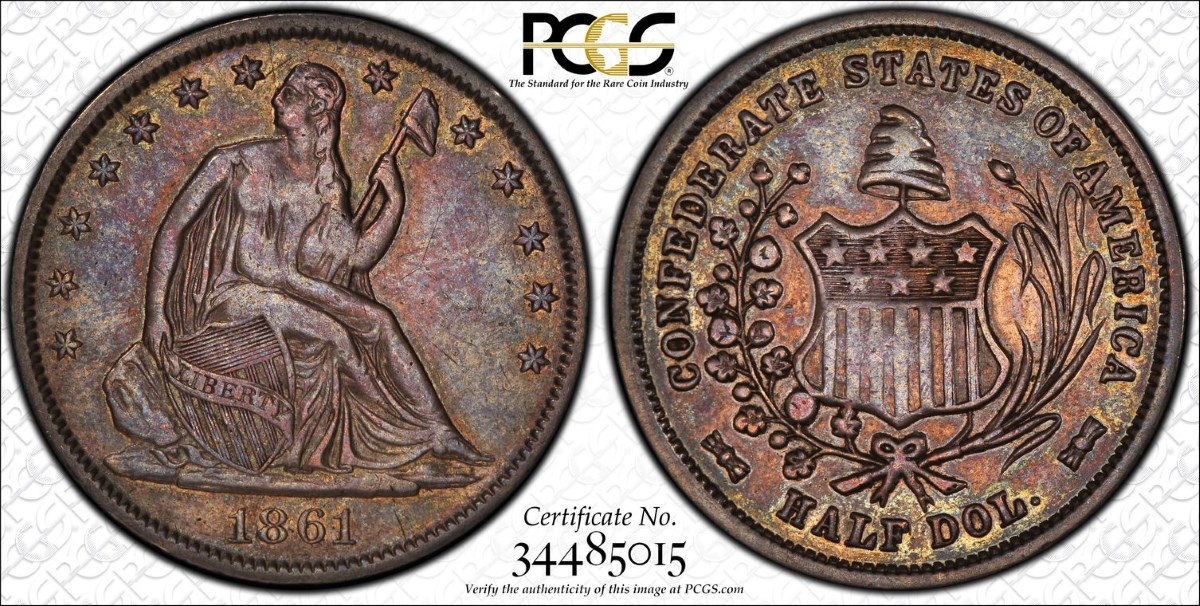 P. Scott Rubin via PCGS
One of the most interesting and rarest coins produced in the United States was made by the Confederate States of America. The Half Dollar of 1861 with a reverse stating that the coin is a Confederate Half Dollar is the only coin officially made by and for the Confederacy. The obverse die is that of the United States Half Dollar of that year but mated with a design showing a shield with seven stars and seven strips representing the seven States that left the United States, topped with a Liberty Cap and surrounded by a wreath containing plants associated with the southern States.
The history of this coinage is most interesting. The first one of these coins became known to the public in 1879 some fourteen years after the Civil War and six years after the discovery of the 1861 Confederate Cent, which was made in Philadelphia and for which no known official sanction by the Confederacy for its manufacture is known.
It is documented that only four Confederate Half Dollars were produced at the New Orleans Mint in 1861 and there is documentation as to who all four were given to. However, only the discovery coin can positively be traced to its original owner, B.F. Taylor at the time Chief Coiner of the Mint for the Confederacy. The three other coins were given to Dr. Ames, Professor Riddell and the President of the Confederacy Jefferson Davis. These coins became known by the numismatic community in the years 1910, 1961 and 1970.
Currently (March, 2014), two of the coins are in museums, one in the ANS collection (the discovery coin) and the Eric P. Newman coin (second coin discovered), ex-Col. Green which may soon be sold
[was indeed sold in 2017 - see (A) below]. Two of the four coins are currently in private collections, the John J. Ford, Jr. coin (third coin discovered) was sold by Stack's in October, 2003 for $632,500 to an Eastern United States Collector
[was sold in 2015 - see (B) below]. The last discovered coin was sold in 1970 by Lester Merkin to an un-named collector.
_____________________
(A) The Newman Coin - PCGS PR40Found in a roll of change by Mark Jacobs (of Rondout, New York) circa 1880 - Thomas Elder - H.O. Granberg Collection - Waldo Newcomer - B. Max Mehl, sold privately in 1931 - "Colonel" E.H.R. Green Collection - Partnership of Eric P. Newman & B.G. Johnson (St. Louis Stamp and Coin Co.) - Eric P. Newman, who paid $4,000 - Eric P. Newman Numismatic Education Society - Heritage 11/2017:15125, $960,000. This coin is not listed in the regular Newcomer inventory
(B) The Ford Coin - PCGS PR30 - 190.5 grains (per the Ford catalog)Superintendent William A. Elmore, of the New Orleans Mint - CSA Secretary of the Treasury Christopher Memminger - CSA President Jefferson Davis, stolen in 1865 - unknown intermediaries, including an unidentified Union soldier - possibly the Bream family of Cashtown, Pennsylvania, reportedly exhibited at the 9/12/1936 meeting of the Washington Numismatic Society - Alice Clark - Ted Schnur, sold privately at the New York Metropolitan Coin Convention in 1961 - John J. Ford, Jr. Collection - Stack's 10/2003:325, $632,500 - Jon Hanson - Donald Groves Partrick Collection - Heritage 1/2015:5847, $881,250
The Scott Restrikes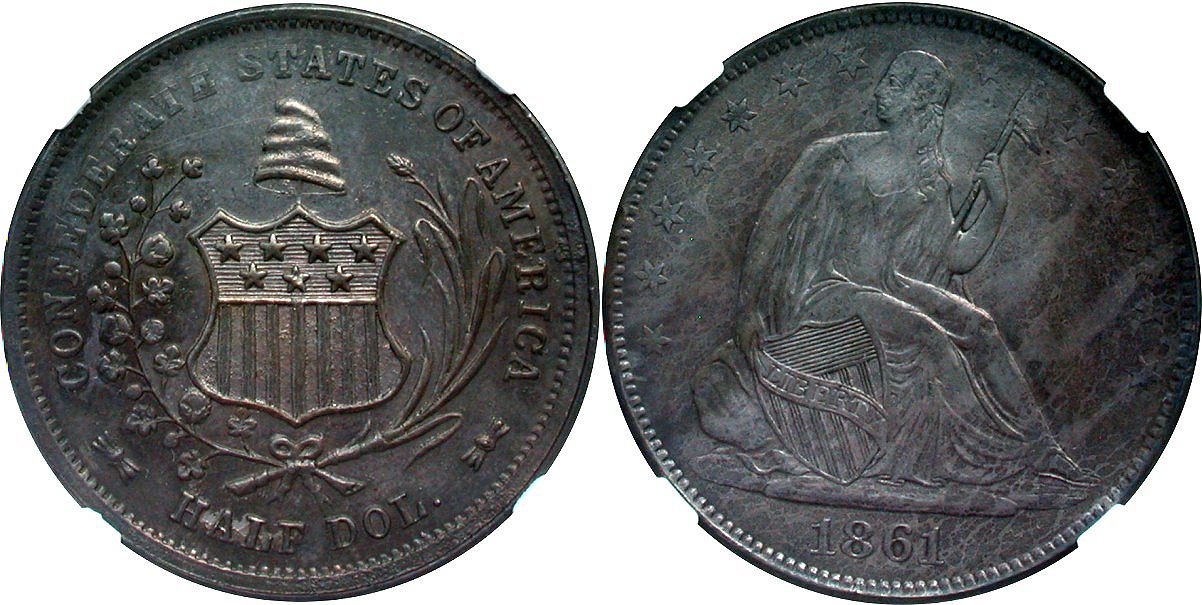
Just 4 original CSA half dollars were struck. NYC coin dealer J.W. Scott purchased the dies in 1879. He also purchased 500 1861
Seated halves (allegedly O-mints), planed off the design of the Federal reverse and struck the CSA reverse. These sell for about $15,000. Gerry Fortin has this beauty for sale.
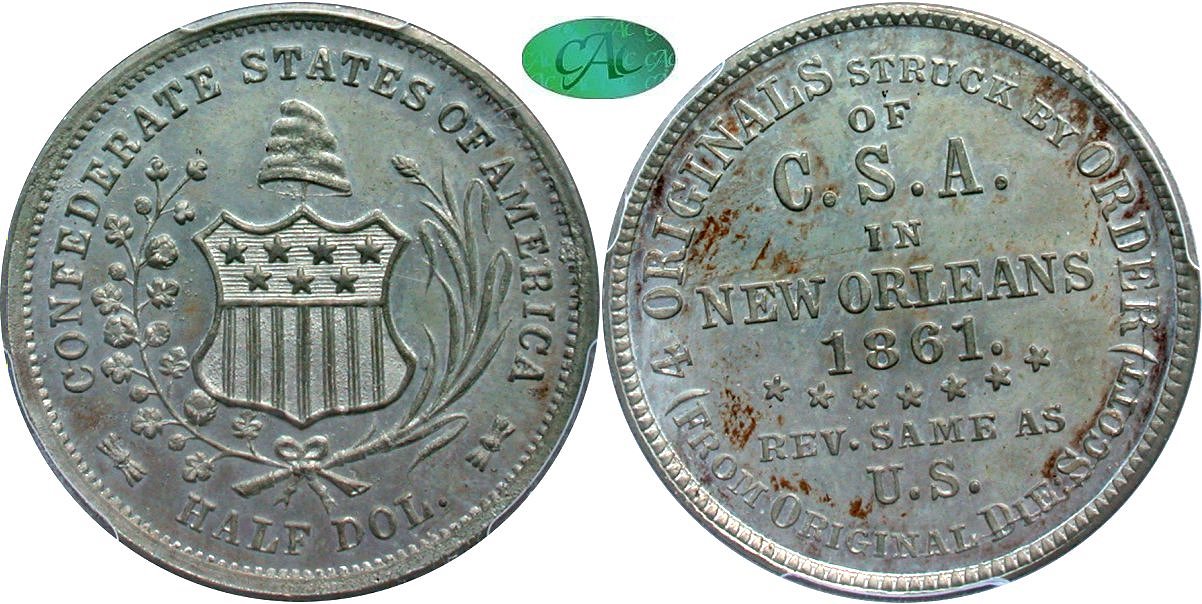
CSA Scott Restrike Half Dollar. In 1879 J.W. Scott purchased the original C.S.A. half dollar die from Ebenezer Locke Mason, Jr., who had originally acquired it from Dr. B. F. Taylor, former chief coiner of the New Orleans Mint. Scott overstruck 500 1861-dated halves with the die after planing off the reverses, then paired the C.S.A. die with a "token" die to strike another 500 pieces in white metal. These sell for less than $10k and this one is also among some confederate issues being offered by Gerry Fortin.










 Posted 12/12/2024 9:19 pm


