I have been attempting to think through some of the implications of the Master Die being produced via CNC milling. One implication, of course, is with respect to the appearance of what Master Die Doubling looks like when produced via the CNC process. (CNCD)
Examples of how CNCD might happen:
• We know that the absence of a fillet in CNC machining can result in tool deviation, tool deflection, vibration, and dimensional inaccuracies. A slight outline around a small section of a device might be a result. (A fillet in CNC machining is a rounded transition (radius) applied to the intersection of a device with the field of the die. The purpose is to eliminate sharp corners which produce stress concentrations, improve fatigue strength, and enhance aesthetics.)
• We know that a "phantom channel" on a die may be caused by tool deflection/spring-back from the cutting tool being under lateral load, backlash in the Machine Axes, or G-code/CAM Post-Processor Error. A "phantom channel" = a short additional outline following the contours of a device such as an eye, a hand/finger, number/letter, or edge of a structure.
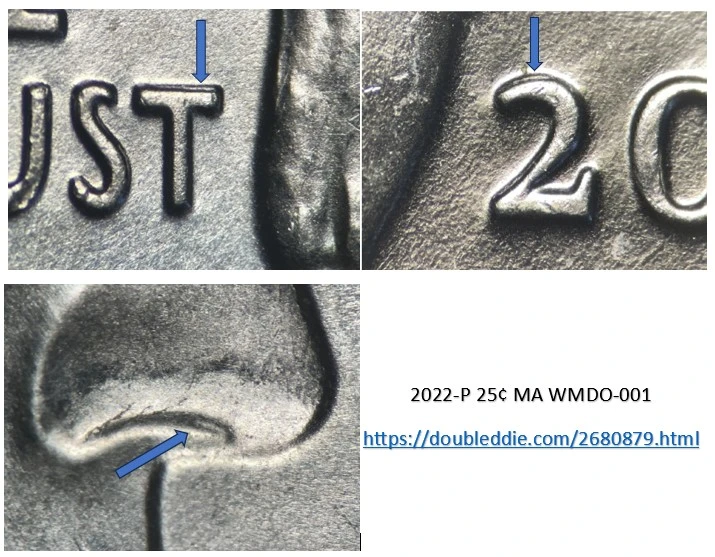
I would submit that the following examples of Master Die Doubling could easily be the result of CNC Doubling. (CNCD).
An attendant question RE: this comment at the following listing:
"Comments: WMDO-001 is known on 2022-P Angelou, Ride, Mankiller, and Wong quarters. It is expected, but unconfirmed, on Otero-Warren quarters. Most, if not all, of Angelou and Ride quarters show this master die doubling. It is less common on Mankiller and Wong."
If it is master die doubling, how can it be less common on some examples? Surely all are not examples of die wear or weak strikes? Is this a clue that there is more than one master die for these issues, as that possibility is implied in Mint documents?
COMMENTS WELCOME!




 First Page


 Posted 03/30/2026 12:49 pm





