| Author |
 Replies: 11 / Views: 4,905 Replies: 11 / Views: 4,905 |
|
|
Locked
822 Posts |
|
|
|
|
Pillar of the Community
United States
2224 Posts |
My ignorance regarding errors might be showing, but if this is struck on scrap how come the rest of the coin is perfectly struck? Looks like the coin was cut to me!
|
|
Pillar of the Community
United States
1807 Posts |
Yeah something seems fishy there. There's also a dime listed with about the same cut. I'd definitely do more homework on those.
|
|
Bedrock of the Community
United States
62064 Posts |
It has reeding on the edges. How could that happen?
|
|
Moderator
 United States
16694 Posts |
That kind of detail would not come out on a genuine struck on scrap error. Also, it's the same thickness as a regular quarter. Bogus IMO.
swcoin.ecrater.com
|
|
Pillar of the Community
United States
3507 Posts |
Hi Guys,
Two things...That dealer is usually pretty accurate with his identifications AND...that coin is indeed struck on a piece of quarter planchet scrap.
Have Fun,
Bill
|
|
Pillar of the Community
United States
2752 Posts |
"Scrap" is a rather useless label, as it's applied to at least a dozen different errors. This quarter was struck on a planchet with a straight clip. The pressure of the strike caused the formerly straight edge to bulge out.
Error coin writer and researcher.
|
|
Bedrock of the Community
United States
62064 Posts |
I appreciate your words Bill. I looked at the images again and noticed the real clencher for this coin. It may have been round enough to form the reeding on the edges. But look at the arrows in this image: 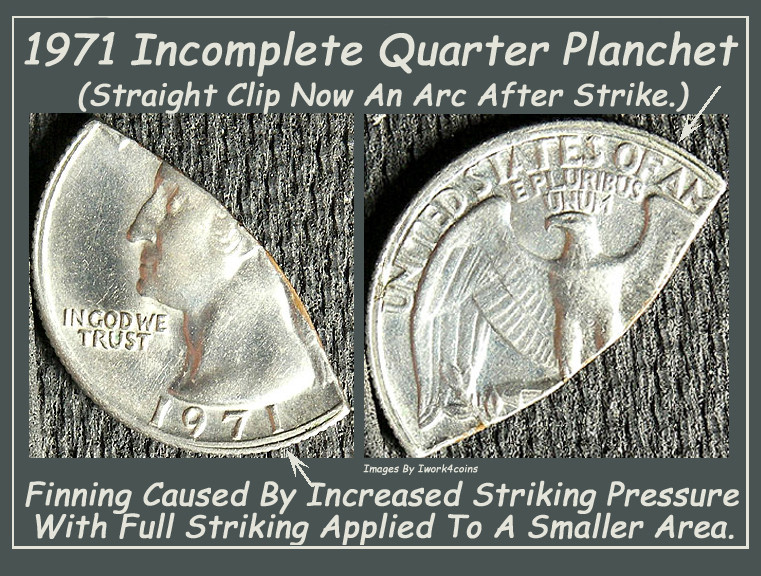 The rim has a doubled area on the coin in the same part front and back. This was from the coin moving slightly during the strike. If this were a normal coin and just cut, that would not be there and it is too small to create. So it would have to be a mint error to make this mark on the rims. I guess sometimes we look to hard at what we think is obvious and when other things are pointed out, we take a second look and notice something else. So this is a real mint error. Edited by coop
08/11/2009 4:15 pm
|
|
Pillar of the Community
Spain
1361 Posts |
coop, you always have a very nice presentation and very educational. Keep it up  |
|
Pillar of the Community
United States
3507 Posts |
Also, Mike did bring up a great point. At what point an incomplete planchet is considered scrap is questionable. Scrap is too subjective in many cases. Since this coin has a portion of a rim, I would lean, as Mike did, toward the incomplete planchet label.
Have Fun,
Bill
Edited by foundinrolls
08/11/2009 2:16 pm
|
|
Bedrock of the Community
United States
62064 Posts |
I would think scrap would indicate a never intended planchet. This one is a straight clipped (incomplete) planchet. I don't have an image right now, but I'm thinking a a bow tie strike, where part of the webbing that fell off got struck. I'll have to get an image of this sometime and post it. ADDEDFound one!  Edited by coop
08/11/2009 4:46 pm
|
|
Pillar of the Community
United States
2752 Posts |
The "double rim" represents finning of the rim. It's caused by increased effective striking pressure. That, in turn, is the result of the entire tonnage of the strike being applied to a smaller area.
The "bowtie" cent is a cent struck on chopped webbing derived from clad dime strip or a quad-clipped planchet produced when a dime punch overlapped some normally punched dime strip. There are three different kinds of "bowties".
Error coin writer and researcher.
|
| |
Replies: 11 / Views: 4,905 |
|







 Posted 08/10/2009 8:06 pm





