| Author |
 Replies: 8 / Views: 8,303 Replies: 8 / Views: 8,303 |
|
|
New Member
United States
7 Posts |
Hi All, I picked this nickel from a mint roll back in 05. When I saw it I was really surprised. The bison is a copper color. My girlfriend calls it a "pink buffalo" so in order to avoid getting   so I make sure to   . Anyway, I've been told the nickel layer fell off before pressing, that it's a on a wrong planchet (but in all ways it's like a nickel) and that it's a fake. I know it's not a fake - so do you have any ideas, comment, suggestions about what the error is? How it got this way? I'm thinking of getting it graded, but just haven't done it. Thanks... 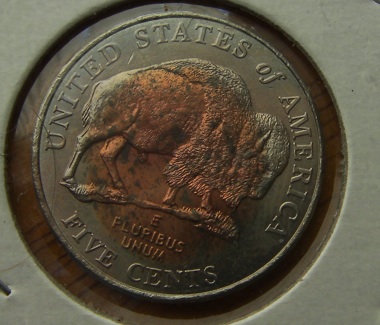 |
|
|
|
Bedrock of the Community
United States
12437 Posts |
 Very interesting, I do not think I have ever seen anything like that before. As for what you have been told, most of it is inaccurate. There is no "nickel layer" to fall off, a five cent coin is composed of a 25% Ni 75% Cu alloy so it does not have layers. This is an error that can occur on CuNi clad coins like the dime, quarter, and half dollar- the cladding is composed of three layers and the outer layer can sometimes separate from the rest of the coin. As for it being a wrong planchet, that is improbable as well since the US Mint does not use any planchets that would have an appearance like that. My best guess is that you either have a coin with an improperly mixed alloy or what is known as a "copper wash", closely related to an improperly annealed/sintered coin. Copper wash errors are not fully understood, the experts cannot quite agree what causes it, but they are genuine collectible errors. According to the dictionary, Sintering is the welding together of small particles of metal by applying heat that is below the melting point of the metals. From the standpoint of the minting process, it is during the annealing process that this "sintering" is thought to occur.
Annealing is the process of heating the planchets as a preparation for striking in order to make the metal easier to strike. The United States Mint, as a part of the annealing process also washes and dries the planchets after they are heated. It is thought that during the annealing process of the planchets that if the annealing drum has not been properly cleaned, that minute amounts of metal left in the annealing drum from prior operations can be deposited on the planchets subsequently going through the annealing process. Since it seems that this occurs most often involving a layer of copper, this is sometimes referred to as the result of a "copper wash" during annealing.
According to Mike Diamond, noted error expert and President of CONECA, (Combined Organizations of Error Collectors of America), " The "sintered planchet" and "copper wash" scenarios are examples of numismatic mythology. No one appears to understand why a copper layer forms on coins that are baked too long (or at too high a temperature) in the annealing oven." Mr. Diamond goes on to say, "Even a metallurgist I talked to can't figure it out."
I tend to agree with Mr. Diamond on this and I think that the terminology used, "sintered planchet" and "copper wash" will fade away very slowly. A more correct description for this type of error and one that is gaining momentum is that a coin such as this one was struck on an "improperly annealed planchet".
http://www.foundinrolls.com/nletter...letter3.html |
|
Bedrock of the Community
United States
62064 Posts |
What does the obverse look like? Sometimes people play with lighters and burn the coin or hold it in the flame from a candle. If so the obverse should be very dark. It would be interesting to see what Mike Diamond has to say on this one.
|
|
New Member
 United States
7 Posts |
Thanks biokmist6. That's a great explanation and the most reasonable I've heard yet. I'm interested if there's text, or website, that you can recommend where I can read abut such processes. How should I go about getting it authenticated? I'm not keen on mailing things like this, or other coins. Though I guess it's the only way.
Thanks too coop. I do have a pic of the coin in a holder. I'll post it for you - try to add to the original post or a new one. Thanks for suggesting it.
|
|
New Member
United States
7 Posts |
Here's the 2005 Bison obverse: 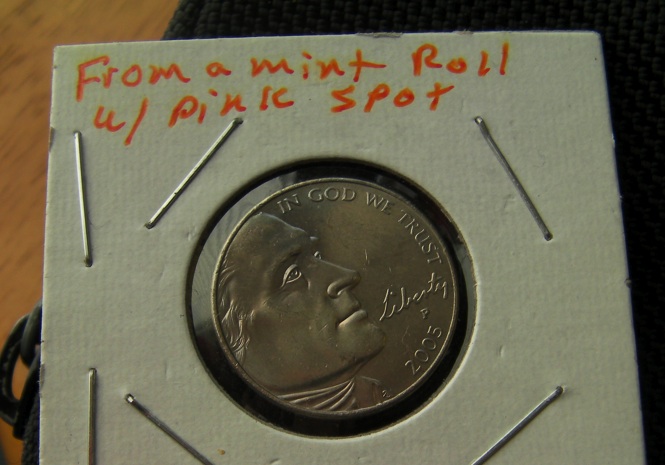 |
|
Pillar of the Community
United States
7629 Posts |
Well, let's see...
Nickels are an alloy minted coin, so there are no 'layers' to fall off, unlike the clad dimes, quarters and half dollars.
This coin is also not fake. I would avoid the person who gave you that advice with any future questions.
The spot in the center of the reverse looks much more like a stain than anything else - it's round and well-shaped. A sintered planchet (improperly annealed planchet) would affect the whole coin, not just a spot.
Looks like this coin was in a roll or something where the center was exposed and the rest covered, then the whole thing was exposed to something that stained the coin - and that's about it.
|
|
New Member
United States
7 Posts |
Fair enough. But the coin was in the center part of the roll so if that's what happened it had to have happened in the mint. And what substance could cause such a "stain"?
|
|
Bedrock of the Community
United States
10284 Posts |
Besides the pink or copper looking spot, I see other things going on in the "pink" area. I see dark areas and so I guess that it is some kind of environmental effect. Maybe some kind of oil or grease at some time in the mint got on that spot of the coin or blank? I think if it were an alloy mix, the both sides would look similar.
|
|
Pillar of the Community
United States
5699 Posts |
Very interesting coin, I do not have a clue, ( not an expert ), I would love to hear what happens if you dip the coin in acetone, it would do no damage to the coin, just a thought, the "area" in question is odd in it's shape and form......It almost looks painted!
|
| |
Replies: 8 / Views: 8,303 |
|










 Posted 11/18/2009 11:25 pm


