| Author |
 Replies: 11 / Views: 3,195 Replies: 11 / Views: 3,195 |
|
|
New Member
United States
15 Posts |
|
|
|
|
Pillar of the Community
3660 Posts |
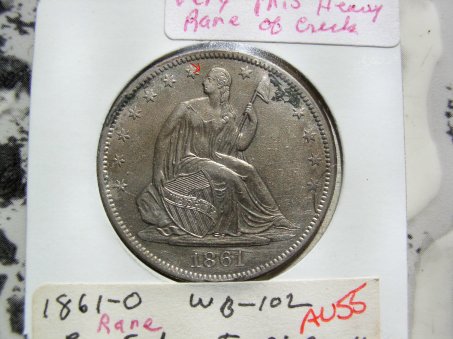
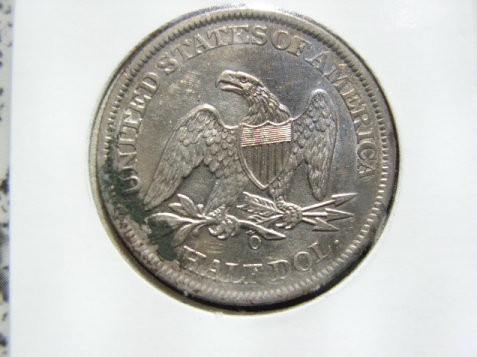
Why is this coin referenced to the word 'Confederate'? I would not think that 'United States of America' would be on the reverse. I think that this particular obverse may have been used to pattern the Confederate half, or that a small amount of these halves had the reverse ground down and were then restruck with a Confederate approved design on a hand press, (I really don't remember the story). Probably I am still misunderstanding the lingo that may be attatched to a particular obverse die with a distinctive crack that is identical to a crack that also shows up on Confederate halves?
|
|
Pillar of the Community
United States
2797 Posts |
zeewool, The confederate Army captured the U.S. Mint in New Orleans in the Spring of 1861. History notes that they minted coins from on-hand planchet stock and dies. The general consensus of Seated die experts agree that the only known diagnostic of coins minted by the Confederate Army at this facility had that die crack. There may be others, but there's no way to identify them. So in reality, this is a U.S. Seated Liberty half dollar that was struck by the Confederate Army. Ah semantics ... |
|
Pillar of the Community
3660 Posts |
So this coin is somehow identified as being struck 'after' March 1861, but not before?
|
|
Pillar of the Community
United States
2797 Posts |
Quote:
So this coin is somehow identified as being struck 'after' March 1861, but not before?
That would be a "BINGO!"  |
|
Bedrock of the Community
United States
12437 Posts |
Quote:
The general consensus of Seated die experts agree that the only known diagnostic of coins minted by the Confederate Army at this facility had that die crack. There may be others, but there's no way to identify them.
That consensus has been radically altered in the past few years since the discovery of the S.S. Republic which had a cache of several thousand 1861-0 half dollars aboard. Randall Wiley(one half of the WB die variety nomenclature with the other being Bill Bugert) was commissioned to examine the hoard and he identified 14 of the 15 die marriages of the 1861-O issue and that 15th marriage is the renowned CSA half dollar. The interesting fact is that only two of those marriages are attributable to coins minted under Federal control with the other twelve minted under the authority of the State of Louisiana after secession and then the CSA. Wiley's work was published in the Gobrecht Journal in 2005, I really wish I had a copy of it  |
|
Pillar of the Community
3660 Posts |
I can buy the part about the mint being under the control of a Confederate government, and that more than likely, production never skipped a beat as the same mint workers simply remained on the job when North/South hostilities broke out in April. It would only make sense to use the monetary venue of your adversary as a weapon against him, especially when you have no such monetary units of your own yet.
To place a 'not earlier than' date on implementation of die usage would suggest (to me) that this particular die was strangely sent to the CSA by the USA, 'after' the normal January shipments to the branch mints. I do not understand how any group of experts can hold in consensus the notion that a die that was on hand since January was not used until after March.
I find this very hard to imagine, but I will accept it for now, because 'you' are the one who told me this, and I do respect your word Nut.
I do however, reserve the right to argue vehemently about this at any future date of my choosing.
|
|
Pillar of the Community
3660 Posts |
Uh oh, looks like I picked the wrong time to make a post 'eh bio? I am really confused now. Not that it really matters much.
|
|
Bedrock of the Community
United States
11951 Posts |
Very interesting topic. And I no way claim to have much knowledge of this matter. But my Two Cents worth would be, because of the die crack, that I assume the die would crack after heavy use. And that would have happened in that small window of time that the CSA ran the mint after April 1st. Here is a paragraph from a online search. J.W. Scott and the CSA Restrikes In early 1861, troops representing the state of Louisiana seized the federal New Orleans Mint, and on April 1 it came under control of the Confederate States of America. The staff and facilities remained intact, and the C.S.A. continued to operate the Mint for a time, using bullion and dies on hand to strike Liberty Seated half dollars and gold double eagles. Soon, the mint closed. For the rest of the decade, continuing to 1878, it was used for storage, unofficial lodging by itinerants and tramps, and generally fell into disrepair. The building was poorly constructed to begin with, and in the 1850s a massive repair / restoration helped solve structural and other problems. In 1878 the mint was refurbished, and in 1879 coinage resumed, consisting mostly of Morgan silver dollars, punctuated by lower quantities of other silver denominations and scattered gold $5, $10, and $20. |
|
Pillar of the Community
United States
812 Posts |
I believe the issue (before the Wiley work published in 2005) was not that this was a different die, but that the die developed a crack late in the production cycle. The obverse die crack is considered one of the few easily visible diagnostics identifying a coin minted under the the authority of the CSA.
Documentation indicates that around 13% of 1861-O halves were minted under the U.S. government, 49% under the State of Louisiana government (after Louisiana seceded, but before it joined the CSA), and 38% under the CSA.
|
|
Pillar of the Community
3660 Posts |
Sensible presumption GoldRush on the die crack thing. Actually, dies have molecular weaknesses at and below surface caused by the processes of their creation. Cracks can occur on first strike or first clash or they could last for tens of thousands of strikes or several clashes without developing a crack. Some dies were duds and some were winners.
Documentation of the die's issue, usage, and disposition are the only accurate means of determining such a time frame. I doubt that such records were kept, especially in New Orleans in 1861.
|
|
Bedrock of the Community
United States
11951 Posts |
Zeewool
Thanks for the info .. was just a thought on my part ..
Tom
|
| |
Replies: 11 / Views: 3,195 |
|









 Posted 01/13/2010 2:49 pm


