Coin Community Family of Web Sites Join Thousands of Coin, Bullion, & Money Collectors
Coin, Banknote and Medal Collectors's Online Mall Specializing in Modern Numismatics Vancouvers #1 Coin and Paper Money Dealer 300,000 items to help build your collection! Join Thousands of Coin, Bullion, & Money Collectors Royal Canadian Mint products, Canadian, Polish, American, and world coins and banknotes. Shop for APMEX Bullion on eBay!


Username:
Password:
Save Password
Forgot your Password?


This page may contain links that result in small commissions to keep this free site up and running.

Welcome Guest! Registering and/or logging in will remove the anchor (bottom) ads. It's Free!

Detecting A Cap And Ray 8R Forgery

To participate in the forum you must log in or register.
Author Previous TopicReplies: 22 / Views: 4,134Next Topic
Page: of 2
Pillar of the Community
swamperbob's Avatar
United States
5362 Posts
 Posted 05/26/2010  7:02 pm Show Profile   Bookmark this topic Add swamperbob to your friends list Get a Link to this Message Number of Subscribers
This is intended as a brief tutorial on how to detect a counterfeit Cap and Ray 8R when you have the coin in hand - but the techniques apply equally well with any MODERN counterfeit made using transfer dies or molds.

This counterfeiting method (transfer technologies) results in a coin that looks real. The design being a transfer of the image is CORRECT. That makes identification from a photograph VERY difficult if not impossible - based on the design alone.

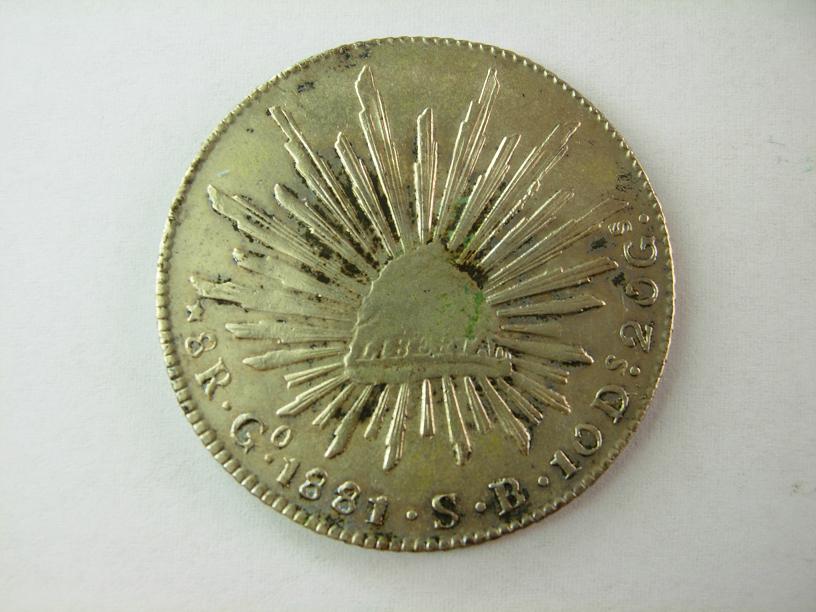
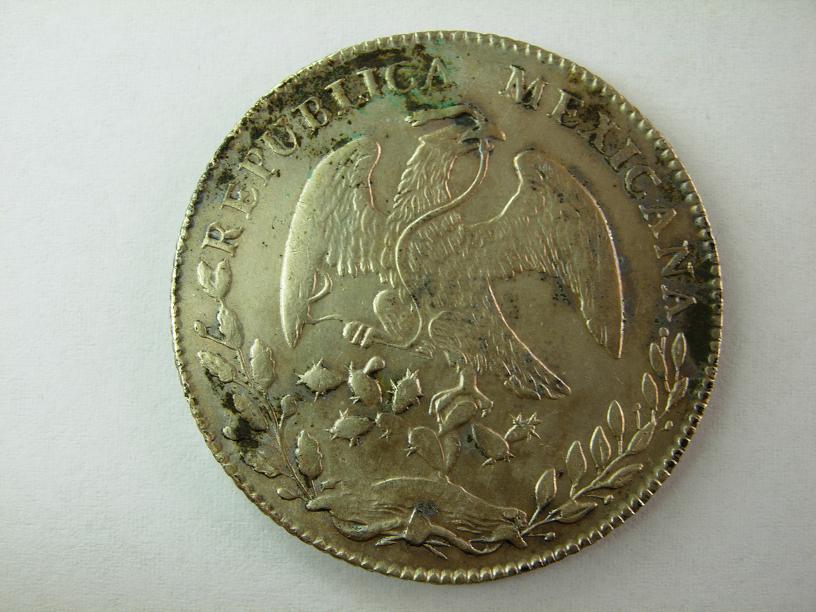
First I will show the coin itself - this coin LOOKS real and even in person it looks like an original sea salvaged coin. The coin is something you might pick up at a flea market when you don't have a scale. Should you buy it or pass it by? Is it worth $5 as a gamble to get 0.78 ounces of silver?
Detecting-A-Cap-And-Ray-8R-Forgery


Detecting-A-Cap-And-Ray-8R-Forgery

I know the coin is not great looking and it is not a numismatically valuable coin - but many people might think "at least it is a hunk of silver". In this case, that is also an error. This is a non-silver forgery in a white metal. IT HAS ABSOLUTELY NO INTRINSIC VALUE.

I decided to do this because recently there have been several questions about other 8Rs and we always seem to get back to the same few issues based what the photos look like. I am afraid that some people might be getting the wrong idea about what is correct and what is not. So I figured we should look for clues on a coin where there is no uncertainty at all.

In this case, I am using a coin from my own collection that I guarantee is a MODERN FORGERY so there is no chance the details are caused by any NATURAL Die Deterioration issues. The coin is not silver and it weighs less than 21 grams. If you have a scale it is a blatant forgery and most people stop right there. The diameter is correct as is the thickness. The edge design is CORRECT as to size and shape of the segments. It was edged and struck in separate steps.

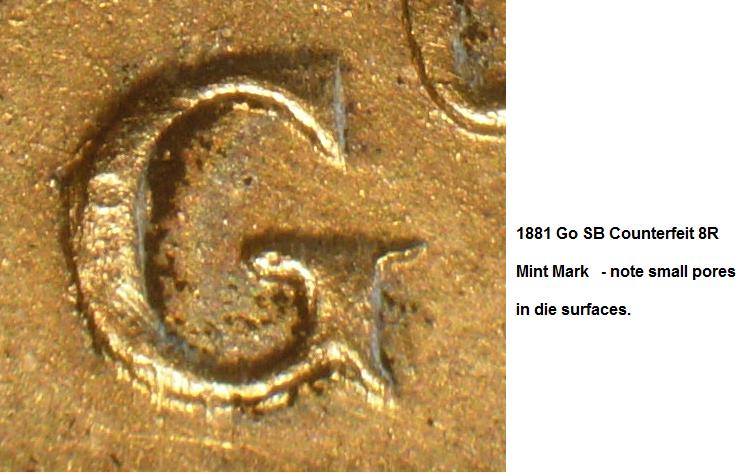
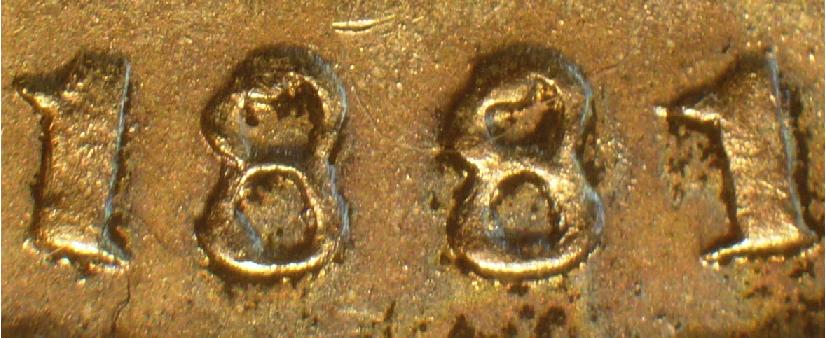
One recurring issue I raise is the presence of roughness on the die surface that tends to accumulate near die features like letters and numbers. So here are just two of several similar spots where that happens on this coin. The fields are better but not perfect.

First at the Mint Mark. Note that the lumps occur near the G where they can not be polished off the die. There is also a lack of smooth sides on the letter. The closer to the letter one gets the harder it is to smooth out the problems.


Detecting-A-Cap-And-Ray-8R-Forgery

Then around the date, the same kinds of things happen:


Detecting-A-Cap-And-Ray-8R-Forgery

On the mint mark you can see some of the flow marks that prove the coin is struck.

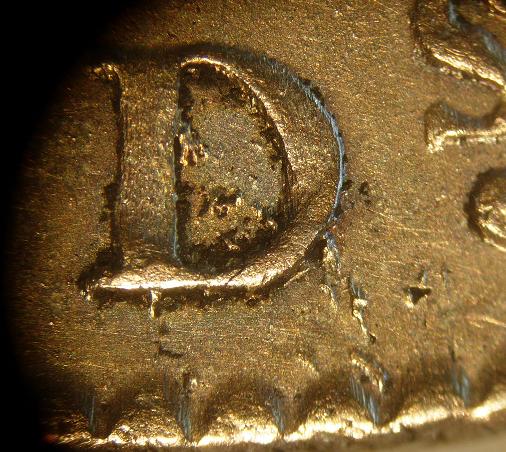
The next subject that comes up quite often are the things I call "soft cracks". They are features that superficially resemble die breaks until you see them up close. They may be copies of actual die breaks but something gets lost in the process. There is an area of "soft cracks" in and around the Ds in the assay value. This photo shows the breaks but they look fairly good. Like older cracks that have worn in a bit.
Detecting-A-Cap-And-Ray-8R-Forgery

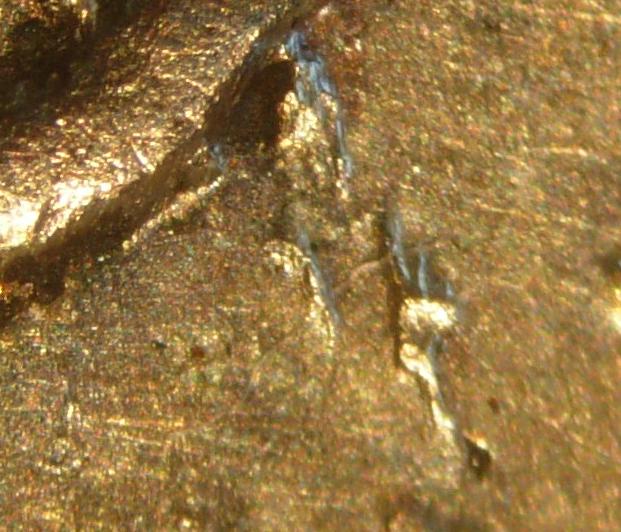
Here is an enlargement of the portion of the crack that really looks incorrect. There are fingers like projections that emanate from the "crack" near the center. The appearance here is typical of "soft cracks" in my experience.
Detecting-A-Cap-And-Ray-8R-Forgery

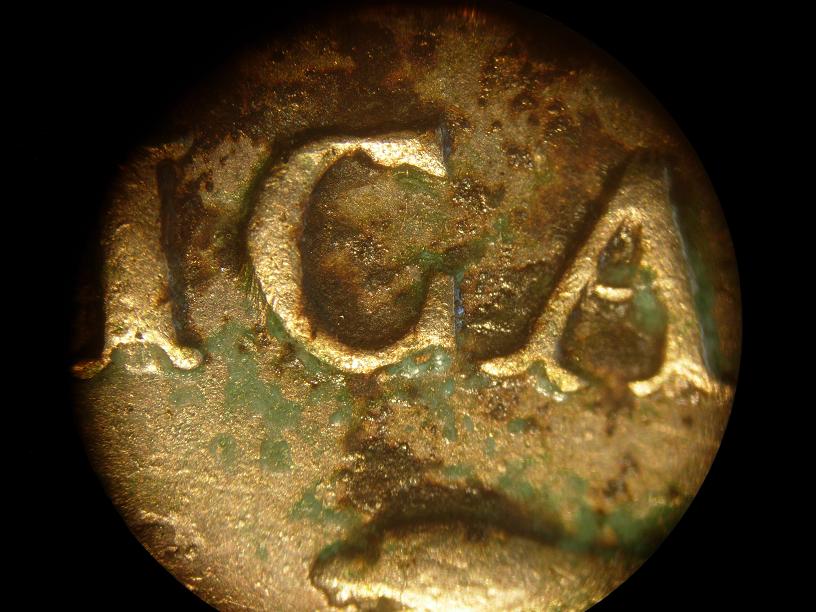
Next - we often discuss the FAKE verdigris seen on some modern chemically aged 8Rs. First is a wide angle view of some of the "green". Even at this level of magnification the green material looks funky. But if you have never studied verdigris you might not know. This picture is taken centered on the C in REPUBLICA. If you note there is a tiny gap in the green material directly below the center of the C. That is a break in the verdigris done by pressing on the surface.
Detecting-A-Cap-And-Ray-8R-Forgery

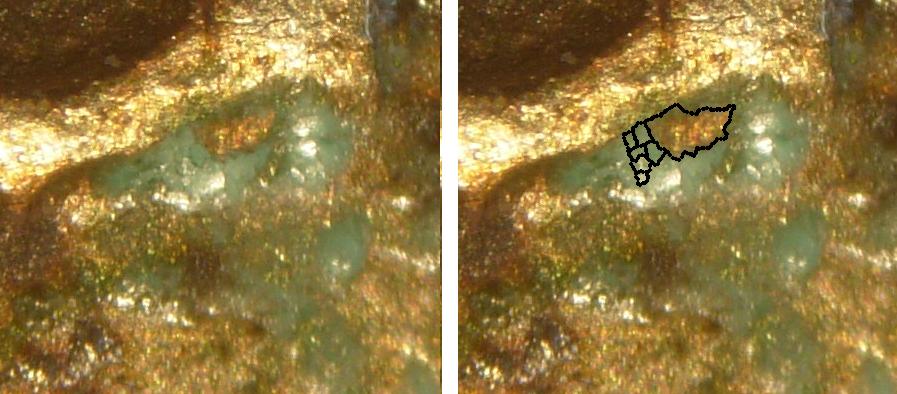
This is an enlargement of the same area where the verdigris is broken. On the right is a picture touched up to show CRACKS in the smooth surface of the fake verdigris. The verdigris should be solid and a bit difficult to remove - it should not flake off or crack under very minor pressure. It should also NEVER expose a pristine surface below it.
Detecting-A-Cap-And-Ray-8R-Forgery

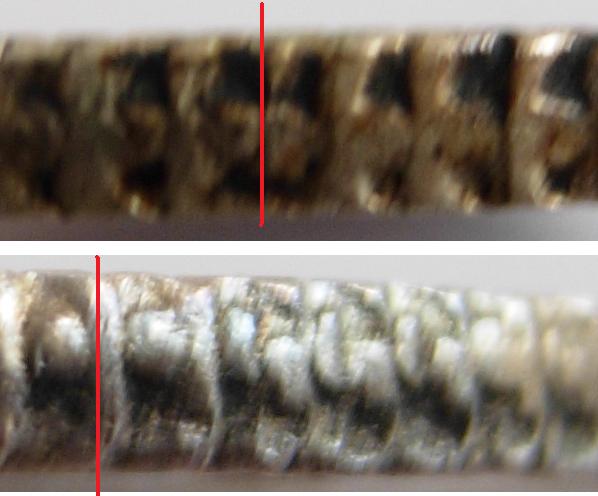
The last subject that comes up repeatedly are the edge die overlaps. I have attached a picture of BOTH overlaps that occur on this coin. They didn't come out to well - it was done hand held. On the picture, I added the RED lines at points that are 180 degrees apart on this coin. The two overlaps are not exactly aligned but more critically they not of equal length. One (the one at the top) is essentially butted with almost no overlapping while the lap at the bottom is several segments in length. It appears to me that the forgers were mimicking the correct edge but got it just wrong. They were most likely using a single die edger and inserted the blank twice allowing an overlap.


Detecting-A-Cap-And-Ray-8R-Forgery
Pillar of the Community
Halfwitty's Avatar
United States
1523 Posts
 Posted 05/26/2010  7:06 pm  Show Profile   Bookmark this reply Add Halfwitty to your friends list Get a Link to this Reply
Well done.Thank you.
Valued Member
needgames4lyfe's Avatar
United States
323 Posts
 Posted 05/26/2010  7:18 pm  Show Profile   Bookmark this reply Add needgames4lyfe to your friends list Get a Link to this Reply
Wow! thank you for this. As a YN, aviouding coins like these (counterfit) is a big challenge - thanks for helpin!
Valued Member
Pandesalapi's Avatar
Philippines
386 Posts
 Posted 05/27/2010  06:49 am  Show Profile   Bookmark this reply Add Pandesalapi to your friends list Get a Link to this Reply
Thanks for sharing this to us.
Valued Member
Rayhaldo's Avatar
United States
74 Posts
 Posted 05/29/2010  6:16 pm  Show Profile   Bookmark this reply Add Rayhaldo to your friends list Get a Link to this Reply
Very interesting.

My pocket digital scale that is extremely accurate will always accompany me anytime I may go to look at a coin along with my mm ruler and 16X loop.
New Member
LlacerSBD's Avatar
Spain
40 Posts
 Posted 08/07/2010  12:00 pm  Show Profile   Bookmark this reply Add LlacerSBD to your friends list Get a Link to this Reply
Hi, Swamperbob

It is a very interesting tutorial. So interesting that I have translate to spanish. At .pdf file format, and only for me, of course.

But, if you want a copy, only have to requuest it.

Regards Joan
Pillar of the Community
swamperbob's Avatar
United States
5362 Posts
 Posted 08/07/2010  12:49 pm  Show Profile   Bookmark this reply Add swamperbob to your friends list Get a Link to this Reply
LlacerSBD Hi Joan, Thanks for letting me know. It is nice to know when what I write makes a positive impression on collectors. I am trying to educate the general audience about what to avoid.

I also like the fact that this forum reaches a larger audience of a world wide nature.

Buena suerte con usted colección.
Pillar of the Community
jfransch's Avatar
United States
1801 Posts
 Posted 08/07/2010  1:11 pm  Show Profile   Bookmark this reply Add jfransch to your friends list Get a Link to this Reply
Excellent info Swamperbob. I now have a an ongoing project to go through my collection of Resplandores and apply this new knowledge to checking each coin.
Pillar of the Community
swamperbob's Avatar
United States
5362 Posts
 Posted 08/07/2010  1:32 pm  Show Profile   Bookmark this reply Add swamperbob to your friends list Get a Link to this Reply
jfransch That is an excellent project and one we should ALL DO periodically.

I recall going back over my own collection about 10 years after I began training in Counterfeit Detection. I discovered more than one forgery in my own collection of originals.

I hope everyone undertakes this project and that any counterfeits that are located can be shown to other members so that we can all gain knowledge.
Valued Member
Rayhaldo's Avatar
United States
74 Posts
 Posted 08/09/2010  3:16 pm  Show Profile   Bookmark this reply Add Rayhaldo to your friends list Get a Link to this Reply
I have a Cap and Ray One Peso 1908 MoGV that I will be checking soon to validate if it is authentic. At 39.46mm, and 27.02g the coin so far passes the authenticity test.
Pillar of the Community
swamperbob's Avatar
United States
5362 Posts
 Posted 08/09/2010  8:27 pm  Show Profile   Bookmark this reply Add swamperbob to your friends list Get a Link to this Reply
Rayhaldo Just remember that when dealing with the Pesos of the era 1898 to 1909 that you are dealing with a coin made differently than the 8 Reale coin.

The Peso was struck in a closed coining chamber with a collar that applied the reeds simultaneously with the strike. So while overlaps MUST occur on an 8R they must NEVER occur on a Peso.

The Peso will also be subject to different forms of Die Deterioration than the 8R. The collar retains the striking pressure while the open sided press allows it to escape at the perimeter. The result is a difference in silver flow, die wear and die cracking.

The Peso series being less popular in circulation than the older 8R was targeted for forgery in far fewer cases. There are counterfeit Pesos but they date to a different era - use different technologies and were made with different metals than most 8Rs.

Most Peso forgeries will be underweight base metal casts or strikes from Transfer Image dies or molds. An engraved die or mold is scarce in the Peso series and commands a higher price. True Sheffield Plate copies are essentially unknown in the Peso series. Most off metal core castings were plated in some form with silver or some other white metal surface.

Period forgeries of the Mo Pesos are far more common than the other mints and in general are more plentiful than any of the early Republican (pre-1850) forgeries.

Hope this helps.

BTW if the coin is magnetic it is POST WWII and is essentially worthless.

Valued Member
Rayhaldo's Avatar
United States
74 Posts
 Posted 08/09/2010  8:33 pm  Show Profile   Bookmark this reply Add Rayhaldo to your friends list Get a Link to this Reply
I just finished a detailed inspection of my 1908 MoGV Cap and Ray Un Peso XF+. The fields were consistent with an authentic coin - no roughness and no 'pores', and all letters and numbers are nicely struck.

There are two very small die breaks emanating from the bottom of the right side of cap. They flow in a south west direction. The detail of the die breaks are consistent with the beginning of an authentic die breaking - the detail is sharp and obviously not a reproduction.

The edge design is correct and without flaws.

It was really a pleasure admiring this coin up close again. The obverse eagle is a very beautiful design.
Valued Member
Rayhaldo's Avatar
United States
74 Posts
 Posted 08/09/2010  8:39 pm  Show Profile   Bookmark this reply Add Rayhaldo to your friends list Get a Link to this Reply
Two more details;

The edge has no overlaps and is nicely/uniformly struck all around.

The coin is not magnetic.
Pillar of the Community
swamperbob's Avatar
United States
5362 Posts
 Posted 08/09/2010  8:46 pm  Show Profile   Bookmark this reply Add swamperbob to your friends list Get a Link to this Reply
It sounds as if your coin is real. I am not aware of a Numismatic grade forgery of the date either.
New Member
8 R€­ÅL€Š™'s Avatar
United States
33 Posts
 Posted 08/11/2010  3:23 pm  Show Profile   Bookmark this reply Add 8 R€­ÅL€Š™ to your friends list Get a Link to this Reply

Quote:
There is a very narrow range 26.5 to about 27.1 that is normal


Hey swamperbob,

I pulled that quote from a old thread that you had commented on regarding weight.

I have a 1833 Pi 8R which weighs 26.4. It is worn in several parts like the eagle and cap but the date, initials part is very readable. It passes the magnet test and the rim although very worn in places looks legit.

Is this still a "safe" weight?
Edited by 8 R€­ÅL€Š™
08/11/2010 3:24 pm
Pillar of the Community
swamperbob's Avatar
United States
5362 Posts
 Posted 08/11/2010  4:10 pm  Show Profile   Bookmark this reply Add swamperbob to your friends list Get a Link to this Reply
I don't recall the thread so I don't know which year was the subject of the thread. But a 26.4 gram 8R should be rather well worn even for an 1833 Pi. Was the thread discussing weights of 8Rs in general or as issued? or possibly was it regarding coins issued in the Late Republican era? At times, I take shortcuts in discussion (to save space and time). The answers for one date like 1833 at Potosi would be different than 1893 at the same mint or for 1833 at Zacatecas. Perhaps being so close to the subject, I tend to micro-focus on one issue forgetting that not all collectors understand the complexity of the series and the fact that there really are NO UNIVERSAL standard figures.

At about 25.9 grams most 8Rs are difficult to read at all with the lettering about gone. So 26.4g should be worn well into the VG range with the rim approaching the letters. The better the state of preservation the lower the issue weight was.

The range quoted sounds like a range of acceptability for circulation. The US government typically did not accept 8Rs for use in circulation that fell below 26.4 grams. Coins were purchased in bulk from the Mexican government or from mine operators and they were weighed individually when received. Lightweight coins were rejected. Banks used a lower weight to pull coins from circulation to allow for a degree of actual use. A high grade 26.4 gram coin - even MS - might never have seen circulation in the US because it started too light. The receiving agent would have rejected it. Banks after removing light weight coins from circulation forwarded them to the mint for reclamation. Bank standards varied according to the available monetary supply. During the Hard Times - terribly worn coins actually circulated because hard money was in short supply. Perhaps in that time frame an underweight coin might have been accepted better than in 1829.

That said, in 1833 at San Luis Potosi a lightweight coin is a distinct possibility. The mint was still being run by the State government of San Luis Potosi at that time. There were quality issues in the 1830-1832 time frame (The worst is 1831). In 1835 the central government of Mexico took over operating the mint and quality and quantity both improved.

The earlier coins tended to have the widest range of weights because of the crude machinery used to make planchets. This varied by mint and varied as well by mint operators. In leased mints or State run facilities - the operators often brought in their own equipment so that a roller coaster of quality resulted.

For another example, the mid 1830s were great for quality at Guanajuato when Manning and Marshall ran the facility completely but that changed in 1842 when the Casa de Moneda took over the "control" of the operation and Manning and Marshall simply operated the facility. The die standards and the operation in general lost ground under the new arrangement. Change was not always for the better in the early days.

There are quite a few 1833 8R forgeries in general but I record NO forgeries of that date from Potosi either contemporary or Modern. It is in fact one date that I am searching for all the time.

So chances are very low that your coin is a fake, but I would love to see it anyway just to be sure. It could be the 1833 Pi forgery I have been hunting for for years.
  Previous TopicReplies: 22 / Views: 4,134Next Topic
Page: of 2

To participate in the forum you must log in or register.


Disclaimer: While a tremendous amount of effort goes into ensuring the accuracy of the information contained in this site, Coin Community assumes no liability for errors. Copyright 2005 - 2026 Coin Community Family- all rights reserved worldwide. Use of any images or content on this website without prior written permission of Coin Community or the original lender is strictly prohibited.
Contact Us  |  Advertise Here  |  Privacy Policy / Terms of Use

Coin Community Forum © 2005 - 2026 Coin Community Forums
It took 0.35 seconds to rattle this change. Forums
